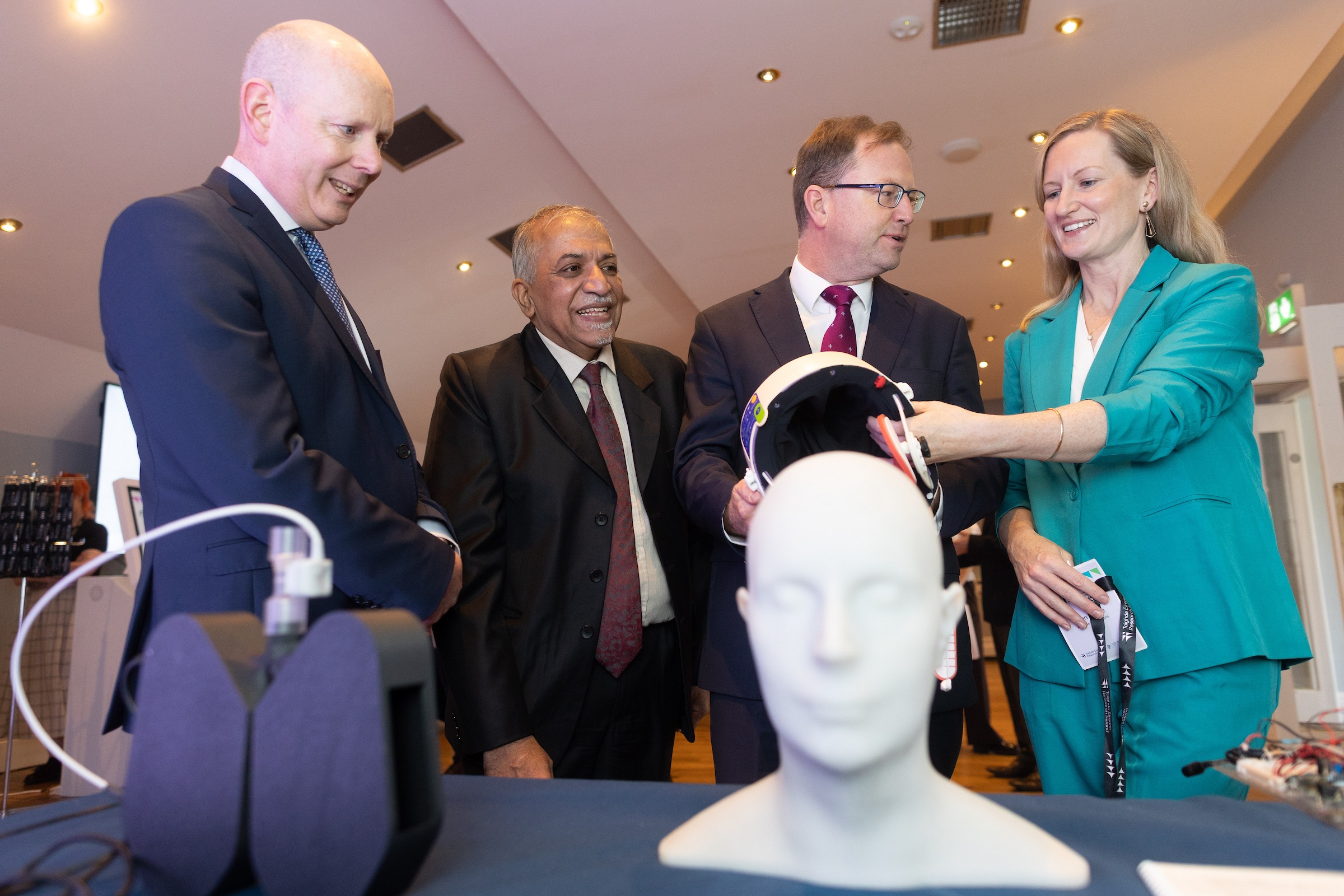
Ireland has built one of Europe’s strongest research and innovation ecosystems, with collaboration between universities and industry becoming an increasingly important competitive advantage. Those partnerships are helping to attract foreign direct investment, accelerate commercial innovation and develop the talent needed for emerging technologies. The challenge now is ensuring that promising research reaches the market faster. What more can be done to strengthen Ireland’s advantage in this key area? Ireland has a world-class research and innovation ecosystem, with strong interconnectivity between academia, industry, government and a highly-engaged public that values the role of research, says Dr Aisling McEvoy, head of enterprise partnerships, Research Ireland. Collaborative relationships are central to attracting and retaining FDI, McEvoy says. The biggest benefit is the pipeline of highly skilled researchers emerging from university-industry partnerships.“Ireland’s young, educated workforce is a key competitive advantage and is critical to the next phase of our development.” Industry partnerships help turn research into practical applications, says McEvoy. Research driven by real-world challenges is more likely to produce improved diagnostics, new treatments and better patient outcomes. McEvoy says these partnerships also create new products, services and treatments that support companies’ long-term growth. Co-funded collaboration with academia also de-risks high-risk, low-technology readiness level research that companies typically struggle to undertake internally, while providing the data and confidence to enable further investment. Dr Aisling McEvoy, head of enterprise partnerships, Research Ireland Many companies depend on universities and research centres for niche expertise, specialised equipment and talent. The Department of Finance’s R&D Tax Credit and Innovation Compass identified measures to close the gap between early-stage research and commercialisation, says Ian Collins, partner and head of innovation incentives at EY Ireland. “These measures are critical to enhance Ireland’s competitiveness, attract and retain high quality investment, and to upskill our talent base.” Ian Collins, EY Ireland partner and head of innovation incentives Collins believes broadening the definition of qualifying R&D would encourage greater collaboration and better reflect how innovation happens in practice. “Similarly, the relaxation of outsourcing rules would unlock opportunities for collaboration, creating a win-win scenario for industry and academia. “The simplification of the R&D support system, including greater alignment between the R&D tax credit regime and targeted cash grant supports would further streamline the incentive landscape, thus creating a more competitive business environment.” Highly skilled, talented researchers are our critical asset, and they are the fundamental output of the research that Research Ireland funds, says McEvoy. “They are trained through our research centres, through all our investigator-led research programmes, and through targeted investments like the Centres for Research Training, a cohort-based PhD training framework. “We currently fund approximately 700 PhD studentships per annum, and we aim to fund 3,800 under our recently launched Research Ireland strategy.” Ireland’s higher education system has strong foundations, but the pace of change in AI and emerging technologies means that global competition is only intensifying, Collins adds. “Greater alignment between industry and academia will be key to closing emerging skills gaps, particularly in fast-moving areas like AI. By creating stronger links between businesses, universities and research institutions, Ireland can develop more applied learning models that equip graduates with the skills employers actually need.” As competition for high‑value investment intensifies globally, countries are being judged much more on their ability to support innovation rather than simply offer access, high volumes of workers or cost advantages, says Collins. “Companies are no longer just choosing where to locate, they are choosing where they can innovate, scale and create long‑term value.” The uplift in the rate of R&D Tax Credit from 30 per cent to 35 per cent (in Budget 2026), with additional enhancements earmarked, is key to ensuring that Ireland is future-proofed, Collins explains. “For example, the easing of rules around outsourced spend to related parties could be a game-changer with respect to FDI decisions. Enhanced measures will fuel the growth of emerging sectors such as decarbonisation, clean energy, digital transformation, quantum computing, cell and gene therapies, to name a few. “Companies are increasingly adopting an “ecosystem” view, recognising the need to collaborate, leverage established infrastructures, networks and suppliers and present to market as a compelling place to work in order to effectively compete for talent.” Michael Gilvarry, head of R&D at J&J MedTech Neurovascular R&D in action Johnson & Johnson MedTech announced the expansion of its research, development and innovation activities in Galway in November 2025, strengthening its neurovascular and stroke-treatment operations. The site focuses on unmet needs in stroke care and the development of new device-based therapies, while expanding engineering and scientific capability. The investment reinforces Ireland’s position as a global hub for medtech innovation. Speaking at the time of the announcement, Michael Gilvarry, head of R&D for J&J MedTech Neurovascular and general manager of the Galway site, said: “Ireland is a critical part of our global innovation network, and the investment reflects our long-term commitment to building and advancing our neurovascular capabilities in the region for the benefit of patients around the world.” APC-VLE is an Irish biopharma process development company cofounded in 2011 by researchers from the SSPC Research Ireland Centre for Pharmaceuticals and University College Dublin, including Dr Mark Barrett and Prof Brian Glennon. It works with eight of the world’s top 10 pharmaceutical companies to accelerate drug development. The company continues to collaborate with SSPC, UCD and NIBRT on co-funded projects and PhD training in advanced therapeutics manufacturing. Precision Oncology Ireland is a national consortium of universities, clinicians, industry and cancer charities led by University College Dublin. It brings together academic researchers and companies including AstraZeneca and Amgen to advance personalised cancer diagnostics and treatments. The partnership focuses on translational research, with the aim of improving patient outcomes through more targeted therapies.
Global tech race boosts pipeline of industry-experienced researchers
Highly skilled, talented researchers are Ireland’s critical asset
945 words~4 min read