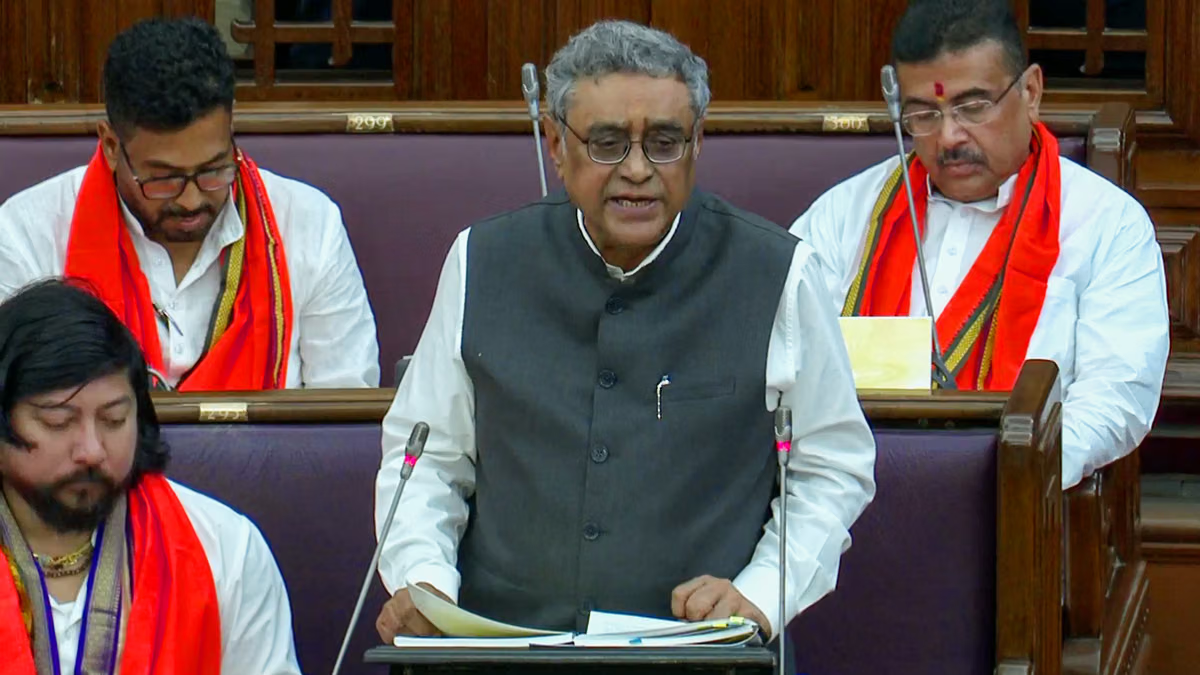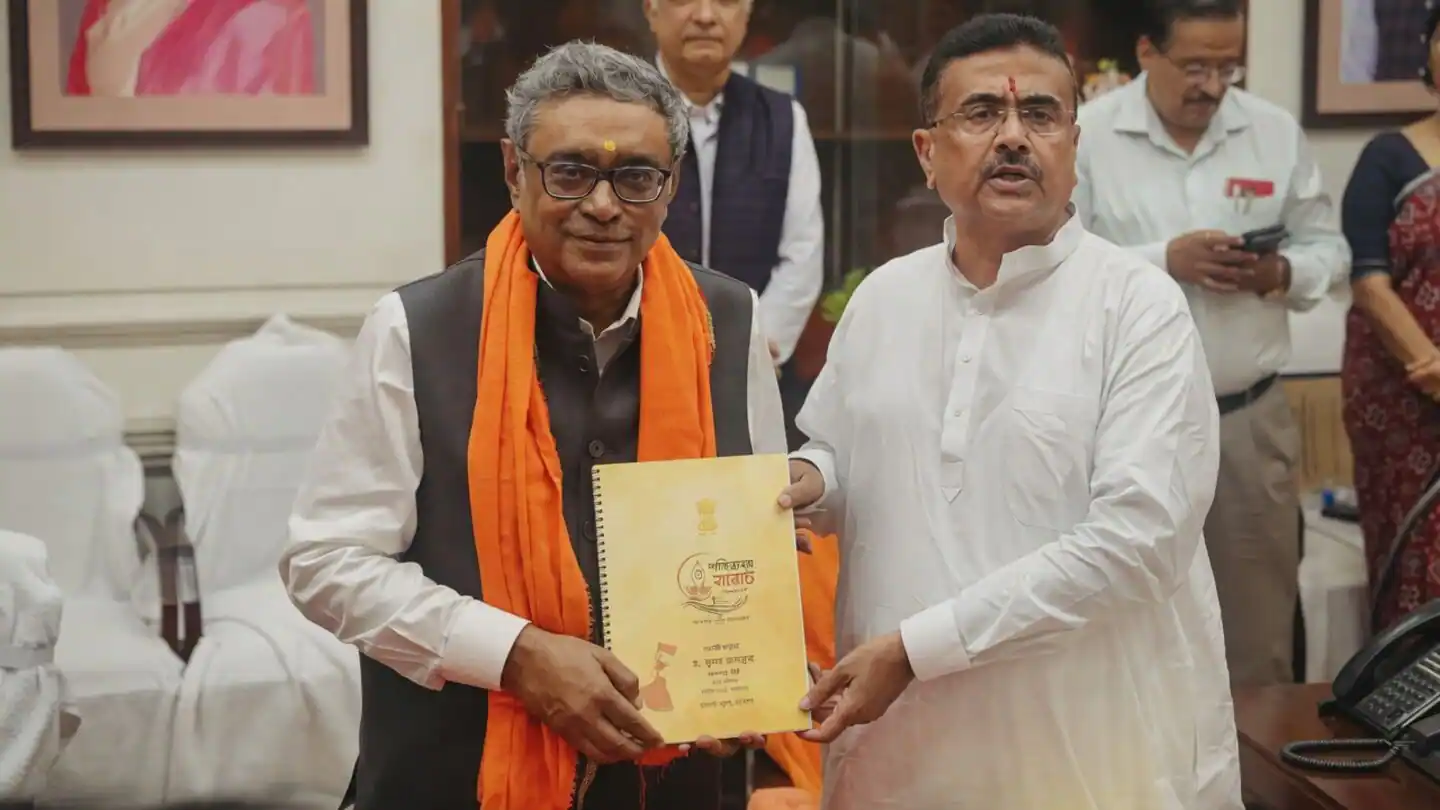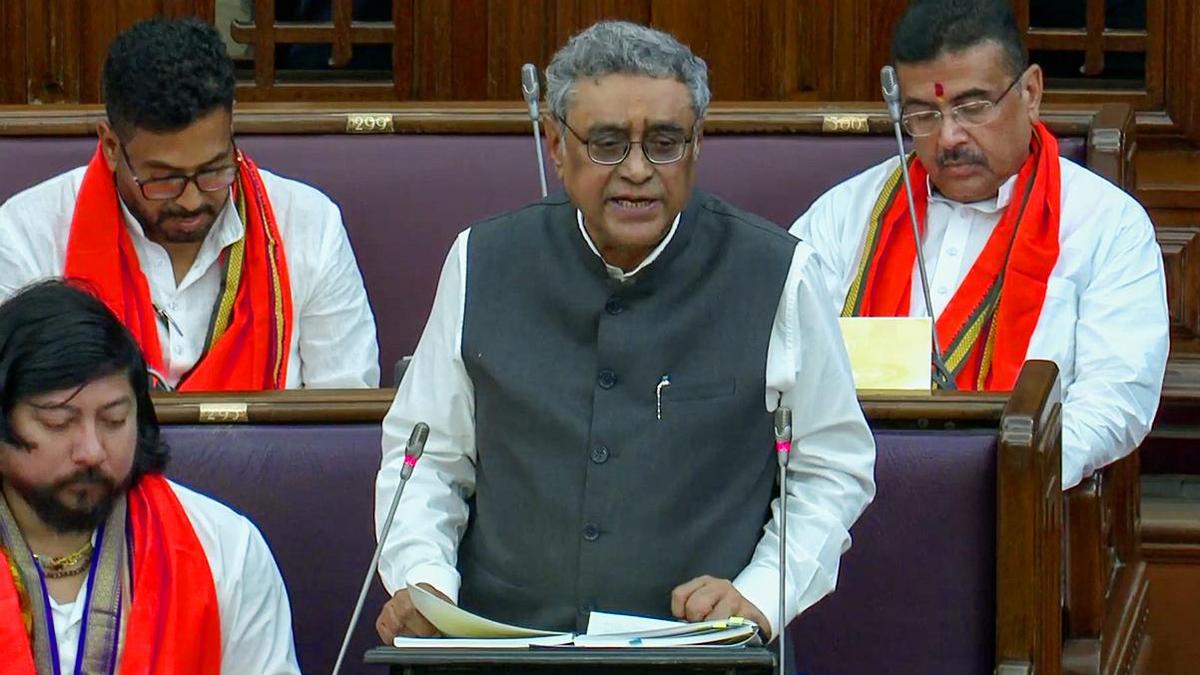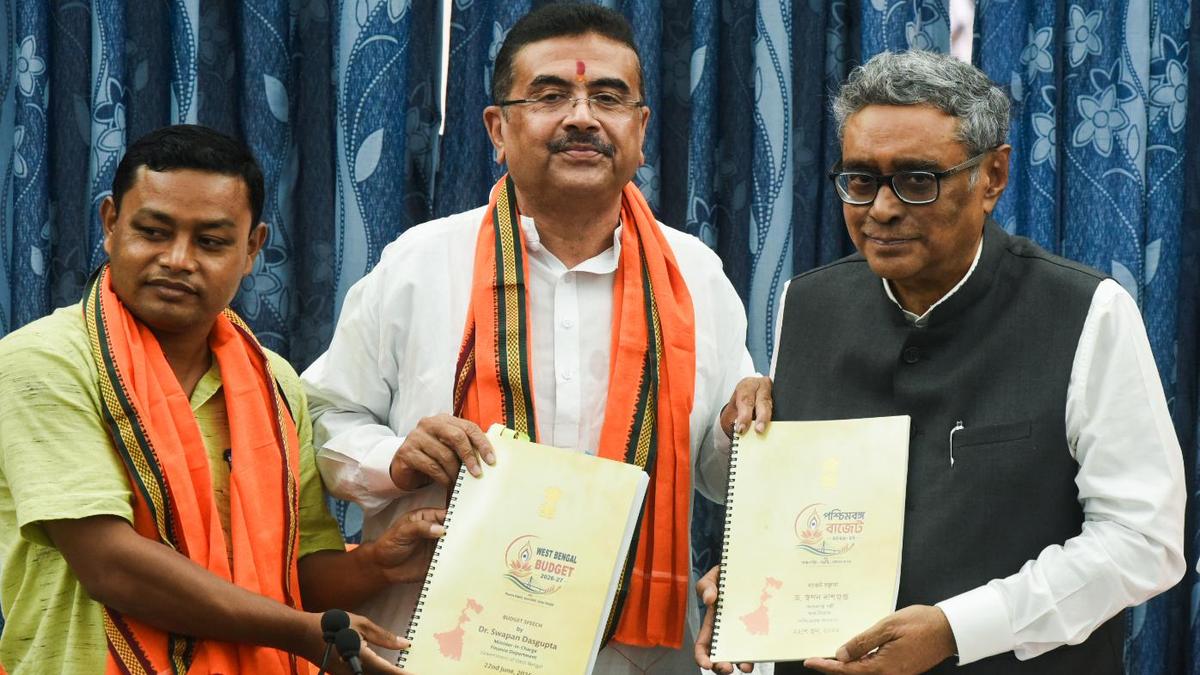
Bengal Chief Minister Suvendu Adhikari, State Finance Minister Swapan Dasgupta (right) and BJP MLA Anandamay Barman hold the Budget book at the State Legislative Assembly House, in Kolkata.
| Photo Credit: ANI
Riding on a historic mandate, the first BJP government of West Bengal presented its Budget on June 22. The BJP’s election manifesto promised to provide ₹3000 per month to women, increase the Dearness Allowance for the State government employees to bridge the gap between the salaries at the Centre and State governments along with other commitments. The first Budget of the BJP government has tried to accommodate these pre-poll promises of the party, while simultaneously trying to reduce the fiscal deficit. The question is whether the expenditure and revenue allocations in the Budget will be able to do justice to the promises made by the government.The government has budgeted a total expenditure of ₹4,28,557 crore in 2026-27 which is ₹82,083 crore more than the Revised Estimate (RE) of 2025-26. This huge expenditure is accompanied by a reduction in both fiscal deficit (from ₹67,774 crore in RE 2025-26 to ₹62,421 crore in Budget Estimate 2026-27) and revenue deficit (from ₹41,164 crore to ₹21,984 crore). How could the government increase its expenditure substantially, while reducing both the fiscal and revenue deficits? The answer lies in the so called “double engine sarkar”.If we look at the revenue receipts of the government, an increase of ₹75,618 crore is projected in 2026-27, as compared with RE 2025-26. This huge increase in revenue receipts is largely explained by a projected increase of ₹49,324 crore in the Centre’s grant-in-aid to the State government, mainly via Centrally Sponsored Schemes. This bonanza of around ₹50,000 crore is the revenue impact of the so called ‘double engine sarkar’. The government also projects an increase in the State taxes to the tune of ₹18,933 crore, non-tax revenue to increase by ₹4,508 crore and State’s share of central taxes to increase by ₹2,853 crore in 2026-27 as compared with RE 2025-26. While the total increase in revenue receipts is to the tune of ₹75,618 crore, the total increase in revenue expenditure is ₹56,438 crore. This shows that the government is more concerned with closing the deficit than passing the benefit of the windfall to the people. This deficit figure is based on receipt projections which can also go awry. In that case, it may be politically difficult for the government to rein in the deficit and stick to its political promises simultaneously.The expectation of the government regarding an increase in State taxes amounting to ₹18,933 crore seems difficult to attain. This is because according to the Medium Term Fiscal Policy Statement of the government, the Gross State Domestic Product (GSDP) of West Bengal is projected to rise from ₹19,90,896 crore in 2025-26 to ₹21,48,244 crore in 2026-27. This entails a nominal growth rate of only 7.9%. In the year 2025-26, the growth rate of nominal GSDP in Bengal was 9.85%. In other words, the government is projecting a 2 percentage points drop in the nominal GSDP growth of the State but assuming an increase in tax collections of around ₹19,000 crore. Even with 9.85% nominal GSDP growth in the State in 2025-26, the increase in State’s tax collection was around ₹13,744 crore as compared with 2024-25. The projected increase in tax collection appears difficult to achieve since the government has not announced any major policy to raise taxes or improve tax compliance. The government may be relying on closing the tax leakage due to corruption. Whatever may be the case, a slowdown in GSDP and a huge increase in tax collection is difficult to materialise simultaneously. Given that it has already committed to a reduction in fiscal and revenue deficits, any shortfall in tax revenue will be met by a cut back on expenditure. This can make the government’s political promise to various sections of the people difficult to maintain. On the capital expenditure side, the government is proposing to increase the capital expenditure by around ₹15,000 crore as compared with RE 2025-26. The government has announced a number of infrastructure projects, new colleges and universities in the State. The additional capital expenditure is welcome. However, here too, the government could have spent more if it did not adhere to a policy of cutting back the deficit.Laxmir Bhandar vs Annapurna YojanaThe Trinamool government’s Laxmir Bhandar scheme covered around 2.4 crore women with a monthly transfer of ₹1,500. The BJP had promised to upgrade beneficiaries to the Annapurna Yojana, offering ₹3,000 per month. However, the ₹36,000-crore allocation announced for the scheme would cover only about 1.3 crore women, as announced by the government. The government has not clearly explained the basis for excluding the remaining beneficiaries. It was announced that individuals whose names were removed during the SIR process would not be eligible for benefits under the scheme. In the absence of transparent criteria, crores of women risk losing access to benefits that were promised without such restrictions. However, the number of women who will lose access to the scheme as compared to Laxmi’r Bhandar turns out to be more than a crore. BJP did not announce any targeting of the scheme in their election manifesto.The government has raised Dearness Allowance by 20%, announced the 7th Pay Commission and promised one lakh new jobs. However, the higher DA will be paid only from October 2026, while DA arrears also remain to be settled. Given these commitments, it is unclear whether the ₹10,000-crore increase in salary and pension allocations will be sufficient.The government has sought to balance fiscal prudence with its promises of expanded welfare and higher pay for employees. Its strategy relies on higher central transfers and a projected sharp rise in tax collections. If these projections fail to materialise, both its fiscal targets and political commitments could come under pressure. The coming year will test how successfully it can reconcile political promises with fiscal realities.The author is Professor of Economics, Presidency University, Kolkata. Published - July 03, 2026 08:30 am IST