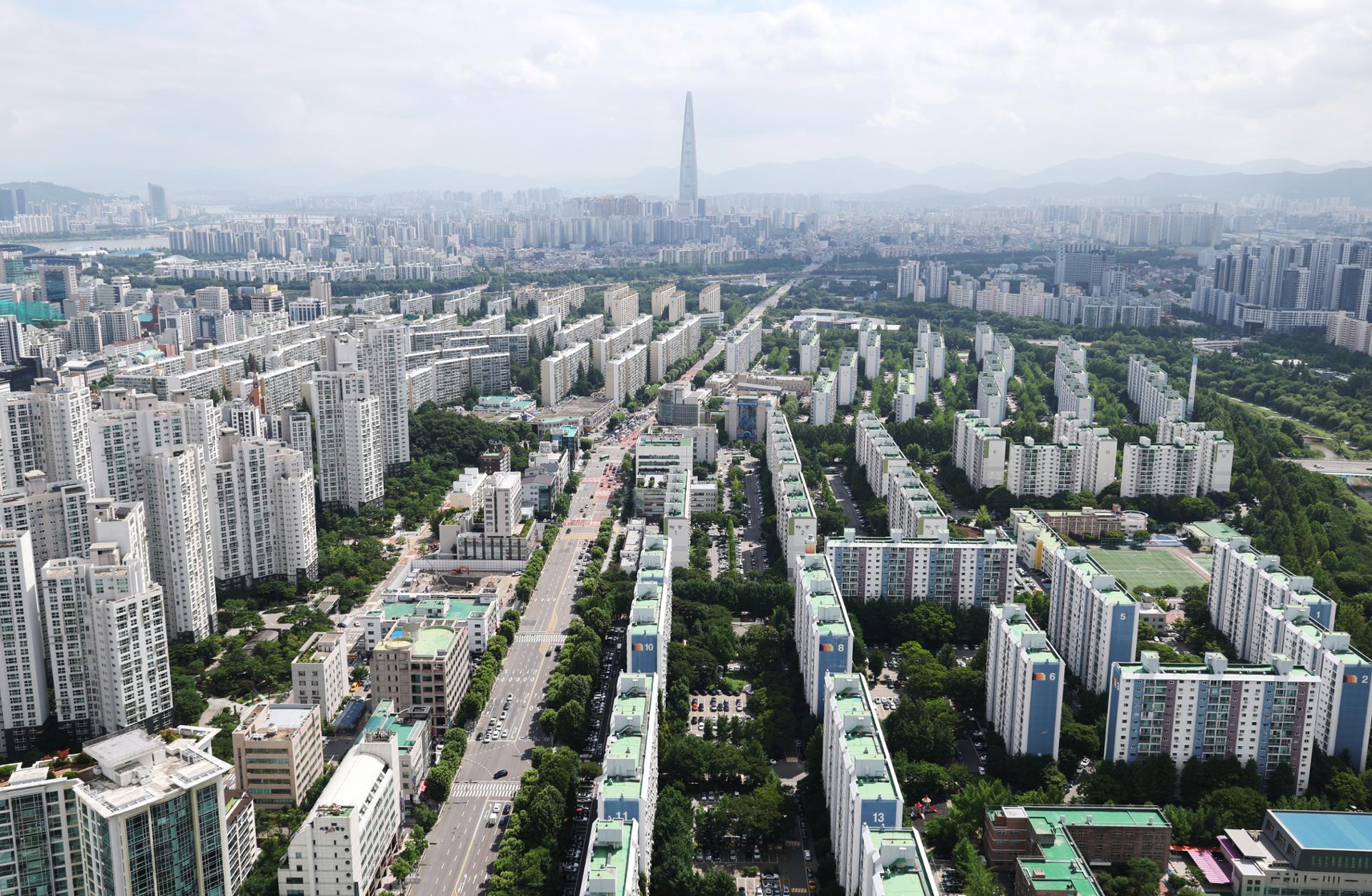
A view of Seoul apartment complexes seen from Lotte World Tower / YonhapKang, an office worker in her 20s, currently rents a studio apartment in Seoul on a monthly lease.During her search for a home, she ruled out Korea’s traditional “jeonse” system — the once-dominant rental arrangement where tenants pay a large lump-sum deposit instead of monthly rent — because of a series of high-profile deposit fraud cases that have undermined trust in the market.“There are also far more monthly rental listings these days, so it’s hard to find a decent jeonse property in the first place,” Kang said.The trade-off is that paying monthly rent leaves little room to build savings for a home of her own.“Even neighborhoods that used to be relatively affordable in Seoul have become so expensive that the difference hardly feels meaningful anymore,” she said. “With monthly lease being my only realistic option, it has become even harder to dream of buying a home.”Jung, a 30-year-old finance professional, had hoped to either secure a jeonse home or buy an apartment with her fiancé. Instead, the couple has widened their search to include monthly rentals as tighter mortgage rules make both options harder to afford.“Apartment prices in Seoul run into the billions of won, but loan caps make it difficult even for dual-income households without a home to buy one to live in. Middle-class families who don’t qualify for special housing programs but aren’t wealthy enough to buy without financing are being squeezed the hardest,” she said.“Jeonse homes are also scarce and expensive, leaving homebuyers caught between an unaffordable sales market and a shrinking rental market.”The experiences of Kang and Jung reflect a broader transformation in Korea’s housing market. More young adults and aspiring first-time buyers, including those early in their careers and newlyweds, are finding jeonse — long considered a stepping stone to homeownership — slipping further out of reach.If the trend persists, analysts say the country’s housing market could polarize further between owner-occupied homes and monthly rentals.The divide has notably widened in recent years, according to a paper published in the latest journal of the Housing Finance Research Institute by professors Jung Kyong-chae and Park Jung-eun of Hanyang University.Using a Markov chain transition model to analyze housing mobility from 2021 to 2025, the researchers found that households living under jeonse arrangements are reaching homeownership faster than before, while those in monthly rentals are taking longer to do so.“Our findings show a growing asymmetry in Korea’s housing ladder,” the authors wrote. “Households in the jeonse market are shortening the path to homeownership with the help of policy-backed financing, while monthly renters remain trapped in a blind spot, significantly delaying their transition to owning a home.”The trend is already evident in the market.According to the Ministry of Land, Infrastructure and Transport, monthly rentals accounted for 68.6 percent of all lease transactions nationwide during the first five months of this year, up 7.6 percentage points from a year earlier.The researchers warned that in the long run, jeonse, once the critical middle rung between renting and owning, could shrink to just 7.3 percent of the housing rental market, thus leading to a more polarized system that could further entrench wealth inequality by making it increasingly difficult for monthly renters to accumulate the assets needed to buy a home.Jung, the finance professional, said housing policies should better distinguish genuine homebuyers from speculative investors.“Measures to curb speculation are necessary, but lending rules for first-time buyers purchasing a home to live in should be based on factors such as debt-service ratios and loan-to-value limits, rather than blanket loan caps tied to a property’s price,” she said.
As 'jeonse' fades, path to homeownership narrows further in Korea - The Korea Times
Kang, an office worker in her 20s, currently rents a studio apartment in Seoul on a monthly lease. During her search for a home, she ruled out Kore...
604 words~3 min read