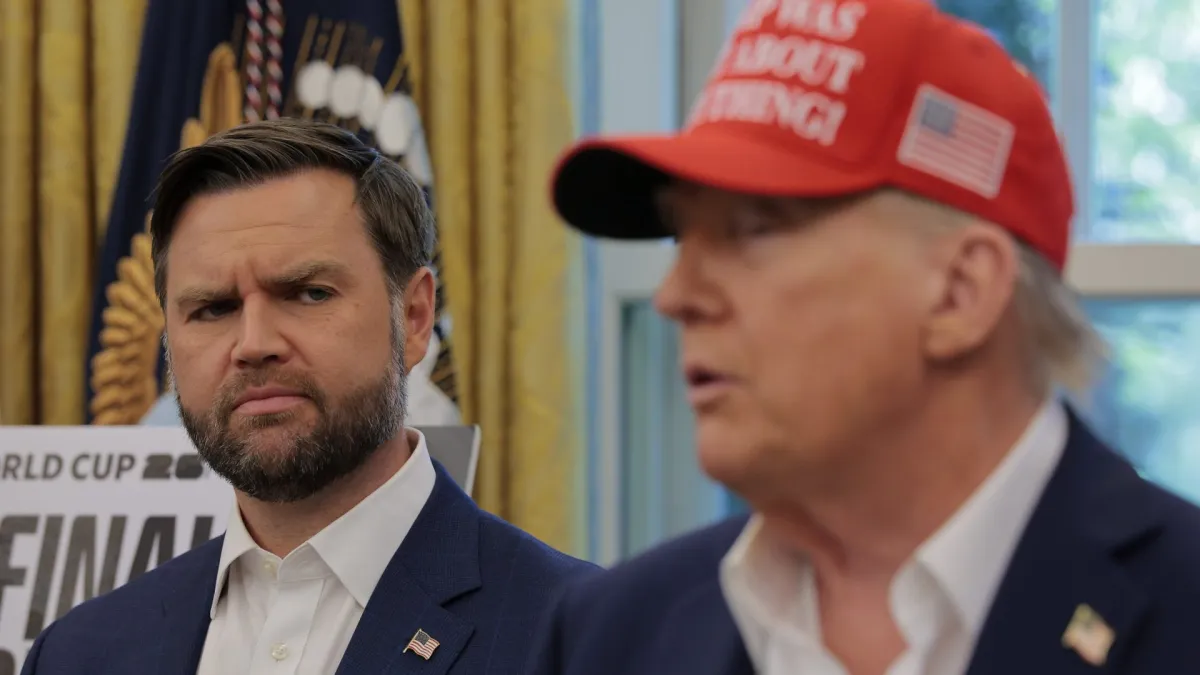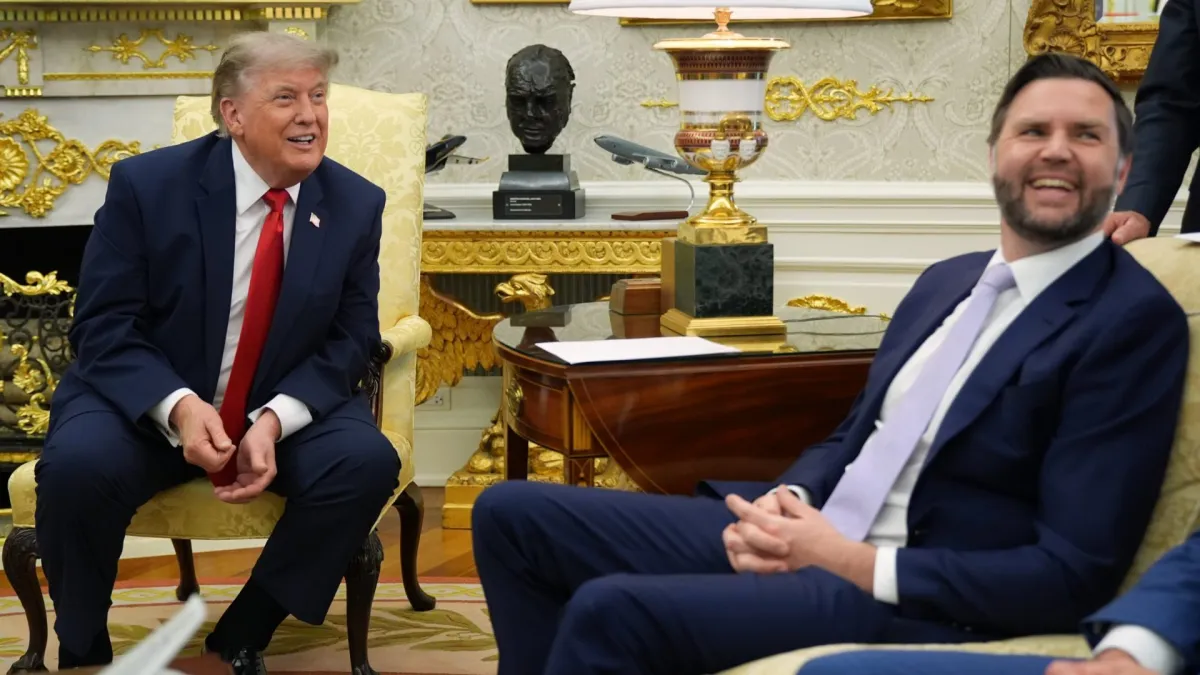
There are two ways to lie about President Donald Trump’s immigration policies, and JD Vance has mastered both of them. The first: muddy the waters, refuse to acknowledge reality and dismiss facts as inaccurate. The second: dehumanize people targeted by the federal government, and describe them as inherently criminal and un-American to justify a policy of mass detention and deportation. Now on his third week of promotion for “Communion,” his memoir about converting to Catholicism, Vance is using his faith to sanitize the worst aspects of Trump’s second term — and possibly previewing how he’ll campaign on immigration during a likely presidential run of his own. Trump’s agenda relies on cruelty. The administration set a new record for people in immigration detention earlier this year, though the vast majority of detained people have no criminal convictions at all. Only a tiny percentage of immigration detainees have convictions for violent crimes. Many people in detention don’t even have a final deportation order, but rather are in the middle of applying for asylum. The administration has asserted the authority to jail millions of people indefinitely, and recently asked the Supreme Court to bless that unprecedented “mandatory detention” policy. Trump officials have admitted to using the misery of detention to pressure people to give up their legal cases and “self-deport.” Vance can’t run from that record. Instead, he’s doing what he’s done for years — talking his way beyond the pale. Muddying The Waters“Communion” lays out the debate over immigration policy in the most general terms possible — presumably because anything else would be damning for Vance. “Law enforcement is an inherently difficult business,” Vance writes. “If you arrest a person illegally in the United States, that person will sometimes resist arrest. Even if they don’t, and even if everyone agrees their deportation is lawful and moral, there will still be some measure of separation and heartache.” These lines are all about the art of the straw man: The issue at hand isn’t the “heartache” of a lawful, moral deportation — it is the question of whether the vast majority of this administration’s immigration arrests and deportations are lawful or moral in the first place. And despite the book being about why he aligned with Catholicism as an adult, Vance is evasive about the fact that two popes in a row have criticized Trump’s immigration agenda at length. He doesn’t engage on the substance of the policies that have been criticized and instead somewhat ironically wishes for “an institutional faith less focused on platitudes and more focused on reality.”The comment about how “inherently difficult” law enforcement is, for example, comes just after Vance describes how, in late 2025, the U.S. Conference on Catholic Bishops approved a “special pastoral message on immigration” that critiqued the administration. Vance writes that the document was “almost too measured,” then moves on without actually addressing the letter’s contents. But the conference’s statement was detailed, expressing concern about mass deportation, racial profiling, “the vilification of immigrants,” horrific conditions inside detention centers, “the lack of access to pastoral care” in the facilities, the fact that “some immigrants in the United States have arbitrarily lost their legal status,” and the administration’s efforts to arrest immigrants in sensitive zones including churches. Vance did not address any of the specifics. Vance has now taken the sleight-of-hand strategy on tour. Rather than defending the worst parts of Trump’s immigration enforcement agenda when faced with legitimate criticisms, he creates a new reality: disputing straightforward facts and cherry-picking hypotheticals. On “The View” a couple of weeks ago, Vance faced questions about in-custody Immigration and Customs Enforcement deaths, children being held in “sub-human” detention centers, and the administration’s racist language.“Law enforcement is always inherently not a very pretty process,” he deflected, especially with “violent people” and those who are “resisting arrest.” He went on to essentially accuse Joe Biden’s administration of running, or at least tolerating, a child trafficking ring, saying there were “tens of thousands of children that were sex-trafficked by the cartels” in the last administration — a number that no one else in the Trump administration has used and for which HuffPost found no evidence. (The administration has repeatedly made broad-brush false claims about the prevalence of child sex trafficking, all while it arrests parents, threatens youth with “prolonged detention,” and targets migrant kids’ legal service providers.) “You think that our immigration policies are inhumane based on the reporting of one person with a political bias,” Vance said, not indicating which “one person” he was calling out, despite there being millions of words written about the specifics of the administration’s policies. “What I’m telling you is that it’s inhumane to allow cartels to sex-traffic people across our borders.” Later, Vance dismissed an accurate criticism about the administration’s agenda. “Since October of last year, there’s been something like 6,668 refugees let into the country. All but three were white South Africans,” co-host Ana Navarro said.Vance suggested the statistic was wrong, though it’s actually a well-known, damning testament to the white supremacist attitudes that pervade the Trump administration. “I’m very skeptical of that number because we have a lot of different immigration pathways in the United States of America,” he said.The Dehumanization CampaignIn his book, Vance writes that it’s possible to support “strict migration policy without dehumanizing anyone” — but his career in the Trump administration is predicated on dehumanizing immigrants. There’s no clearer example of the impact of that strategy than what Vance did to Haitian immigrants in Springfield, Ohio. In 2024, Vance was the first major elected official to push the lie that Haitian immigrants in Springfield were eating pets in the area. Local officials told Vance’s staff the claims weren’t true, and no evidence ever supported them. Vance was unapologetic. “If I have to create stories so that the American media actually pays attention to the suffering of the American people, then that’s what I’m going to do,” he said at the time. Vance acknowledged that the rumors he was spreading could be lies, and he kept spreading them anyway, saying he was merely amplifying (unverified and politically convenient) reports his office received. He also falsely claimed that, as a result of Haitian migrants, communicable diseases like tuberculosis and HIV had “skyrocketed” in Springfield. Within days, Trump had pledged to revoke temporary protected status — or TPS, a deportation protection for people whose birth countries are in severe turmoil — for Haitians, saying Springfield had been “overrun.”The Supreme Court just signed off on that move, meaning that, with the help of Vance’s propaganda, Trump has a list of more than 300,000 people who are now newly deportable and at risk of being sent to their extremely dangerous home country. As the historian Timothy Snyder observed Monday, “If there is a Springfield pogrom, JD Vance will have his first namesake policy.”Just this week, Vance warned against allowing “low-wage third-world immigrants” and said European countries risked “committing civilizational suicide” through immigration. He dresses up his casual racism in his book, referring to “the social instability inherent in assimilating one population into another.” “Too much immigration,” he writes, “actually destroys the social cohesion necessary to form labor unions.” That’s pretty rich coming from Vance, who as a U.S. senator opposed the Protecting the Right to Organize Act — the U.S. labor movement’s top legislative priority — because, as he told Politico in 2024, “I think it’s dumb to hand over a lot of power to a union leadership that is aggressively anti-Republican.” Vance also takes pains to suggest that immigrants make America less Christian — even though the facts are more complicated.“Churchgoing kept declining just as Biden-era immigration policy caused a skyrocketing increase in the foreign-born share of the population,” he writes. “That makes assimilating newcomers even harder.” Toward the end of the book, in a discussion of racism, Vance again suggests that migration is associated with decreasing religiosity. “From the intermarriage of the Spanish and native populations in Mexico to the American melting pot of the nineteenth century to the Civil Rights Movement, Christianity has long brought people together,” he writes. “And yet, as our leaders have ushered in an unprecedented increase in demographic diversity through immigration, they have simultaneously discarded the most powerful force for cultural cohesion: Christianity. It is hardly any surprise that the fruits of their labor are rising racial conflict and gender division. Secularism has produced social strife despite its promises of enlightenment.” The data tell a different story. Pew Research Center’s 2025 Religious Landscape Study shows that immigrants to the United States said the Bible is extremely or very important to them at rates higher than people born in the United States to U.S.-born parents. The same group also attended religious services more frequently and were more likely to say religion was very or somewhat important to them. While, overall, the study found that immigrants were a few percentage points less Christian than people born in the United States, a separate 2024 Pew report using different data found that 70% of migrants to the United States were Christian, compared with 64% of the U.S. population that was Christian as of 2020. It’s true that religiosity in America has trended downward in recent years, but that’s regardless of immigration status. It’s also true that most undocumented migrants are from the Americas, and that Trump administration policies — including turning away asylum-seekers at the southern border and ending certain deportation protections — disproportionately affect migrants from Latin America and the Caribbean, which are far more Christian than the United States. “Catholic immigrants are being differentially impacted by these policies,” Stephanie Kramer, a senior researcher on religion and public life at Pew, told HuffPost. If Vance has any regrets about backing up Trump’s anti-immigrant crusade, he hasn’t said so. In his book, he walks back a snide remark about “childless cat ladies,” calling it “boneheaded.” As far as the Haitian community he slandered as disease-spreading pet-eaters — or anyone else he’s allowed Trump to set his sights on — Vance lets the administration’s actions do the talking.
JD Vance Cannot Defend Trump's Cruelty — So He'll Lie About It Instead
The vice president isn't defending the worst parts of Trump's agenda. He's just creating a new reality.
1,674 words~8 min read