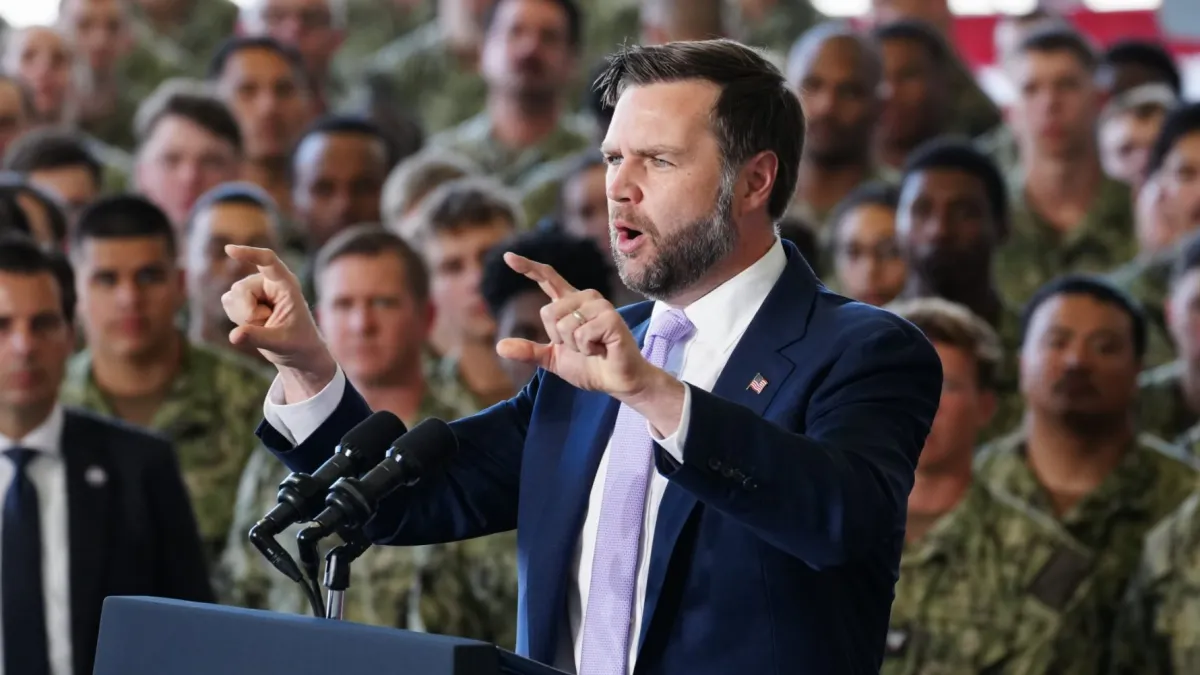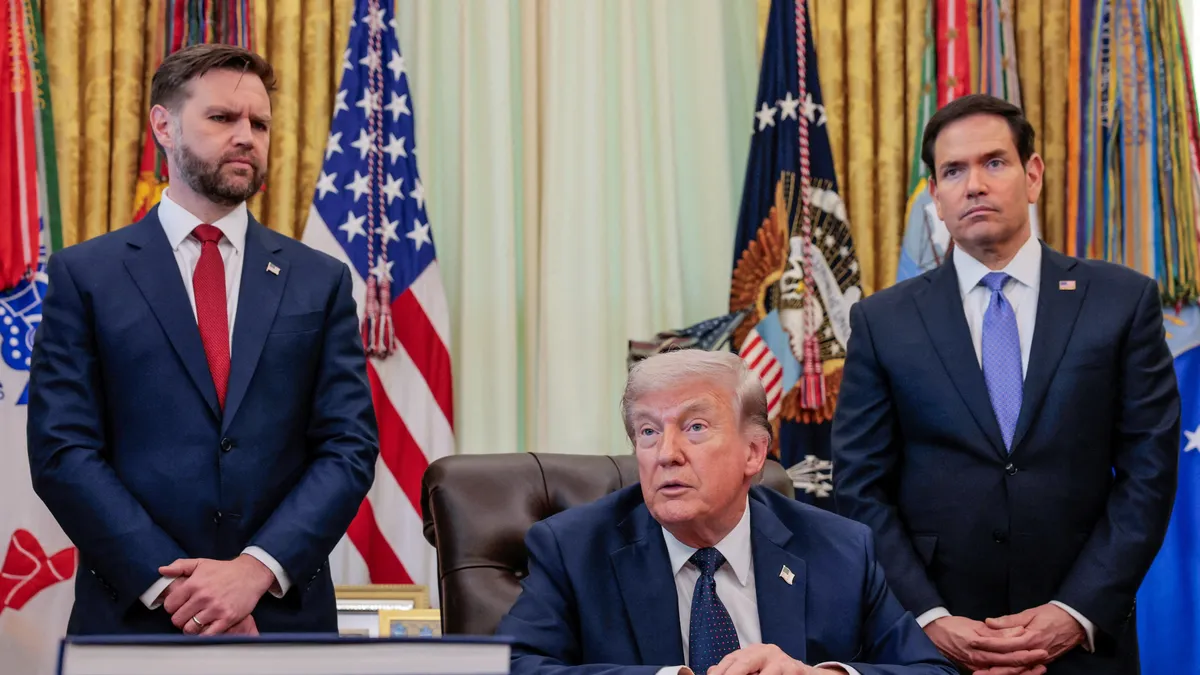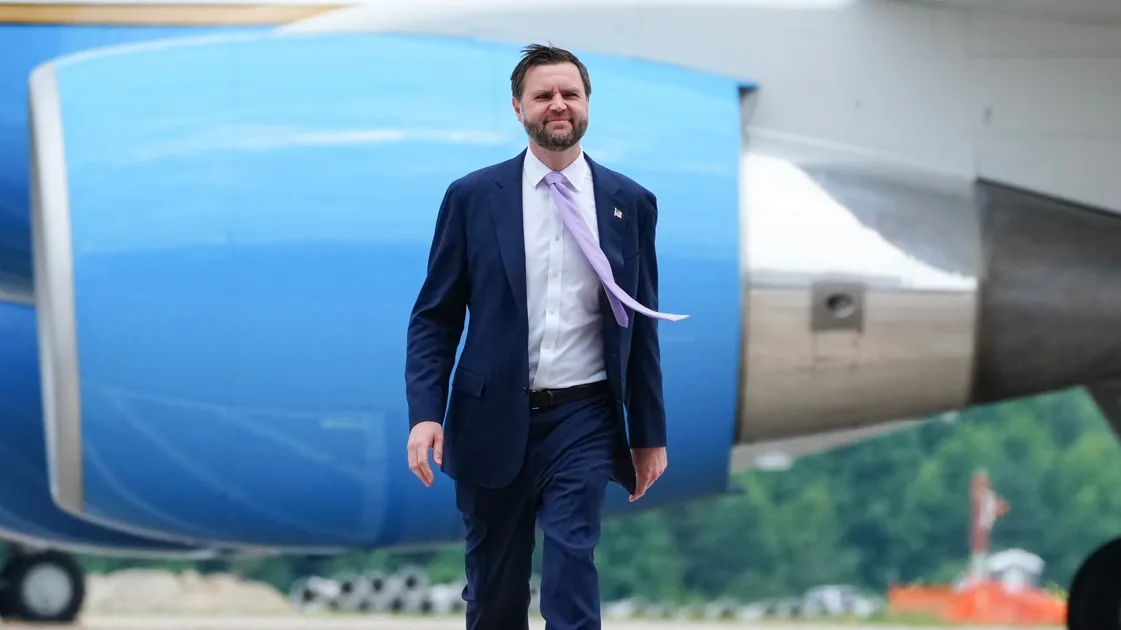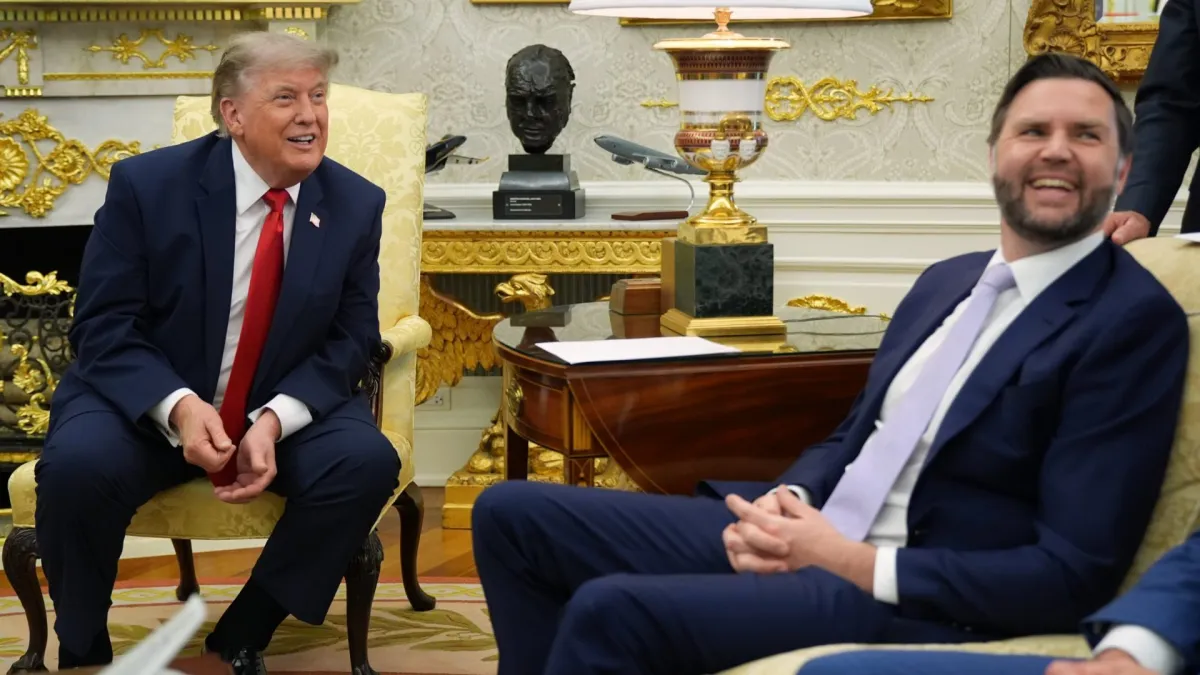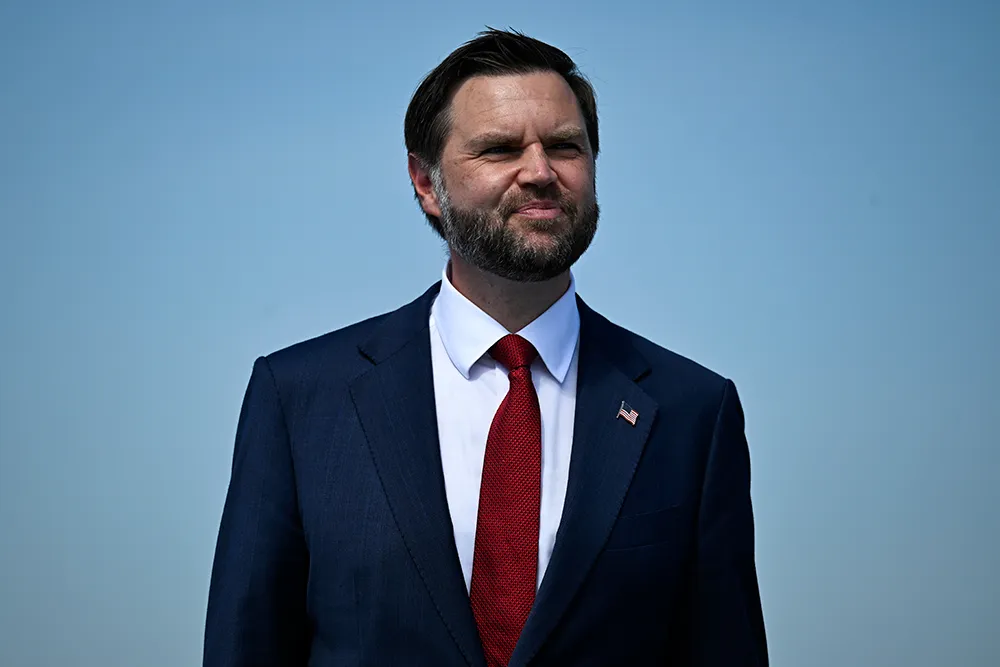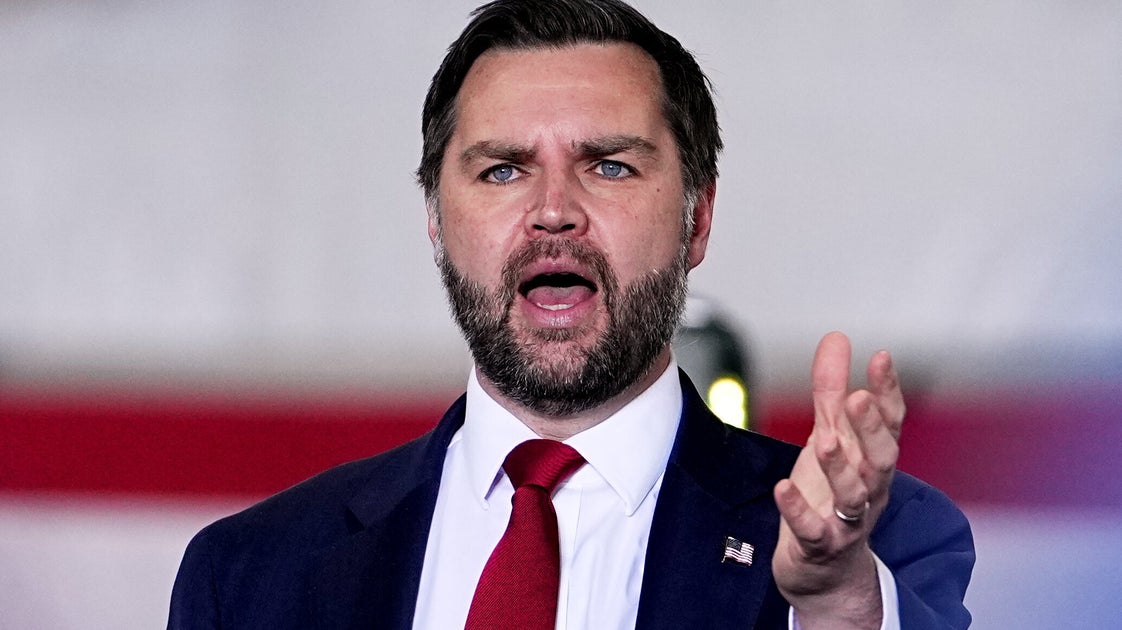
There must have been a moment during his recent visit to Switzerland to lead peace talks when US Vice President JD Vance looked about and thought: is this all a dream? Growing up surrounded by poverty, raised by his extended family in hillbilly Kentucky and rust-belt Ohio, his mother struggling with opioid addictions, meant that dinner at a restaurant was a once-a-yeavr luxury at best and, even then, it was at an all-you-can-eat buffet joint.Graduating from Yale with a law degree in his late 20s, he was still only familiar with two kinds of wine, red and white; offered chardonnay or sauvignon blanc at a work event, he went with the one that was easier to pronounce (he later remembered thinking, “Come on, lady, stop with the fancy French words and just give me some white wine”).Now here he was, guest of honour at the Burgenstock Resort, a spectacularly expensive hotel complex perched atop a Swiss mountain like a lair for a Bond villain (which did, incidentally, feature as a backdrop in 1964’s Goldfinger). It boasts one of the oldest funicular railways in Switzerland, views over Lake Lucerne, spas, a golf course, cigar lounges and elegant restaurants that offer local salmon fattened in crystal-clear mountain streams and caviar literally squeezed from specially selected sturgeon.JD Vance (left) arrives to board Air Force Two at a Swiss air base after peace talks with Iran at the Lake Lucerne Summit. APWhisked up here in a motorcade of black SUVs to head the US-Iran peace talks, Vance surely had to pinch himself. The third-youngest US vice president in history, still just 41, he had come a very long way in a very short time, but this was next level; he was entrusted with some of the most important negotiations since the 1973 accords that eventually led to the end of the Vietnam War. Succeed here and Vance could strengthen his grasp on the Republican nomination in 2028, not as a stereotypical lame-duck vice president but as an astute dealmaker in his own right.And yet, who knows what Donald Trump was thinking when he handed Vance this opportunity? Was it to see if he shone, or stumbled? “If it works out, I’m going to take the credit,” Trump “joked”. “If it doesn’t work out, I’m blaming JD.” How did Vance get here? Is he still the likely Republican nominee for presidential elections in 2028?JD Vance: “I nearly gave in to the deep anger and resentment harboured by everyone around me.” Where did JD Vance come from?The Vance origin story is well-trodden, at least in the United States, where his 2016 bestselling childhood memoir, Hillbilly Elegy, later made into a film, was widely seen as a window into the disaffection of the disenfranchised working classes that propelled Trump to power in his first term.“It was that book that really launched his career,” says Jared Mondschein, director of research at the United States Studies Centre at the University of Sydney. “It was perfect timing in 2016. That was one book everyone said you should read, regardless of your political persuasion, to help give an idea of where Trump was coming from and why.”Panbowl Branch hollow in Jackson, Kentucky, where JD Vance spent part of his childhood with his great-grandmother.Washington Post via Getty Images A manifesto about how the US was failing a forgotten generation of poor whites – “hillbillies” – written largely from Vance’s own experience, it is a frank and compelling tale of growing up in a dysfunctional but loving clan that hailed from the Kentucky boondocks, Appalachian country.“He’s lived the problems of deindustrialisation and the malaise to which Appalachia and that semi-rural working class was subjected,” says Tim Lynch, a professor of American politics at the University of Melbourne.Vance and his elder (half) sister Lindsay were largely raised by their grandparents, “Mamaw” and “Papaw”, in the absence of their parents in struggling steel town Middleton, Ohio. His father, Donald, vanished early and mother, Bev, struggled with substance abuse and a string of failed relationships.A young Vance with his grandmother Bonnie, known as Mamaw, in an undated photo. CNN/JD VanceA resident of Middletown, Ohio, mows the lawn in front of his home, near where JD Vance was raised, in 2024. Getty Images As a child, Vance writes, he didn’t particularly notice the poverty all around him, but it would later inform his politics: Hillbilly Elegy (subtitle: a Memoir of a Family and Culture in Crisis) is full of his hard truths about hardscrabble folk descended from Scottish and Irish immigrants who he says have been left to rot in an economy wrecked by globalisation. “I was one of those kids with a grim future,” he writes. “I almost failed out of high school. I nearly gave in to the deep anger and resentment harboured by everyone around me.”What kept him afloat amid this messy upbringing, he says, was his extended family’s old-fashioned virtues of loyalty and love of country.Even his name tells a story of dislocation and transience: born James David Bowman, his surname was changed by his mother to that of her third husband, Hamel; Vance later changed again to his mother’s maiden name and chose to go by his nickname, JD.What kept him afloat amid this messy upbringing, he says, was his extended family’s old-fashioned virtues of loyalty and love of country. Mamaw, who Vance said kept 19 loaded handguns around the house and as a child had shot a man who had tried to steal the family cow back in Kentucky, “loathed disloyalty, and there was no greater disloyalty than class betrayal”.Somehow, Vance made it through high school, then enlisted in the Marines, seeing active duty in Iraq, where he was deployed as a military correspondent, writing articles and taking photographs for internal publications. “I left for Iraq in 2005, a young idealist committed to spreading democracy and liberalism to the backward nations of the world,” he would later write. “I returned in 2006, sceptical of the war and the ideology that underpinned it.”JD Vance’s official US Marine portrait. He enlisted in 2003. Wikipedia/US Marine Corps Back in Ohio, he attended state university on the GI Bill (the program supporting veterans to attend college), graduating with such good grades he was accepted into Yale Law School. Yale was where he reportedly became politicised, as an outsider given an insight into the lives of the elite (he later described such institutions as “expensive day care centres for coddled children”). Yale was also where he met the two women who would shape the course of his future: law professor Amy Chua and fellow student Usha Chilukuri, accomplished daughter of successful Indian immigrants (she would go on to attend Cambridge University and win a coveted role as a judicial clerk, including for a Supreme Court justice).Chua was not just an academic but an author well known for the controversial 2011 memoir Battle Hymn of the Tiger Mother, which introduced the phrase “tiger mom” into common usage and caused an uproar for her uncommonly strict approach to parenting. Something of a mentor to Vance at Yale, Chua was among those who guided him to turn his initial idea for a polemic about dispossessed white Americans into what became a much more marketable and appealing personal memoir.Usha took it upon herself to bring him up to speed, reportedly keeping a spreadsheet listing things he should try, including Greek yoghurt.Chua is also credited with encouraging Vance to romantically pursue Usha, whom Vance had met in 2010 at a discussion group about “social decline in white America”. “Usha is a woman of many talents,” observed the Yale magazine Rumpus in 2006, profiling her for its Most Beautiful People edition. “Her interests are as diverse as she is attractive,” it noted (these were different times), saying she had tended to date men who were tall, handsome and conservative but was still, surprisingly, single (Vance yet to make his case).Usha, who had grown up in middle-class San Diego to parents Lakshmi, a molecular biologist, and Radhakrishna, a mechanical engineer and university lecturer, was far more at home among the coastal elites of Yale than Vance, and took it upon herself to bring him up to speed, reportedly keeping a spreadsheet listing things he should try, including Greek yoghurt. She even advised him on how to negotiate the social minefield of multi-course cutlery at work events (make your way from the outside in, she said). They married in 2014 in back-to-back Christian and Hindu ceremonies, Usha putting her legal career on the back burner to raise a family; they now have three children, with a fourth on the way. (Usha has recently debunked rumours that she was considering converting to Catholicism, as Vance did in 2019.)JD and Usha Vance with their children at the Taj Mahal in Agra, India in 2025.Facebook, Vice President JD VanceHow did Vance become vice president?Alongside Amy Chua and Usha Chilukuri, there turned out to be a third major influence in Vance’s life, also from his time at Yale. In 2011, Vance went to see a talk at the university from the tech billionaire Peter Thiel, a co-founder of PayPal and the AI and data firm Palantir Technologies. Afterwards, Vance introduced himself to Thiel, the two hit it off and two years after graduating and dabbling in law, Vance went to work for Thiel in 2015 at venture capital firm Mithril Capital. (He later stepped out on his own to invest in Midwestern start-ups, moving from California back to Columbus, Ohio with Usha and family in 2017. “It wasn’t an easy choice,” he wrote in The New York Times. “But there were practical reasons to move: I’m founding an organisation to combat Ohio’s opioid epidemic … and the truth is that not every motivation is rational: part of me loves Ohio simply because it’s home.”)Amy Chua and Peter Thiel are among guests at an event hosted by Uber, X and The Free Press in Washington DC on the eve of Trump’s inauguration (and Vance’s swearing-in as vice president) in January 2025.Getty ImagesThiel was a long-time Trump fan, Vance at this stage not so much, telling an associate in a private Facebook message: “I go back and forth between thinking Trump is a cynical asshole like Nixon who wouldn’t be that bad (and might even prove useful) or that he’s America’s Hitler” (a remark that would subsequently be regurgitated in a million profile articles).Promoting Hillbilly Elegy in 2016, Vance did make several critical remarks about Trump, such as telling NPR, “I can’t stomach Trump. I think that he’s noxious and is leading the white working class to a very dark place.” He did call Trump an “idiot” on Twitter, said he didn’t like him, and wrote in The New York Times that Trump was “unfit for our nation’s highest office”.Vance backstage with the host of TV show Late Night With Seth Meyers in 2017, where he spoke about his book Hillbilly Elegy. Getty Images So when Vance later ran for Congress with Trump’s endorsement, his opponents painted him as having made a total about-face. That wasn’t completely the case. He had also told another interviewer, at right-wing website The American Conservative, that he recognised Trump’s appeal in America’s hinterland. “These people, my people, are really struggling, and there hasn’t been a single political candidate who speaks to those struggles in a long time. Donald Trump at least tries,” he said. “Trump’s candidacy is music to their ears. He criticises the factories shipping jobs overseas. His apocalyptic tone matches their lived experiences on the ground. He seems to love to annoy the elites, which is something a lot of people wish they could do but can’t because they lack a platform … He shoots from the hip; he’s not constantly afraid of offending someone; he’ll get angry about politics; he’ll call someone a liar or a fraud. This is how a lot of people in the white working class actually talk about politics, and even many elites recognise how refreshing and entertaining it can be.”With an endorsement from Donald Trump for his Senate candidacy in 2022, Vance speaks with voters in his hometown of Middletown, Ohio, his banner describing him as “conservative” and an “outsider”. Getty Images Vance reportedly had his eye on politics by 2017; by the time he tilted for Republican nomination for a 2022 run at the Senate, in a seat being vacated by retiring Ohio senator Rob Portman, propelled by the popularity of Hillbilly Elegy but needing Trump’s support to get over the line, he was overtly contrite. “I ask folks not to judge me based on what I said in 2016,” he told Fox News. “I’ve been very open that I did say those critical things and I regret them, and I regret being wrong about the guy.” For his part, Trump was magnanimous, choosing to endorse Vance over stronger candidates. (“God loves a sinner that repenteth,” notes Tim Lynch.)‘JD Vance may have said some not so great things about me in the past, but he gets it now, and I have seen that in spades.’Donald Trump, 2022It was Thiel, meanwhile, who arranged for Vance to break bread with Trump at Mar-a-Lago in Florida in 2021; Vance apologised to Trump and the rift was healed. “Like some others,” Trump later said, “JD Vance may have said some not so great things about me in the past, but he gets it now, and I have seen that in spades.” Trump’s endorsement got Vance the primary nomination (where the party chooses its candidate for the election) then the Senate seat.Vance supporters cheer as he is announced winner of his primary in Ohio in May 2022.
‘I’m blaming JD’: Meet the ‘outsider’ in line for Trump’s job
JD Vance’s phenomenal rise is well known, but his likely direction, if he were to become president, is harder to tell.
4,403 words~20 min read