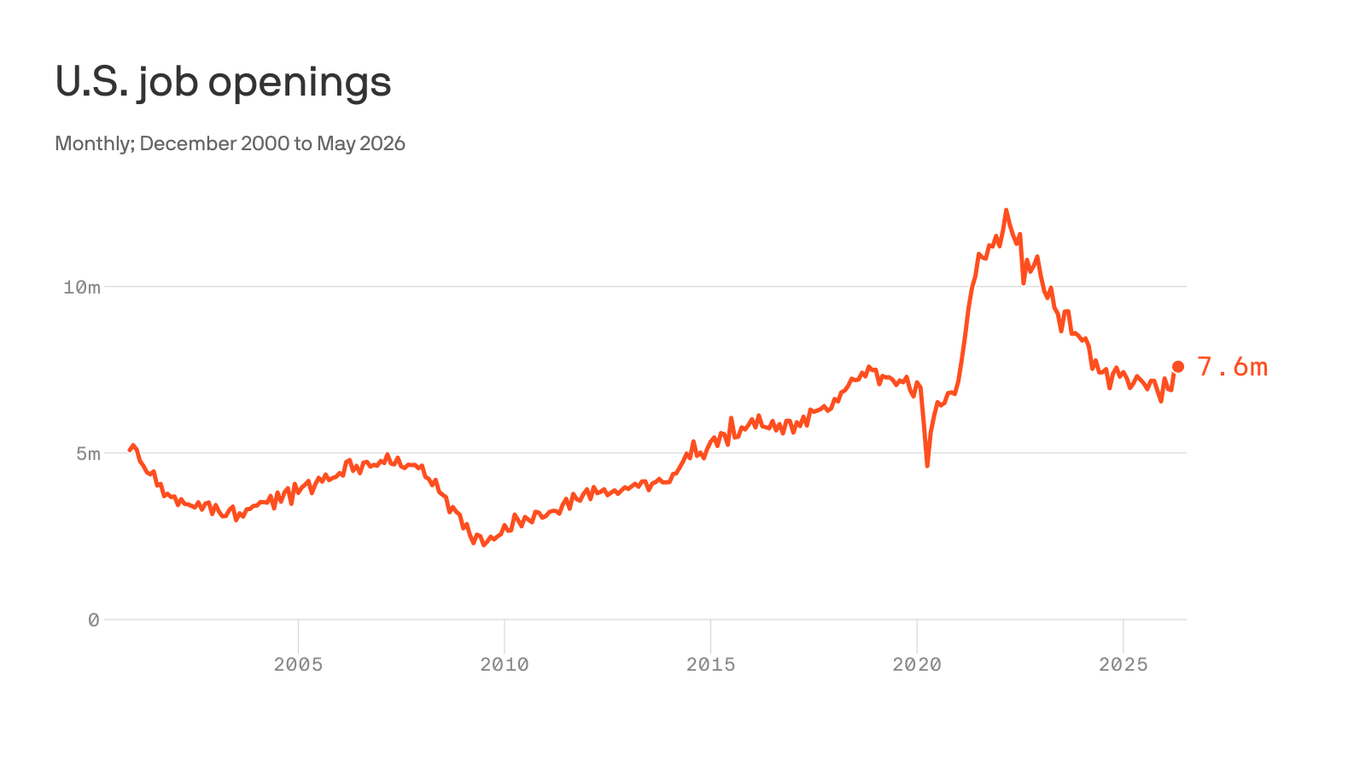
In a stagnant, low-hire labor market both workers and job hunters are feeling stuck.GettyIn June, the U.S. economy added 57,000 jobs to the labor market, far fewer than economists expected and a sharp slowdown from the 172,000 jobs originally reported for May, and May’s just downwardly revised job growth of 129,000. Unemployment dipped slightly to 4.2% from 4.3%, according to the Bureau of Labor Statistics, with much of this decrease being due to a decline in labor force participation rather than a decline in the number of people unemployed. While the large number of jobs gained in May may have signaled to some that the tides were turning in a slow labor market, Laura Ullrich, director of economic research at Indeed, said that June proves that May “was the exception, not the new rule.”“Honestly, this is about what I expected just given the stillness we’re seeing in the labor market,” Ullrich said of the latest jobs report. “If you look at the [Job Openings and Labor Turnover Summary] report that came out earlier this week, the hire rates are quite low, layoff rates are low, quit rates are low so there’s just not a lot of movement in and out of jobs. And because of that, I didn’t expect there to be a blockbuster number of jobs added in June.” She explained that the decline in labor force participation was likely due to a mix of people aging out of the workforce and the impact of immigration policies, rather than folks becoming discouraged and giving up on finding work.The “stillness” in the current labor market has a different impact depending on where you sit, Ulrich observed. If you’re employed, then you’re likely to stay put at your current job because, depending on your industry, opportunities elsewhere may be limited. And if you’re unemployed, you’re likely met with challenges when it comes to finding a job because there are very few new openings to pursue. Ullrich points out that current hiring levels are close to where they were 11 years ago when the labor force had nearly 13 million fewer people than it does today. As a result, the percentage of people who have been unemployed for 27 weeks or more has increased to 27% from 23% at this time last year. Where jobs are growing and shrinking, according to the June jobs report.ForbesWhere Jobs Are Being AddedIn June, professional and business services led the pack with 36,000 job gains, followed by social assistance and health care. While health care has continuously been a top sector for job growth for the past few years, professional and business services has been a bit more sluggish, making its surge in June a little surprising to some. “That has been an area that’s certainly struggled over the last couple of years,” LinkedIn’s Head of Economics, Americas, Kory Kantenga said. “There’s a lot of speculation about whether it's because of AI or not. But I think we’re very much in a tighter interest rate environment and to some extent things may be leveling out and that's good news for [professional and business service] workers. If things are starting to level out and stabilize then at the very least things are not going to get worse for them and they are likely to get some opportunities.”While leisure and hospitality saw the most job growth in May, with some experts linking its surge to World Cup hiring, June showed a totally different picture, with 61,000 job losses, the most of any industry. Both Kantenga and Ullrich agree that one month of pullback data isn’t enough to draw big conclusions about the strength of this sector, especially considering its history of up and down job growth. “I think it's very much those technical seasonal factors probably playing a role than there actually being something deeper going on in leisure and hospitality,” said Kantenga. “The amount of employment in that sector is about what it was at the start of the year. We just haven't seen any gains there, which is consistent with what we saw in 2025 as well. Some months it added jobs, some months it lost jobs. That sector is just volatile and not consistently adding jobs at the moment.” How To Find Your Next OpportunityIn a low-hire job market with uneven growth, it’s important for job seekers to prioritize networking and making connections to stand out, Kantenga says. In addition to highlighting your skills on your LinkedIn page, he says anyone looking for employment today needs to “use your network to connect with people who are in the roles and in the industries that you have an interest in. That way, you're not just sending cold resumes out and you're actually making a warm connection and potentially getting a referral, which is very important in a market like this.”He also advises job seekers to do their homework and research where momentum is taking place in the labor market to ensure that their job searching efforts are directed in the right places. “Say you want to work in an accounting firm, if it's an accounting firm that serves healthcare providers, you probably have some options there,” he said. “But if it's an accounting firm that serves other accounting firms, then it's probably more challenging. So you want to make sure that you're focused on areas where there's going to be momentum and you're not just looking at what industry a company is in, but who are their clients? Are their clients in industries and areas that have momentum because if there's momentum there, then there's going to be growth.”Want to be more successful? Subscribe to the weekly Forbes Careers newsletter to get insider tips and insights.More from ForbesForbesAI Is Changing Work. These Are The Human Skills Employers Want MostBy Courtney Connley-HamptonForbesThe Economy Is Still Adding Jobs—So Why Does Finding One Feel So Hard?By Courtney Connley-Hampton
What Today's Standstill Labor Market Means For Workers
Economists say June’s modest job gains point to a stagnant, low-hire labor market where people are continuing to have a hard time finding new jobs.
979 words~4 min read