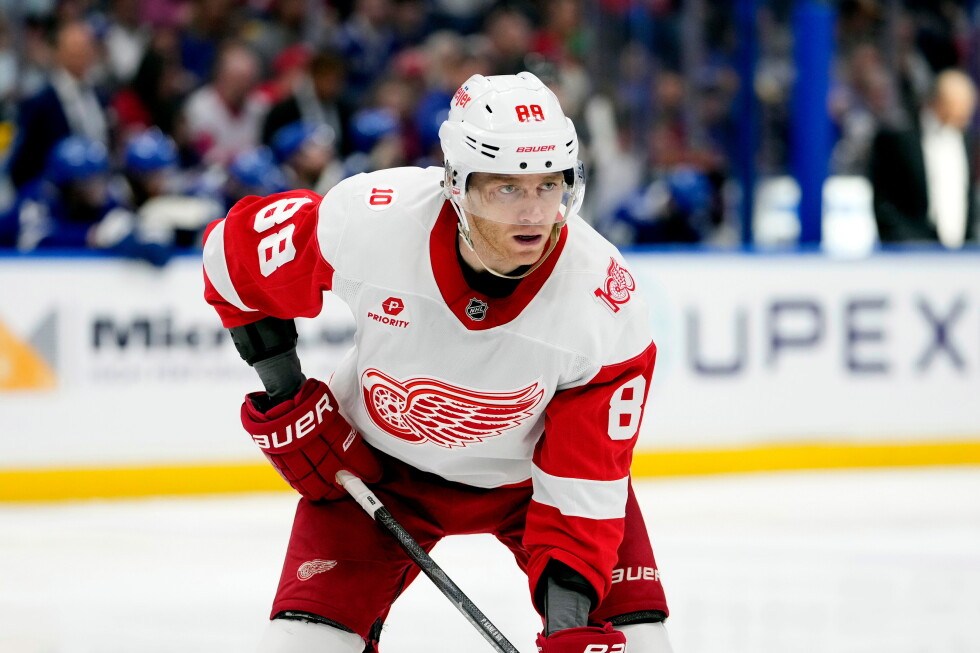
July 1 had some fireworks despite this year’s weak free-agent class. There were plenty of motivated buyers, both in signings and on the trade market.Most of the true difference makers are off the free-agent board, but there are still intriguing names available. Expectations just have to be tempered — these aren’t top-six players or top-four defenders who will be core pieces, they’re solid supporting-cast and depth options.Here are nine of the most attractive targets left. Just close your eyes and pretend that these names are from 2019 and it’ll feel a whole lot more exciting.Are the Sharks why the Blackhawks traded for Bowen Byram?Corey Pronman, Scott Wheeler and moreAnthony ManthaMantha was one of the best bargain signings of free agency last year, scoring 33 goals at an inexpensive $2.5 million cap hit. That production was even more valuable considering most of it came at even strength; his 25 five-on-five goals were tied with Nikita Kucherov, Mark Scheifele, Jason Robertson, Martin Nečas, Adrian Kempe and Cutter Gauthier for sixth most among NHL players. Mantha’s one-shot scoring ability in the middle six ensured that the Pittsburgh Penguins were no longer a one-line offensive team as they had been at times in recent seasons.It was a dream bounce back after he missed all but 13 games of the 2024-25 campaign due to a torn ACL.Mantha’s top-level speed and 6-foot-5 frame are a tantalizing combination, but his longstanding inconsistency makes him a frustrating player. The 31-year-old was a playoff ghost, registering just a lone assist in the Penguins’ six-game defeat to the Philadelphia Flyers. Mantha drove just a 40.9 percent share of expected goals in the playoffs, and the Penguins were outscored 4-1 with him on the ice at five-on-five. He has zero goals in 20 career postseason games.Between Mantha’s career-long inconsistency, playoff warts and the one-dimensional nature of his game, there are red flags. Tack on the likelihood of some shooting percentage regression next season (he shot 21.7 percent in 2025-26 versus his career average of 13.8 percent), and clubs should tread carefully with how much money and term they offer. At the right price, however, there’s no question he can meaningfully boost a team’s middle-six offenseMarcus JohanssonJohansson is still a useful middle-of-the-lineup player, but role, expectations and contract valuation will dictate whether he’s a sensible target for a team.He scored 49 points in 75 games, which makes him look like a solid second-line winger on paper, but it’s important to remember he was riding shotgun with Minnesota Wild star Matt Boldy for much of the season. The two seasons before that, he scored 34 and 30 points, respectively, which is far more modest. Combine that with him turning 36 in October, and teams need to be mindful that his actual value is probably closer to that of a third-line player rather than a full-time top-six solution.Johansson is still an excellent skater, can make a secondary impact carrying pucks up the ice and has posted above-average defensive metrics.Patrick KaneKane will turn 38 in November, but he still racks up points and provides legitimate secondary offense. The iconic American scored 57 points in 67 games, which translates to a 70-point pace prorated over 82 games. He’s still a prolific producer at both even strength — his 2.03 points per hour at five-on-five ranked second best among Detroit Red Wings forwards — and on a team’s first-unit power play due to his vision, hands and creativity.There’s a decent chance his even-strength production will taper off a bit next season; his line scored on 12.1 percent of its shots at five-on-five, which is unlikely to repeat itself. He’s also a drag defensively, which needs to be factored in. He still has plenty of game left to help a team offensively, however, provided the lineup and power-play fit are right.Logan StanleyWhether you’re a fan of jumbo defensemen with mixed on-ice results or not, the truth is Stanley is the kind of player teams always covet and overpay for.The 6-foot-7 left-shot defenseman gradually improved his puck play and secondary offense over the years in Winnipeg, which culminated in the Buffalo Sabres paying a premium to acquire him at the deadline. The playoffs, however, were a reminder why he’s a polarizing player. Stanley is prone to big mistakes because of his limited mobility and questionable reads, which led to him averaging just 13:04 of ice time across eight playoff games for the Sabres.Stanley would be a solid third-pair defenseman in the right situation, but there’s a risk someone is going to pay him too much based on his size.Claude GirouxGiroux isn’t as dynamic as he used to be, but there’s still a lot to like about him as a top-nine winger. No, he can’t drive a line like in his prime years — Corey Sznajder’s tracking data shows that he isn’t very involved in transporting the puck up ice or as a solo offensive creator — but he’s smart and crafty enough to complement other top players. Giroux scored 49 points and won a staggering 63.1 percent of his faceoffs.Critically, the 38-year-old didn’t drag the rest of his line’s ability to control two-way play as some aging veterans do: The Ottawa Senators controlled over 55 percent of expected goals and had a plus-14 goal differential with Giroux on the ice at five-on-five.Giroux could be a savvy pickup for the right team on a one-year deal.John KlingbergKlingberg would be a reasonable target for a team that needs depth puck moving and offense from the back end at a reduced price. He’s a complete liability in his own zone, as his defensive metrics are some of the worst in the league, but there’s still some offense left in the tank.The 33-year-old right shot scored 10 goals and 27 points in 56 games for the San Jose Sharks last season. Fit will be extremely important, as he’d ideally just be a sheltered third-pair defenseman with some secondary power-play time.Vladimir TarasenkoTarasenko had an encouraging bounce-back season with the Minnesota Wild, producing 23 goals and 47 points in 75 games while averaging roughly 15 minutes per night. Any interested team needs to understand and accept his limitations, though: He’s a slow skater, below average defensively and more of a complementary piece on a line than a driver.If you can live with those shortcomings, you’re looking at a high-end finisher who can fill the net. Tarasenko’s 16 five-on-five goals ranked No. 3 among Wild players behind Kirill Kaprizov and Boldy.Patrik LaineIf you’ve sensed a theme in this article, it’s that a few of the players on this list are limited and somewhat flawed defensively but still have scoring potential. Laine is the most extreme example of that.He can’t drive play, his defensive metrics are awful, and he’s a bit of a tweener in that he’s not quite productive enough to play among the top six forwards on most teams yet also doesn’t fit as a prototypical bottom-six player. For most teams, he doesn’t make sense as a target. If a club needs a cheap, high-end power-play scoring specialist, though, the upside could be appealing.Laine scored 20 goals in 52 games during the 2024-25 season (a 31-goal rate prorated over 82 games) for the Montreal Canadiens, and 15 of those were tallied on the power play. He missed all but five games this season due to injuries, which makes him eligible for a low-risk, bonus-laden contract.Michael BuntingBunting has bounced around five teams in the last four seasons. His post-deadline run with the Dallas Stars didn’t go well, as he notched just two points in 13 games, which led to him appearing in just one playoff game.In the big picture, though, Bunting has produced 0.55 points per game over the last three seasons, which is a bona fide middle-six rate. He’s a high-energy pest who’d be best served as the puck retriever on a line, in addition to having the knack for drawing a lot of penalties.
NHL free-agency watch: The 9 best players remaining on Day 2
Despite a flurry of league activity on the first day of free agency, useful players are still available.
1,320 words~6 min read