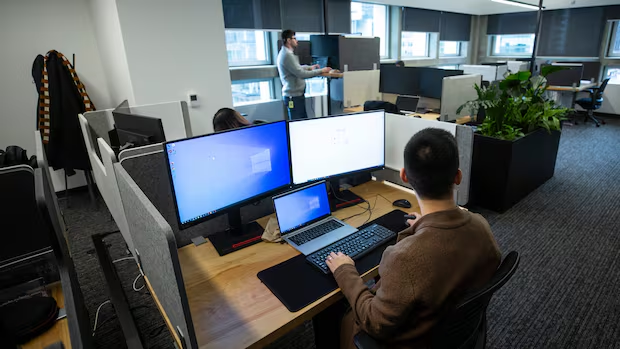
Research does not back up reasons generally given by employers for returning to the office, though authors concede remote does not always work New research reveals that objections to working from home from superiors are likely to be driven by ego. Photograph: iStock Thu Jul 02 2026 - 09:15 • 5 MIN READThe real reason many bosses want everyone back in the office five days a week? Their ego.No joke. New academic research has found what many of us long suspected. Over the last six years, organisational psychologist Adam Grant at the Wharton School in the University of Pennsylvania, and PhD candidates Marissa Shandell and Courtney Elliott, have studied why some leaders embrace remote work while others resist it. They surveyed thousands of executives, middle managers and supervisors on a range of personality traits and asked them about their attitudes to remote work.“Some leaders say they insist on full-time in-person work because it boosts productivity, despite clear evidence that it does not. Others claim it’s about collaboration, creativity or culture. Our new research reveals that the objection to work from home is more likely to be driven by something else entirely: ego.”Ordering people back to the office full-time is a power-and-status move they claim. When people aren’t in the office, command and control is harder. “It’s a signature strategy of leaders who exhibit narcissistic qualities. They see any kind of remote work as a threat to their authority and admiration. They want to be worshipped at the office altar.”[ Brave new world of remote working in rural areas yet to materialiseOpens in new window ]Harsh words. The authors acknowledge that hybrid and remote work does not work for every business or every role. “None of this is to say that individual leaders who reject remote work are necessarily egomaniacs, as many factors influence workplace policies around flexibility. But our data does show that, overall, self-centred leaders tend to struggle with the idea of employees making independent choices about where to work.” The full study is worth reading, as leaders need to stop fighting hybrid work and embrace it as a normal part of the modern workplace.Hybrid revolutionWorkers are making their preferences known, with office-based positions receiving fewer applications than hybrid roles. Companies need to adapt rapidly or miss out on high-performing workers, greater productivity and loyalty. The biggest obstacle to managing a hybrid team is often the manager. Managers’ roles have changed significantly since 2020 and will continue to evolve rapidly with the adoption of AI, yet training them up in these new hybrid working skills is weirdly not a priority in many companies.Barriers may include fear and a lack of experience or expertise in managing hybrid or remote teams. That’s certainly something I encountered when I started my fully virtual company 20 years ago in June 2006 – a very unusual thing to do at the time.Hybrid and remote working had been a little obsession of mine since I wrote a paper for my MA in journalism at DCU on teleworking in 1998. It all seemed so sensible to me (as an introvert who values quiet thinking time) to just let people get on with it. They were adults after all. [ ‘There’s an issue around mindset’: Parents on hybrid working and childcare pressuresOpens in new window ]Also, why should I pay for an office, force the team to suffer a commute and endure a noisy open-plan workplace? Instead, I told the team members they could work whenever they wanted, wherever they wanted. There were only two stipulations: the quality of the work must be excellent and it must be delivered on time. The 4TsNow, when I’m designing a successful hybrid team, I talk about the four Ts – togetherness, tools, teamwork and touchpoints. This advice is based on academic and business research on what works, and what my clients and I have found when moving from teams who were full-time in the office to hybrid or fully remote.For some leaders, having staff in the office rather than working remotely is all about control. Photograph: iStock Hybrid working requires managers to focus on communication, motivating employees, readjusting their role – is it employee supervision or support? – and putting structures in place that make this happen.Togetherness: Coming together in person needs to mean something. There’s no point in asking junior staff to go to the office to do video calls. Be strategic in your approach and don’t waste people’s time. To get buy-in on ways of working, organise an in-person team meeting. Use this for an open discussion (using logical criteria and centring the business’ needs) about how often, when, for what reasons and why the team needs to be in the office together. When in-office team days happen each week, make sure the team is meeting together with purpose: to problem solve, innovate, share information and build their relationships. If employees feel they could have done the same work from home – but you’ve put them through a commute, or they’ve had to hire a carer for the day – your hybrid work policy isn’t working, and they’ll become disillusioned and demotivated.Try spending a few minutes at the beginning of every virtual weekly meeting catching up with one another on a personal basis. Question prompts can help: any funny or unusual things happen this week?Tools: Most companies have excellent technology and tools, but they only use about 20 per cent of their capability. Now is the time to prioritise training all team members in how to use tools competently, especially the virtual work tools and communication channels on which they rely every day. Spell out and document how each channel should be used (daily communication between peers and managers, urgent communication with senior leadership team, team problem solving, project management, tracking) and share this with everyone. How employees “choose their weapon/tool” greatly impacts on their effectiveness and the way they are perceived internally. Sending the chief executive an urgent message on WhatsApp after hours – as one client told me happened when a junior employee was unaware of the ground rules – is not a good look for anyone.Teamwork: Human beings connect easily in person, but when we’re communicating virtually, some nuance and lots of humanity and humour can be lost. How can you help team members relate well to one another even though it’s through technology? [ Remote working: ‘I will overdeliver because I know this is a privilege’Opens in new window ]Research shows that when working on a hybrid basis, social ties need to be reimagined, maintained and used to support strategic goals. Try spending a few minutes at the beginning of every virtual weekly meeting catching up with one another on a personal basis. Question prompts can help: any funny or unusual things happen this week? What did you enjoy doing this weekend? Holidays or staycation plans? Or follow up on something that they mentioned last week. Active listening and participation is key to these moments. Regular facilitated workshops on various issues (strategy, customer relationships, using AI, communication, high performance) are also helpful for team motivation, energy and physical movement.Touchpoints: Managers who succeed in this era understand the power of the personal touch. Regular one-to-one calls with each team member are an absolute necessity. These are discovery, support and listening meetings. What does the employee need to get the job done? How much effort is involved? What can make it easier? How can you help them prioritise and balance their workload? What skills do they need to develop? What helps them be more productive? What are they doing to mind themselves and manage burnout?Humans need to feel valued at work and, if you give them the tools, structures, respect and humanity they need, they’ll thrive – and your business will too.Margaret E Ward is chief executive of Clear Eye, a leadership consultancy. margaret@cleareye.ieIN THIS SECTION
What’s the real reason your boss wants you back in the office?
Research does not back up reasons generally given by employers for returning to the office, though authors concede remote does not always work
1,310 words~6 min read