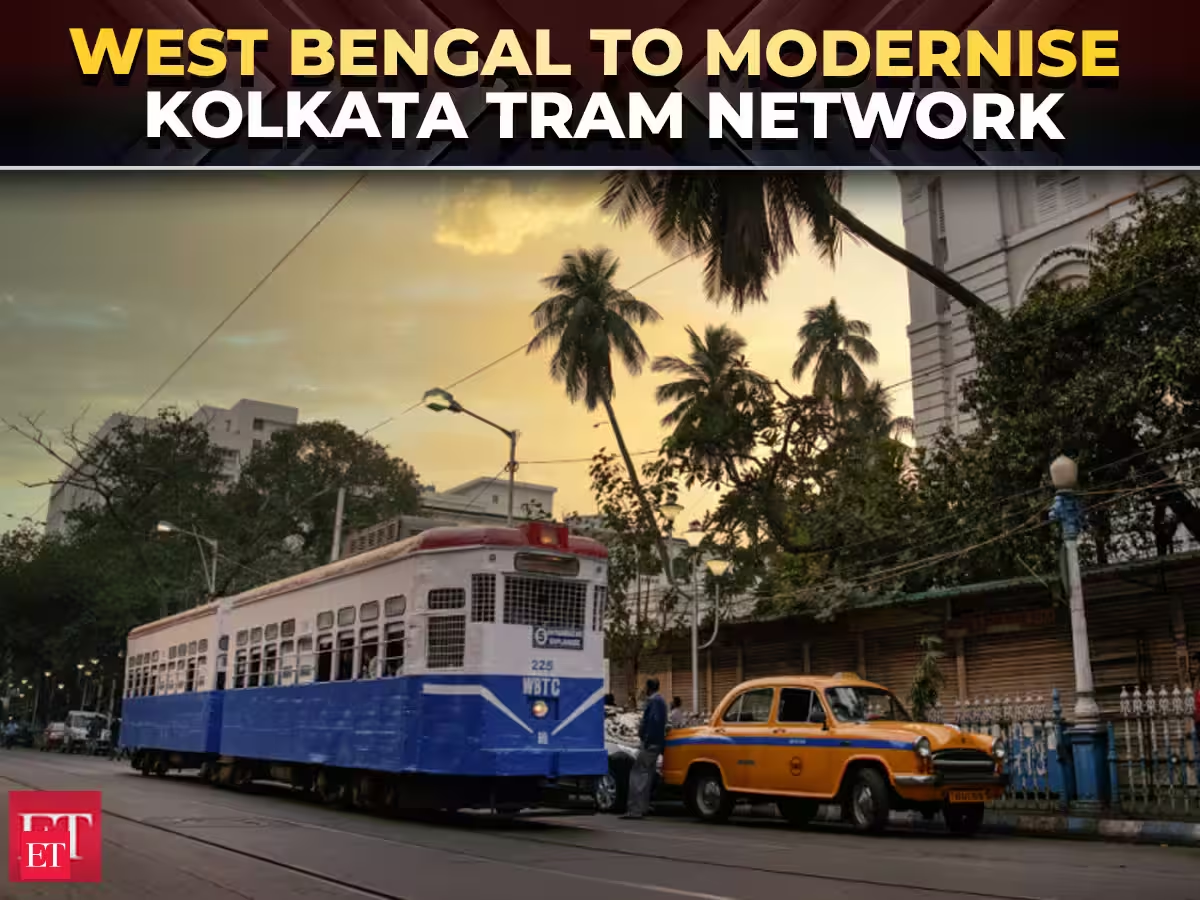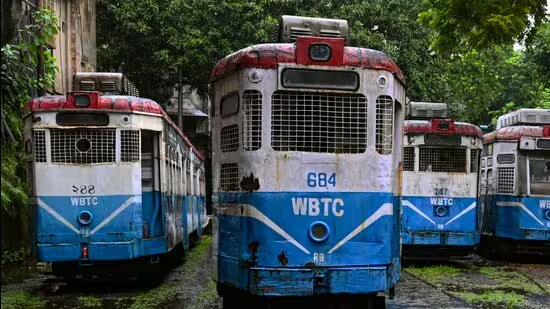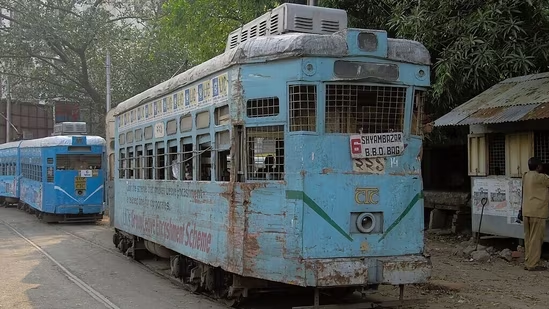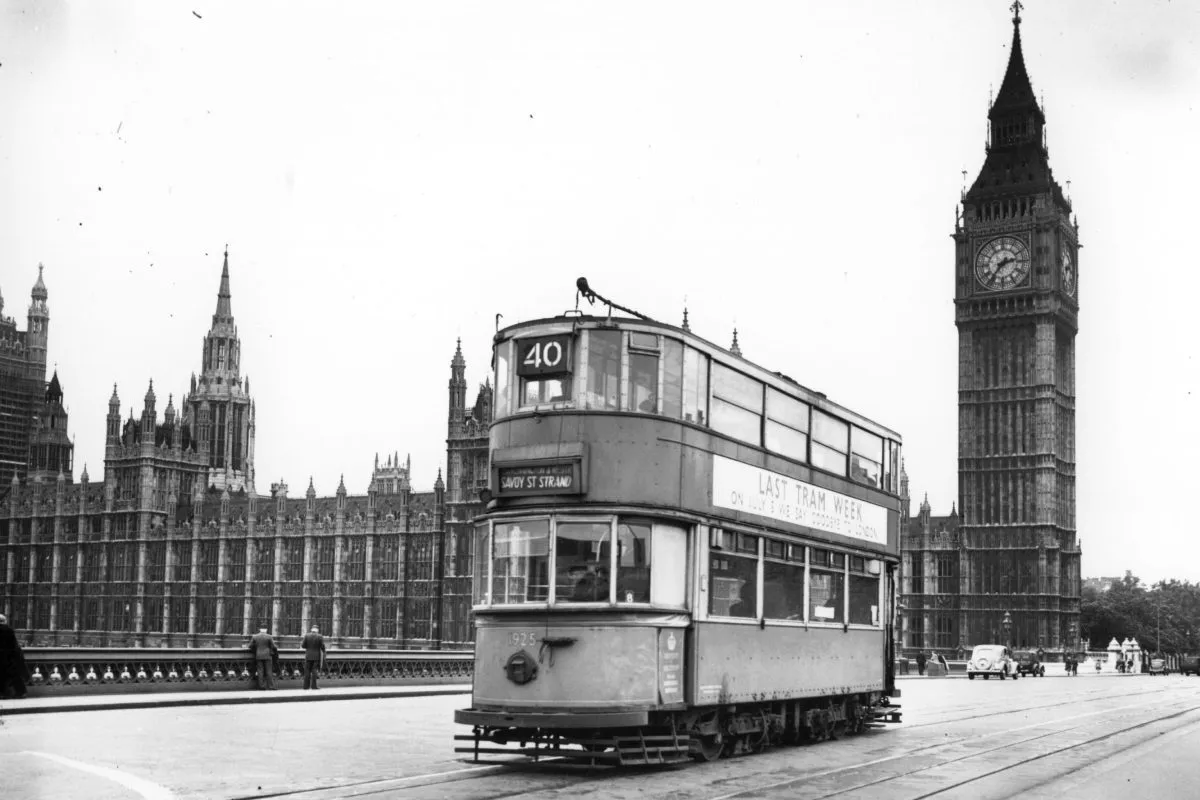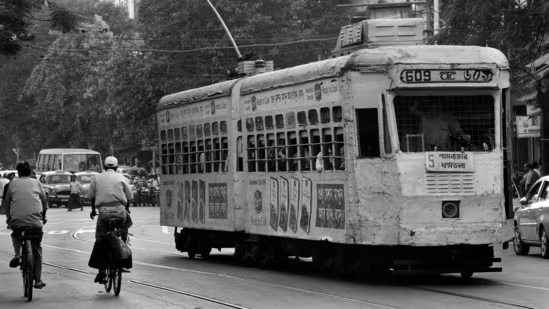
From a failed 1873 horse-tram line to a 150th birthday and a near shutdown, Kolkata's trams have a long history of being written off, and saved. Where trams once threaded through Kolkata, clanging past busy lanes, only two routes now remain of a network that shaped how this city moved, protested, fell in love and, more than once, buried its poets.A tram in Kolkata (Courtesy: CTC)That may be about to change. West Bengal's new BJP government said last week it wants to revive the tram network, which shut down most services in September 2024."We want to revive the environment-friendly public transport system. RITES (Rail India Technical and Economic Service) has been asked to conduct a survey," state transport minister Arjun Singh said on Sunday.Officials say the plan is to renovate the existing tracks and preserve the network as heritage infrastructure, while also drawing tourists and offering an eco-friendly transport option. New tram carriages, modelled on those running in Australia and parts of Europe, would follow.A moving piece of historyTrams needed roads first, and Calcutta did not have them. Until the 18th century, the city's streets and lanes were narrow and "kutcha", or unmetalled. No horse carriage could use them, and bullock carts, palanquins and pedestrians filled that gap, according to a 2023 doctoral thesis on Calcutta's transport history, From Palki to Automobile: A 'Transport Revolution' in Calcutta, 1827-1947, by Bishwendu Ghosh.Circular Road, built in 1742 and metalled in 1799, was the city's first pucca road.But trams didn't come easily even then. It was only in 1803 that British-era governor-general Lord Wellesley set up a thirty-member committee to push road-building in the city, Ghosh's paper submitted to the department of history at Jadavpur University notes.In 1865, Bombay got the first licence for a horse-drawn tram, but the project collapsed. So Calcutta, as Kolkata was known then, got there first. Its inaugural horse-pulled tram ran in 1873, a 3.9-kilometre line between Sealdah and Armenian Ghat Street along the Hooghly.But the Sealdah line was not for the masses. In Ghosh's words, it was conceived as "a lifeline for the trade and commerce hub of Calcutta", built for goods to be moved from the riverfront's docks and jetties to the city's warehouses and the Sealdah terminus.Each car was hauled by a pair of sturdy Australian walers and served suburban traders' stores in Shova Bazar and along Strand Road, according to an October 29, 1980, HT report that marked the tramways' centenary.The plan didn't work out. The line was opened for passengers after authorities realised that Calcutta's port canals had by then silted too badly to serve goods traffic reliably.Nonetheless, the system didn't last long. Losing roughly ₹500 a month and built for ₹1.5 lakh against a sanctioned budget of ₹1 lakh, the service shut in November 1873. Horses, too, could not withstand the Indian summer and many of them died from over-exhaustion at the time.Calcutta tried a second time in 1880. Independent promoters had floated revival proposals from 1876, and on 2 October, 1879, the Calcutta Corporation signed an agreement with a newly formed Calcutta Tramways Co. Ltd (CTC) — founded by Dillwyn Parish, Alfred Parish and Robinson Sutter — for rights over eight prescribed routes, Ghosh's paper notes.Construction moved fast thereon. The Bowbazaar line was certified for operation on 27 October 1880 and the Hare Street line on 19 November, ahead of a formal inauguration of a longer, metre-gauge route running from Sealdah to Armenian Ghat via Bowbazar Street, Dalhousie Square and Strand Road, according to CalcuttaTramways. The company itself was formed and registered in London on 20 December, 1880, though it dated its own founding to 1 November that year.There were many who were unconvinced about the service."The tramways starts operations on the 1st, but how far it will prove successful remains to be seen. The trial trips which are now being made have proved anything but satisfactory," the 1980 HT report quoted The Statesman (then called The Statesman and Friend of India) as saying at the time.The fears did not hold up.Steam engines came next, in 1882, and brought their own chaos. A month-long trial on the Chowringhee section saw six accidents, though no fatalities were recorded. Steam trams were barred from running after sunset for lack of street lighting, Ghosh's paper records. The engines were also loud enough to spook horses pulling other carriages nearby, and some European residents formally objected to the smoke and noise. "Awful", it was in the words of the city's "white town", the HT report says, adding that many Indians though welcomed the speed of the commute.The protests briefly won out, and horses returned to duty "with dignity", before electricity arrived in 1902 and reached every route in the network by 1905, the same HT report noted.Also read: Govt to bring back AC trams in Kolkata; new route may link Dakshineswar, Kalighat templesA horse-drawn tram (Courtesy: Heritage Transport Museum)Steam tram in Kolkata (Wikimedia)Electric trams take overIntroduced in 1902, electric trams made Kolkata home to Asia’s oldest continuously operating electric tram network. Madras was the first in India to get electric trams, in 1895, but that system did not survive the century.Kolkata’s first service ran from Esplanade to Kidderpore and later extended to Kalighat.Like any technology, electric power brought with it a fresh set of problems. According to Ghosh's paper, high electricity drawn for the trams disrupted laboratory work at nearby Presidency College. Both were believed to be linked to a transformer close to the campus.The trams also entrenched a visible class divide. There were two ticketed compartments — a first class one with cushioned seats, overhead fans and blue lighting, and a second class with plain wooden seats and red lighting.Ghosh's thesis cites writer Kshitindranath Thakur documenting protests from the public against this divide.Trams as colonial legacy, and as its targetThe tram was a modern convenience, but it was also a visible symbol of the colonial rule that built it.And so, attacks on trams began as early as the Swadeshi movement of 1905.Ghosh says that trams were set ablaze when nationalist leaders were arrested during the Civil Disobedience movement, and also during the Quit India movement, when overhead wires were cut and tramcars burned. Some local policemen, too, are believed to have joined in the arson attacks."Hence when it came to protesting against the oppressive colonial rule, the local people did not hesitate to destroy their primary mode of surface transport which they otherwise avail on normal days," the thesis reads.Then, the service was disrupted from strikes by staffers too. In 1921, for instance, tram services were suspended in Calcutta for 64 consecutive days because of a strike.Even after Independence, the Calcutta Tramways Company remained under London management, even staying listed on the London Stock Exchange until 1968, according to a BBC report. But day-to-day control had passed to the state a year earlier. The first United Front government took over running the company in 1967, after its British owners stopped paying staff salaries, HT reported in 1980.CTC finally turned into the West Bengal Transport Corporation Limited and has run tram services since 2016.Early electric tram at Chitpur Road (Courtesy: CTC)Two anniversaries, and an uncertain futureKolkata's trams have marked at least two big birthdays. On 1 November 1980, the city celebrated a century of the Calcutta Tramways Co., with then chief minister Jyoti Basu inaugurating an exhibition on its history.Organisers had wanted to put the city's sole surviving horse-drawn tram car on display, but it was in a museum in Bombay by then and CTC was not sure it could be brought back in time for the event. The fleet then ran 438 cars, an average of 320 plying daily, and carrying some nine lakh passengers, kept afloat by a state subsidy of ₹40 lakh a month.A ₹102-crore modernisation plan was in the works, promising 75 new cars and 165 renovated ones — which CTC, with characteristic good humour, called "a bounty from the oil crisis".Forty-three years later, in 2023, Kolkata marked 150 years since that first Sealdah–Armenian Ghat line, with vintage trams — including a century-old wooden carriage — paraded through cake-cutting ceremonies and musical performances, according to the BBC.But the celebration proved short-lived. Within a year, in September 2024, the state government had shut down most of the network, leaving the two routes that survive today: Gariahat-Esplanade and Shyambazar-Esplanade.College Street, through a tram (Wikimedia Commons)In culture and literatureLong before it became a heritage cause, the tram was the "lifeline of Kolkata city", featuring prominently in Indian cinema. Satyajit Ray, Ritwik Ghatak and Mrinal Sen wove it into Mahanagar, Bari Theke Paliye, Interview, Calcutta 71 and Padatik. And more recently, the trams turned up in Piku, Kahaani, Barfi! and Yuva.Bengali literature returned to them just as often. Jibanananda Das's poetry uses the tram to evoke the solitude and quiet rhythm of urban life, nowhere more than in Tram Line-er Dharey, translated to Along The Tram Line.A popular translated version reads:"I walk along the tram line: night now deepI hear the teasing of some life of the past:'You are like a broken tram—there is no depot, you don't need wageAlas, when has this occurred!'That old life sinks behindthe star in the sky, in darkness.It is often taken as a cruel irony that Das, who often spoke of the tram, died after being struck by one in 1954.A 1980 HT article on Kolkata's tram network. (HT Archive)Trams were ubiquitous in Bengali prose too, Ghosh's paper notes. Bibhutibhushan Bandopadhyay's Aparajito has its female lead, Leela, describe the electric tram running past her house to Apu as a vehicle needing neither horses nor a steam engine, moved instead by an overhead wire. Sunil Gangopadhyay's Prothom Alo has its protagonist, Bharat, rate the tram as more reliable and faster than even the steamships plying the Hooghly.A September 2005 HT feature on Tramjatra – a carnival celebrated by Calcutta and Melbourne, the two cities where the mode of transport survived the passage of time – notes a namesake book by Soumitra Das referring to Kolkata's obsession with trams. While other Indian metros Bombay and Madras phased out the service long ago, trams in Kolkata, "woven into the fabric cultural ethos" of the city, continued to “trundle down the streets”.Kolkata marked 150 years of its tram network in 2023 (Courtesy: CTC)(With inputs from Karishma Ayaldasani & Danita Yadav)Prerna Madan leads the explainers and immersives team at Hindustan Times, bringing more than eight years of editorial experience across India's three largest English-language newsrooms — Hindustan Times, The Times of India and The Indian Express. Her career spans the full range of modern news journalism: digital-first production, print news desks covering metro, national, and front-page, and editorial decision-making at the planning and commissioning stage. From managing coverage of Assembly elections and the Union Budget to steering the reporting, editing and production of in-depth reporting into the Delhi-NCR’s pressing issues, Prerna has honed journalistic storytelling that spans genres, topics and formats. Running through her current work is a facility for complexity — translating consequential, difficult material in the fields of policy, science, environment and politics into rigorous, accessible journalism that sets out to answer two critical questions: why it matters, and what happens now. Prerna holds a degree in English Literature from the University of Delhi and a postgraduate diploma from the Indian Institute of Mass Communication.Read More
Off the rails and back again: The story of Kolkata's trams that BJP's Bengal govt wants to revive
From a failed 1873 horse-tram line to a 150th birthday and a near shutdown, Kolkata's trams have a long history of being written off, and saved. | India News
1,884 words~9 min read