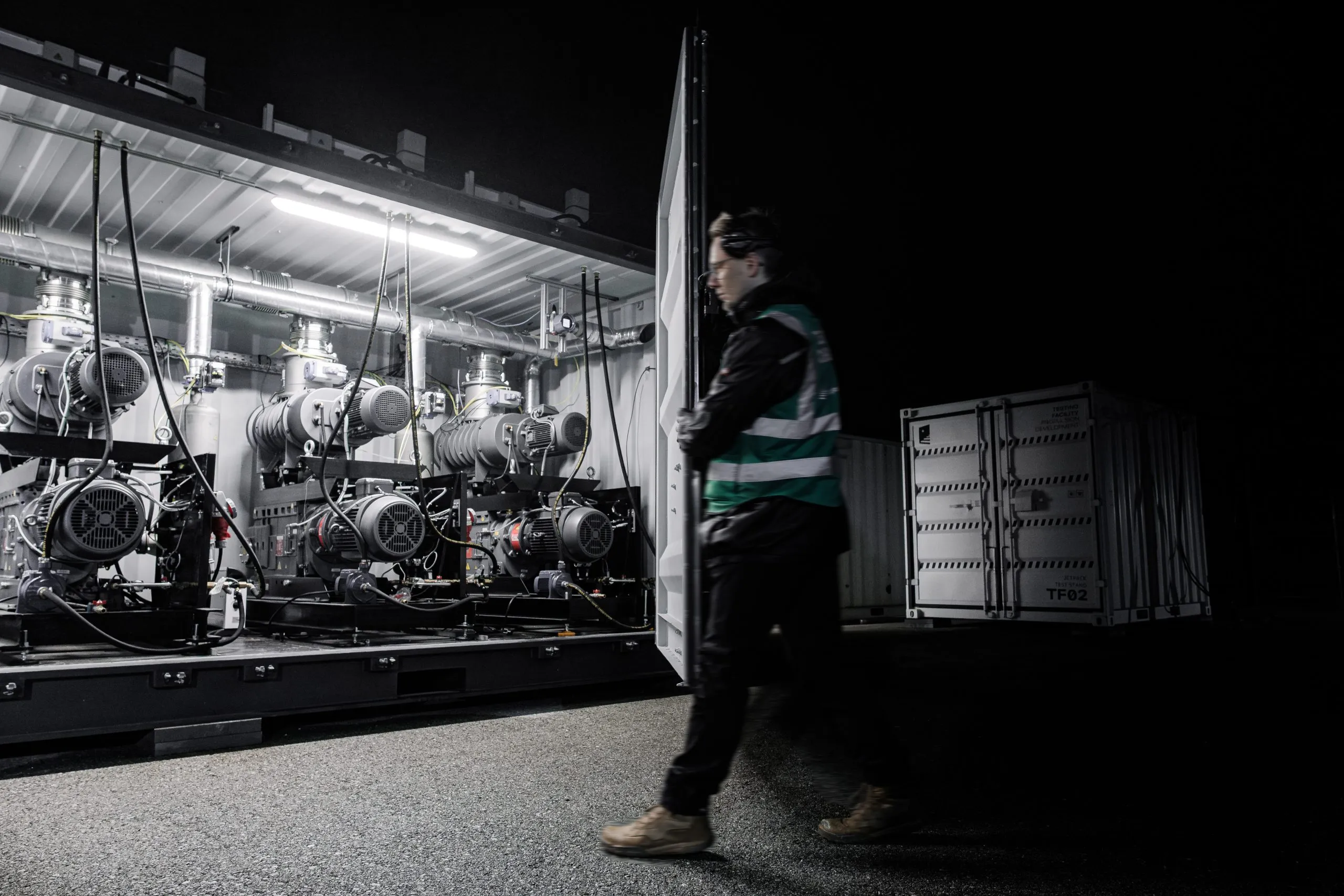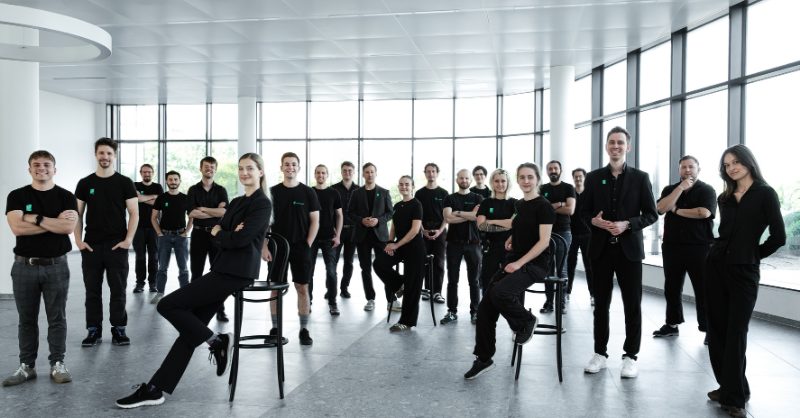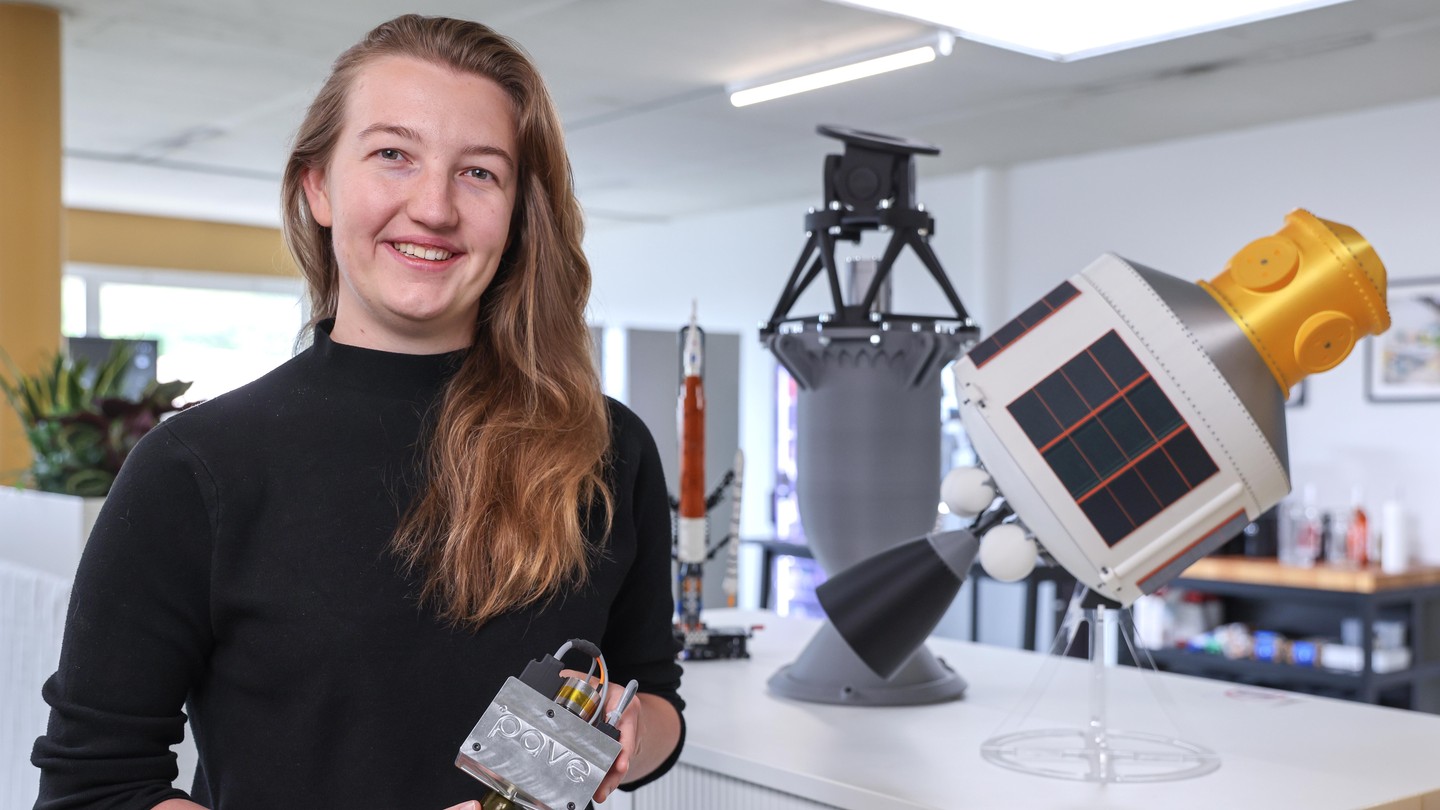
PAVE Space is on a mission to accelerate access to space and transform the way satellites reach orbit. Its founder, Julie Böhning, sees space as a new continent waiting to be explored and developed – a vision that earned her the 2026 PERL Trophy.Julie Böhning spends her days thinking about space. Yet the CEO and co-founder of PAVE Space remains firmly grounded. Just a year and a half after its launch, the startup has raised $40 million and, in May this year, it won the 2026 PERL Trophy, which recognizes entrepreneurial, high-potential and innovative young companies in the Lausanne region. “While recognition from customers and colleagues from around the world matters enormously, there’s something particularly gratifying about receiving strong support close to home,” says Böhning.The early-stage venture is developing Lyoba, a 20-metric-ton vehicle capable of delivering satellites to their final orbit in just 24 hours. “Right now, satellites have to get there under their own power, using small propulsion systems,” explains Böhning. “The journey can take anywhere from six months to a year. Our idea grew out of a simple observation: while 95% of satellites remain in low Earth orbit, around 5% need to travel much longer distances – for example to geostationary orbit, which lies roughly 60 times further away.” PAVE Space plans to launch Lyoba aboard a partner rocket. Satellites will be mounted on the vehicle and, once the launcher has reached low Earth orbit, Lyoba’s 45 kN engine will take over, carrying them to their final destination. “It works on the same principle as a conventional rocket engine,” says Böhning. “We’ll run our first tests this fall at the disused Chavalon plant in Valais.”The rocket engine will be tested in the old Chavalon factory © 2026 PAVE SpaceFinding her way at EPFLBöhning was born in France. Her family moved to Switzerland when she was seven years old and settled in Gruyère. “That’s where I spent my teenage years and met the friends I still work with today,” she explains. When the time came to choose a degree, she followed those same friends to EPFL: “Honestly, I had no real idea what I wanted to do. Languages weren’t my thing, and neither were biology or chemistry. That left physics and math.”Today, Böhning is designing vehicles for satellites. But as a child, she had no grand ambitions: “I remember wanting to be an astronaut at one point. My parents said I’d have to good at math. I told them that sounded way too hard. The funny thing is that I did turn out to be good at math. I just never became an astronaut.”Böhning continues: “My younger sister is studying architecture at EPFL and, honestly, she’s the bravest person I know. She passed her first year at the first attempt. I didn’t. I missed the pass mark with a 3.95 and had to repeat the year. She loves bringing that up every time we see each other.”And so begins the Gruyère Space Program“Repeating my first year meant I suddenly had a bit more time on my hands, so I got involved in student associations,” says Böhning. She and a group of friends from Gruyère wanted to join the Rocket Team, but it wasn’t open to first-year students back then. “So in 2018, we decided to start our own group: the Gruyère Space Program, or GSP,” she explains. “We did it entirely without EPFL funding.”The Gruyère Space Program designs everything from A to Z © 2024 EPFLGSP’s projects quickly grew in scale, culminating in Colibri, Europe’s first reusable rocket demonstrator. The five students designed every part of the vehicle themselves – the engine, control algorithms, structure and avionics – while completing their degrees in order to prove that their system could work. They also developed the propulsion technology and carried out a full suite of validation tests.The small team raised CHF 250,000 from sponsors, persuading companies to back the project through funding or equipment. In 2024, they successfully demonstrated the technology, proving that a rocket could land vertically on its own legs – something no one had previously achieved in Europe. “We generated quite a buzz because companies like Arianespace and Lockheed were pursuing the same goal, and we were the first to pull it off,” says Böhning.Buoyed by that success, the team from Gruyère went on to found PAVE Space, a spin-off born out of the association. “GSP taught us a huge amount”, explains Böhning. “Arriving at EPFL after high school, you suddenly discover just how much is possible. The big lesson for me was that you can achieve a great deal by starting small. Then you get completely absorbed by it and, before long, it’s grown into something far bigger than you ever expected.”School friends and new employees Kenneth J Paul, Lucas Pallez, Lionel Isoz, Taras Pavliv, Julie Böhning, Matthieu Gachet, Mattéo Berthet, Jérémy Marciacq, Simon Both © 2026 EPFL/Alain Herzog - CC-BY-SA 4.0Treating space like a new continentAlthough she graduated from EPFL with a degree in robotics, Böhning now spends much of her time dealing with finance, fundraising and management as she learns to help a rapidly growing team find its feet. “When you come out of EPFL, you want to save the world,” she explains. “That’s what we’d spent six years learning, so we thought we’d better put it to good use.” Together with her team, she began exploring how space technology might help tackle some of the world’s energy and sustainability challenges. Two ideas proved particularly influential: space-based data centers and the vision of space as a new continent to be developed for the benefit of life on Earth.“We founded PAVE Space during our master’s degrees, two years before Colibri took flight,” says Böhning. “It was a pretty intense period. I spent a huge amount of time at industry events, talking to people across the sector and meeting local companies like ClearSpace, Astrocast and SWISSto12 to understand the landscape and figure out our business model.”Lyoba, a vehicle weighing approximately 20 tons capable of transporting satellites to their final orbit in 24 hours © 2026 PAVE SpaceThe team came to see space logistics as a crucial piece of the puzzle. Their top-down thinking was simple: start with the societal problem, not the technology. That led them to consider who might actually need space logistics services. “We quickly identified three major markets: telecommunications, navigation and Earth observation,” explains Böhning. “Telecommunications stood out immediately as the biggest opportunity. So we mapped out the companies involved, went to meet them and asked a simple question: what problems are you trying to solve and what do you need to solve them?”The future will be written in spaceBöhning and PAVE Space have become inseparable: “During my studies, there was GSP. Now there’s PAVE Space. You have to go all in and love what you’re doing. Otherwise there’s no point.” But for the startup, launching satellites is merely a first step. The team’s long-term vision is to help open up what Böhning describes as a new continent – one whose resources could ultimately benefit life on Earth: “In the United States, people are already talking seriously about producing energy in space, manufacturing infrastructure there or even using lunar resources. We face huge challenges here on Earth, and I’m fascinated by the idea that space could help us address some of them.”For now, PAVE Space is focused on a more immediate goal: getting satellites to their final orbit far more quickly than is possible today. “Our priority is to develop this capability and begin serving customers within the next five years,” says Böhning. “Then we can focus on the next wave of projects – the space infrastructure that will underpin the expansion of the space economy.”
“Go all in and love what you're doing. Otherwise there's no point.”
PAVE Space is on a mission to accelerate access to space and transform the way satellites reach orbit. Its founder, Julie Böhning, sees space as a new continent waiting to be explored and developed – a vision that earned her the 2026 PERL Trophy.
1,283 words~6 min read