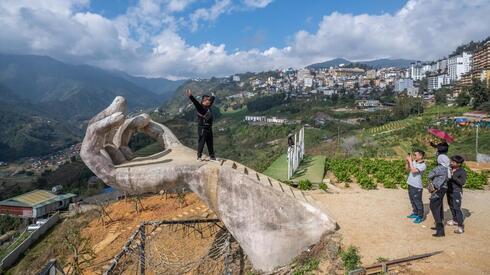
Travel blogger Yonatan Herskowitz says Sapa’s rice terraces and mountain views lived up to the hype, but the promised encounter with local culture felt staged, commercialized and built around touristsAssaf Kamar|When Yonatan Herskowitz climbed the narrow trail toward a picturesque village in northern Vietnam, he still believed he was on his way to one of the most authentic experiences of his trip. A few hours earlier, he and his partner had left the center of Sa Pa, the iconic tourist town in Vietnam’s far north. They walked between green rice terraces, passed mountains and villages, and imagined the unusual evening ahead: a night in the real home of a local family from the mysterious Hmong community. He wanted to see how they lived, where they slept, how they cooked and what their lives looked like when tourists were not watching.At the end of the exhausting trek, they arrived at a modern building. “From the first second, it was clear this wasn’t really their home,” Herskowitz, 35, told ynet, laughing at the absurdity of the moment. “It was a new, orderly building that had been built for tourists. Later I understood that the host, the mama, was very successful and had built a guesthouse where she hosts travelers. Her children come there toward the end of the day, do some homework, cook with the tourists and then go back to sleep in their real home. It was a setting, a stage built especially for tourists. It felt like a show.”GalleryGreat for photos (Photo: Maodoltee / Shutterstock)He laughs again. “It didn’t really represent what I hoped to find.” He arrived in Vietnam after he and his partner quit their high-tech jobs, with the country serving as the second stop on their trip after China. Sapa was among the places he had most eagerly anticipated. Like many travelers before him, he came with a ready-made image in mind: rice fields cascading down mountain slopes, women in traditional dress, small villages wrapped in mist, dramatic scenery and the promise of authenticity.“On social media, you see a five- or seven-second clip,” he says. “It shows incredible scenery, and you arrive with very high expectations. I knew Sapa would be touristy, and that didn’t bother me. But I still expected to find some degree of authenticity. What I felt in Sa Pa was that the local culture had been packaged and turned into a tourist product.”This is what it looks like on Instagram (Photo: Yonatan Herskowitz)Sapa lies in northwestern Vietnam, not far from the Chinese border. For years, it has been considered one of the country’s most famous destinations: a mountain town surrounded by green peaks, striking rice terraces and remote villages belonging to ethnic minority groups. For many travelers, it is one of the most beautiful places in Vietnam. Herskowitz does not dispute that.“The nature around it really is amazing,” he says. “The mountains are very beautiful, the rice terraces are impressive, and in the right season, walking there is stunning. My disappointment wasn’t with the landscape, but with what was built around it.”“You walk for hours with the mama through the rice fields and mountains, and it really is beautiful,” he says. “But when you reach the village, you realize you are not actually staying in the home where the family lives. I wanted to sit with them, see where they sleep, how they eat and how they cook, to truly get a sense of their daily life. Instead, it felt like a guesthouse made to look like a local family home. The whole experience felt a bit staged.”Herskowitz says that distinction is central to the way he travels. “I always say I’m not looking for attractions, but for interactions,” he says. “Bungee jumping, ATVs or any other tourist activity can be fun, but that’s not why I travel. An interaction with a local person gives me a window into their life, their culture, something I would not have known otherwise. In Sapa, I felt that interaction with locals had been turned into another attraction.That same uneasy feeling followed him into the center of the town. For Hershkovitz, Sapa itself no longer felt like a Vietnamese town, but like a destination redesigned around tourists. “You walk through the town center and you don’t feel like you’re in Vietnam,” he says. “It feels more like a Disney park built for tourists with a Vietnamese theme. The streets are full of shops, tourist restaurants, English menus, pizza and hamburgers. Everything is extremely touristy.”Sapa street (Photo: Yonatan Herskowitz)Still, he says, travelers can find quieter, more local corners of Sapa if they are willing to make the effort. “We really tried to get away from the main street,” the travel blogger says. “After a few days, we found more local restaurants, places where the entire menu was in Vietnamese and there were no tourists around us. It felt completely different. But you really have to get out of the central area to find that.”One of the most absurd moments of the trip came in Cat Cat village, one of the best-known attractions in the Sapa area. Hershkovitz and his partner thought they were leaving the commercialized town behind for a small, authentic village where they might get closer to local life. Then, at the entrance, they were asked to pay.“That should have been a warning sign,” he says with a laugh. “But we said, fine, we’re already here. We hadn’t done any research, so we just paid and walked in.”Very quickly, they realized they had arrived somewhere entirely different from what they expected. “Cat Cat is basically a village that is one big exhibition,” Herskowitz says. “There are dance performances, demonstrations of traditional crafts, reconstructed buildings, a kind of recreation of ‘how the locals once lived.’ The place itself is beautiful, with a valley, a waterfall and nature all around, and it’s pleasant to walk through. But when you come looking for something living and real, and instead find an open-air museum, it’s hard to connect.”Here too, he is careful not to dismiss the place entirely. “We saw an older woman using her feet to operate a traditional weaving device for making a rug,” he says. “I’m sure those methods have a fascinating history, and I’m sure the dances have cultural meaning too. These things interest me. But when they come inside that kind of setting, like a display for tourists, it feels different. It wasn’t the encounter I was looking for.”If Cat Cat represented the commercialization of local culture, the popular photo park in town, in his view, represented the commercialization of the scenery. “There’s a small park in central Sapa with statues and photo stations,” he says, with evident irony. “There’s a huge concrete hand you can climb onto for a picture with the mountains behind you. There are swings, wings and all kinds of setups like that. The view in the background really is amazing, with green, beautiful mountains, but you stand in line with 50 other people, take the picture and move on to the next station.”‘Bali’s Heaven Gate’ at Moana Sapa photo park (Photo: Kanchana P / Shutterstock)Worth it for the photos alone (Photo: Yonatan Herskowitz)A kind of open-air Instagram museum (Photo: Yonatan Herskowitz)For Instagram enthusiasts, he admits, the park probably does exactly what it promises. “It may be a must-visit for anyone looking for photos,” he says. “The pictures come out beautifully because the backdrop is beautiful. But if I want a good photo of the mountains, I’ll just go to the mountains. I don’t need to pay money to stand next to a concrete hand with a mountain behind it, waiting in line with dozens of other people.”And yet, Hershkovitz is not telling travelers to avoid Sapa. Instead, he says they should arrive with the right expectations and understand what kind of trip the town offers. “If someone is looking for beautiful nature, rice terraces, the cable car to Mount Fansipan and plenty of tourist attractions, they can really enjoy Sapa,” he says. “There is a reason this place is so popular. The scenery really is impressive. But anyone looking for a deep, authentic local experience should know that they are not necessarily going to find it in central Sa Pa or at the best-known attractions.”He found the most beautiful part of his visit to the mountains only after leaving the town. “We rented a motorbike and just left Sapa,” he says. “The moment you get out of the tourist bubble, you are exposed much more to the real rural life of the area. You don’t even have to plan too much. Go right, go left, move away from the center. The people are kind, and there is a lot to see.”Stunning scenery. It was worth getting away from the town (Photo: Yonatan Herskowitz)Despite the criticism and disappointment, Hershkovitz is careful not to frame his experience as an indictment of the locals.“There’s nothing wrong with it,” he says. “At the end of the day, this is their livelihood. There is an audience for it, and many people enjoy it very much. You just need to know what you’re getting into before you go. I left disappointed, but that was partly my fault too. I came with certain expectations and got something else.”
‘Full of tourist traps’: Israeli traveler questions Vietnam’s most hyped mountain town
Travel blogger Yonatan Herskowitz says Sapa’s rice terraces and mountain views lived up to the hype, but the promised encounter with local culture felt staged, commercialized and built around tourists
1,541 words~7 min read