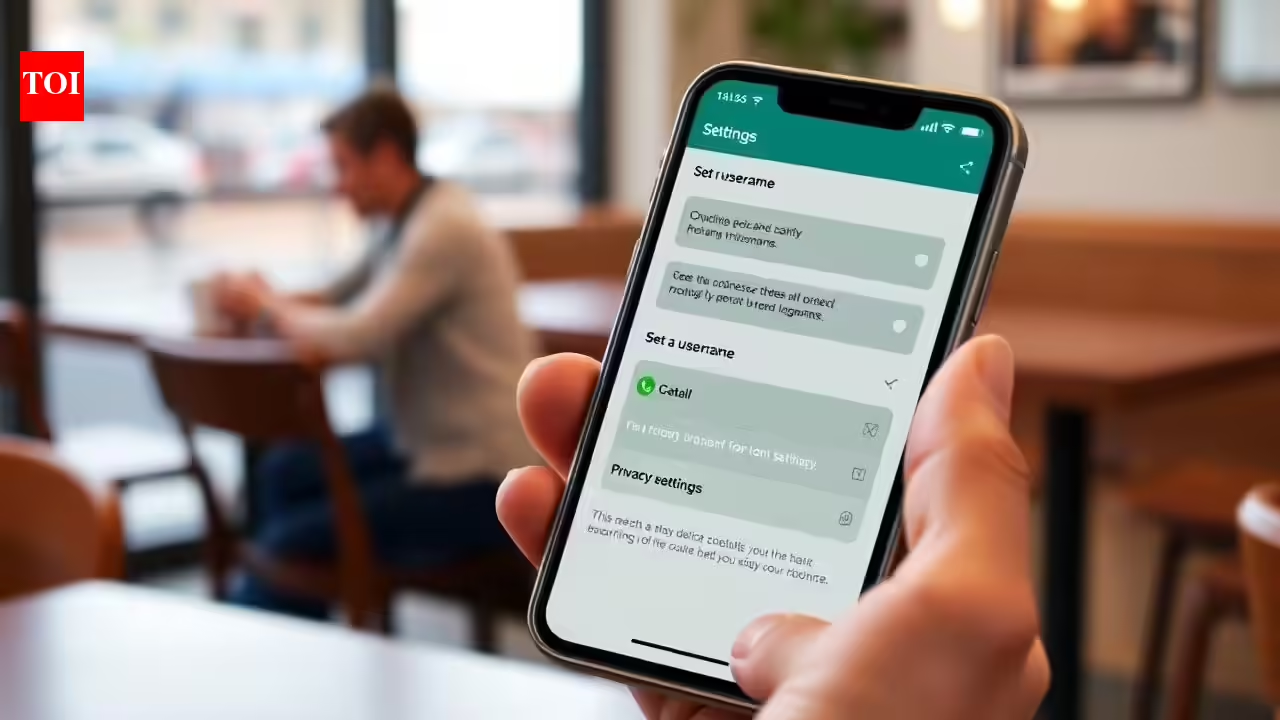
Two days after WhatsApp announced a new username feature, the government wants to know what it means for a country where cyber scams already run on hidden identities.The Ministry of Electronics and Information Technology (MeitY) issued a notice to WhatsApp on Wednesday. (AP Photo)WhatsApp’s username feature promises a way to message someone without handing over a phone number — a genuine privacy upgrade, and one users on rival apps have had for years.The Ministry of Electronics and Information Technology (MeitY), which issued a notice to WhatsApp on Wednesday, has sought the answer to a narrower question: in a country where scams run on impersonation and untraceable numbers, does that same privacy feature also make it harder to trace who is behind the message?The ministry has given WhatsApp three days to explain and asked the company to hold off on a full rollout until consultations are complete. The reservation phase, a step that lets users claim a handle ahead of the feature’s launch, falls outside that hold and remains open.It isn’t the first time that ministry has raised this concern. Before courts, the government has flagged Telegram’s own username system as vulnerable to the same abuse. But the difference this time may come down to scale. WhatsApp has a worldwide user base at least three times larger than Telegram’s.On Wednesday, Hindustan Times also reserved the handle @dcp.north, styled on a real Delhi Police designation, without any block from WhatsApp. Former Delhi deputy chief minister Manish Sisodia, on X, raised a similar concern.Meta, in a statement, said a phone number will continue to sit behind every username and can still be traced. What it hasn’t said is whether a reserved handle is checked another time before it goes live.Also Read | How does WhatsApp's new username feature work? Here's how you can chat without phone numberWhat is the feature?Usernames let a WhatsApp user create a handle — an @-tag — that others can message on, instead of a phone number. The number stays attached to the account behind the scenes, but it stops being visible to other users.WhatsApp has framed this as a privacy tool, a way to connect with strangers, sell online or share a contact detail without having to give a personal number. The feature will be optional, and WhatsApp has said it will roll out gradually through the rest of this year, including in India.What users have been allowed to do so far?WhatsApp is not yet issuing usernames outright. It has opened a reservation window that lets a user claim a handle ahead of the feature’s rollout.A reserved username does not mean it is final, but WhatsApp hasn’t said whether those handles reserved will face a second round of review before they are activated.The company’s ‘help documentation’ says that names tied to public figures, brands, organisations and government bodies “may be restricted or reserved for the legitimate owner” — a suggestion of some built-in check against impersonation.A WhatsApp spokesperson said of the safeguard, “To protect against impersonation, we’ve held the highest-profile names — think public figures, government entities, celebrities, verified Meta accounts — so they can only ever be claimed by their legitimate owners and lookalike derivatives of known names are held as well.”The government’s concernsMeitY’s concerns relate to the potential use of the messaging app by cyber fraudsters.The Department of Telecommunications has raised a separate worry: how usernames will sit alongside its SIM-binding directive, which requires messaging platforms such as WhatsApp, Signal, Telegram, Arattai and Snapchat to link accounts to physical SIM cards for traceability.A DoT official had told HT the core risk was jurisdictional. A handle built to resemble a real designation, registered against a foreign number, would be far harder for Indian law-enforcement agencies to act on than one tied to a +91 number. The same official pointed to WhatsApp’s response time to law-enforcement requests — a minimum of five days, sometimes longer, with no immediate data-sharing.Meta’s response to this has been that a phone number remains mandatory at registration, and will be traceable, ensuring accountability.Also Read | How to reserve your WhatsApp username: A step-by-step guideWhy the concerns hold upScale: Telegram, the platform with which officials have compared WhatsApp's move to, has around 1 billion active users by its own founder’s account. Against it, WhatsApp has roughly 3.3 billion users world over. Whatever risk a username feature carries will likely be tested at more than three times the population it was tested at before.How the scam model already works: Digital arrest and impersonation scams — in which fraudsters often pose as law enforcement officials such as police officers, CBI officials or judges over video calls — already rely on online users being unable to verify who they are actually speaking to. A username system that hides a number by design removes one more check a wary recipient might have used.The regulatory record: Police cybercrime units have earlier said that Telegram’s username-only visibility makes it substantially harder to identify suspects. DoT’s TIUE (Telecommunication Identifier User Entity) framework, which involves the mobile number revocation list and financial fraud risk indicator systems that flag and act on suspicious numbers, is also built around the number being visible and traceable across platforms.What HT found, what politicians are sayingHT on Wednesday reserved the handle @dcp.north, styled on a real Delhi Police designation. WhatsApp allowed it, with no block or warning. The designation is commonly used shorthand in local parlance rather than the formally registered name of a police entity, so the test may sit at the edge of any protected-names list rather than demonstrate a clean breach of norms.Former Delhi deputy CM Manish Sisodia also said on X that he could not reserve several combinations of his own name and his party, AAP. Similarly, independent researchers claimed to have reserved the handle @linkedin. HT could not independently confirm this.Meta’s responseMeta maintains that a phone number remains mandatory and traceable behind every username, preserving accountability even when the number is not visible to others. That answers the SIM-binding objection by DoT.But it does not fully answer the impersonation objection. An online user or a first responder acting on what they can see has only the handle, not the number behind it, until an investigation formally unwinds it — the same resolution-time gap DoT has already flagged.So far, Meta has not said whether a reserved handle undergoes further verification before the feature goes live, whether a protected-username/terms list exists and what it covers, or what happens to a reserved handle flagged as impersonation before launch.A WhatsApp spokesperson, however, has said that the company will use systems to detect abuse patterns and provide context such as account age, shared contacts or groups and location to give users more information.
Privacy for better, worse, or both? Why WhatsApp username feature worries the government & how the concerns hold up
WhatsApp’s username feature promises a way to message someone without handing over a phone number — a genuine privacy upgrade. | India News
1,116 words~5 min read