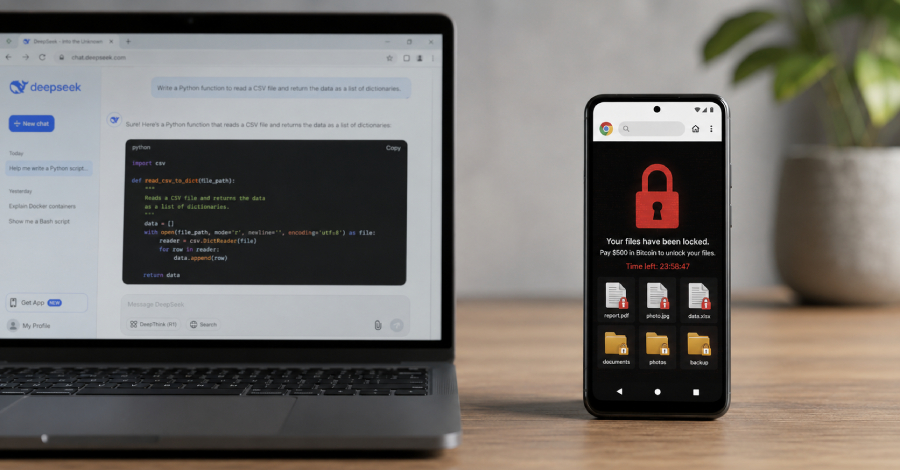
You can't ask most models to help you make "ransomware" directly, but many will be more than willing if you give them the right prompt. DeepSeek and other LLMs with fewer safety and security controls make theoretical cyberthreats - like browser-only ransomware - much more likely to be used in real-world infections, according to Check Point researchers.The Israeli cybersecurity company analyzed a DeepSeek-generated sample in a Wednesday report that its threat hunters describe as in-browser ransomware.Over the past year, the team has tracked almost 3,000 files attributed to DeepSeek, and classified nearly half (1,383 files) as malicious or dangerous using VirusTotal or static source analysis.
“Within this dataset, we found a sample that implemented a dangerous browser-native technique we have not observed exploited in the wild,” researcher Alexey Bukhteyev wrote. And while the sample was incomplete, and unable to pull off an in-the-wild infection, the security shop’s testing showed “little effort” would be required to make it attack-ready.“Our research shows that the original incomplete DeepSeek sample can be transformed into a fully functional attack with minimal effort,” Pedro Drimel Neto, malware analysis team leader at Check Point Research, told The Register. “Very little effort is needed,” Neto said. “Low-level expertise is sufficient. You don't need to be a sophisticated cybercriminal or advanced persistent threat group. In fact, we've already observed evidence of actual threat actors attempting this attack using straightforward LLM prompts.”Known threat gets an AI boostThe risk ransomware poses to browsers isn’t a new idea. The File System Access specification lists ransomware as a security consideration, and a 2023 USENIX Security paper on Ransomware over Modern Web Browsers described how File System Access API could be abused to encrypt local files from a malicious web application.The File System Access API is a browser capability, primarily supported by Chrome and Chromium-based browsers, that allows developers to build web applications, such as editors, IDEs, and creative tools, that can read, write, and manage files on the user’s local device.“Even though it can be used to develop rich web applications, it greatly extends the attack surface, which can be abused by adversaries to cause significant harm,” Google’s Güliz Seray Tuncay and Florida International University researchers Harun Oz, Ahmet Aris, Abbas Acar, Leonardo Babun and Selcuk Uluagac wrote in 2023, long before LLMs could develop working malware and attack chains.