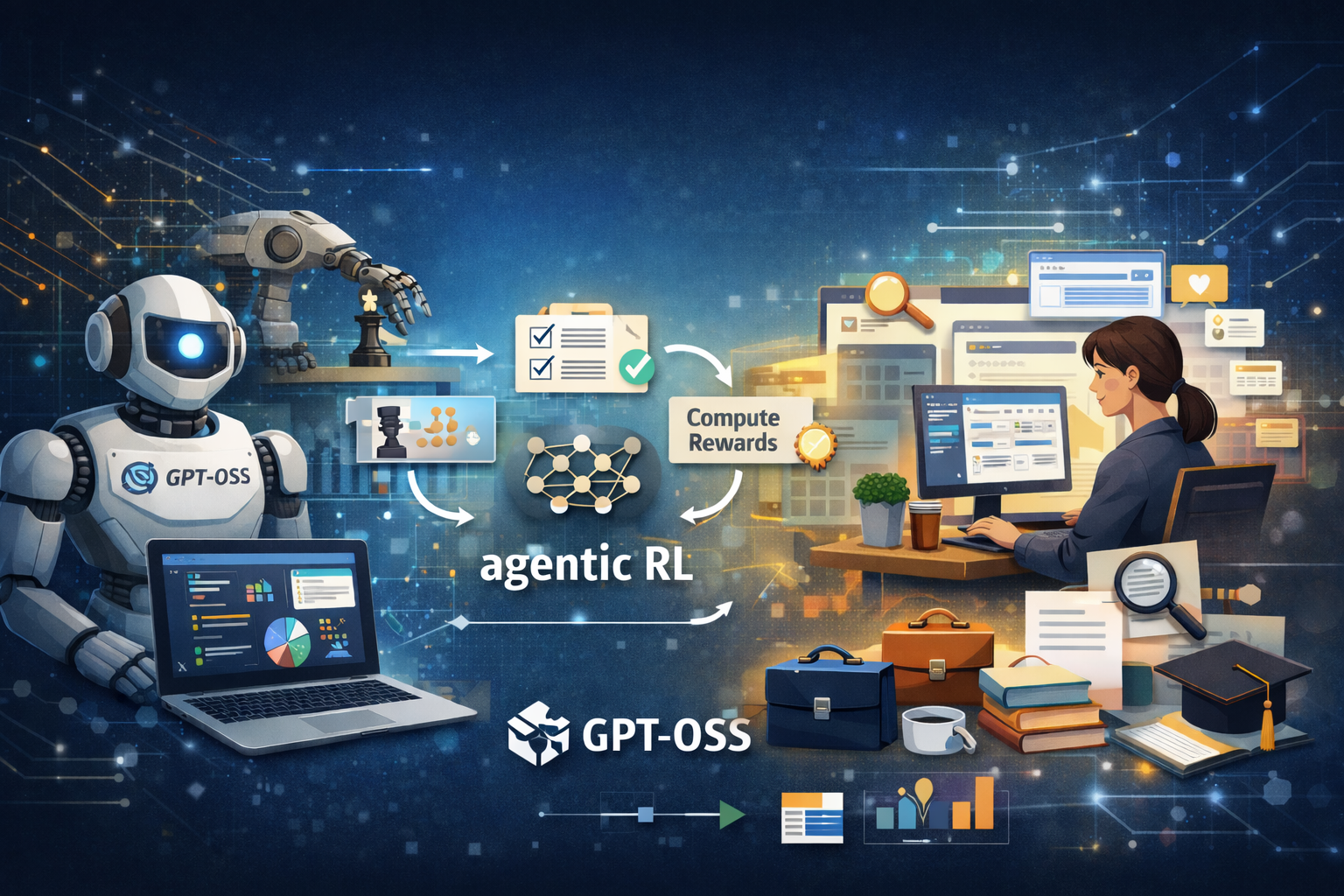
Reinforcement learning (RL) is central to aligning language models, from reinforcement learning with human feedback (RLHF) within AI assistants to newer reinforcement learning with verifiable rewards (RLVR) workflows for reasoning and agent tasks.
RL is now becoming a practical technique for specialized AI where enterprises need more accurate agents for domain-specific workflows. Open models provide more control over data, IP, and deployment, while RL turns domain success criteria into training signals.
Frontier labs have shown RL can improve general model capabilities. OpenAI trained their o-series models with large-scale RL, and DeepSeek-R1 showed how group relative policy optimization (GRPO) and verifiable rewards improve math, code, and reasoning behavior.
NVIDIA Nemotron 3 Super was post-trained using multi-environment RL across 21 NVIDIA NeMo Gym verifiers and 37 datasets, generating about 1.2 million environment rollouts.
This guide helps model-builders, research teams, and agent developers decide when to use RL and how to run a first verifiable RL training loop for long-running agents.