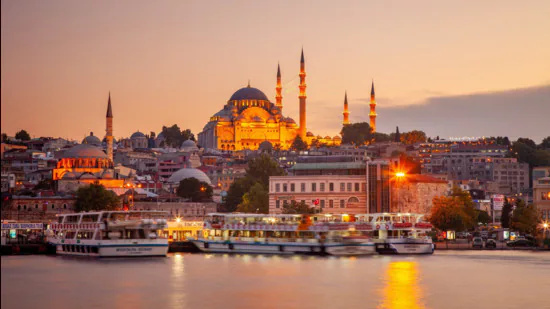
A good holiday doesn’t necessarily begin with a passport. In an age shaped by rushed itineraries and, readers are quietly reclaiming a slower, more intimate way of seeing the world: through page-turners and destination book clubs.Istanbul (Courtesy Expedia)Across Tuscan hillsides, England’s historic pubs and Kyoto’s quiet ryokans, readers are gathering to travel together, yes, but also to read together. What binds them is the shared love for a book and the belief that it can reveal more about a place than any checklist ever could. To trace Elena Ferrante’s Naples with her sentences echoing in your head, or to debate James Joyce over a pint in Dublin, is to let literature act as both map and lens.Fuelled in part by post-pandemic fatigue with fast tourism, destination book clubs offer a deeper connection: to place, people, and ideas. Days typically involve literary walking tours, museum visits, and long lunches; evenings are often spent in discussion, wine bottles circling as much as opinions do.Boutique operators such as Books in Places, Enchanted Book Club and Storyteller Cruises are catering to this appetite, curating programmes that combine guided literary walks, moderated discussions, local cuisine and, at times, meetings with writers, booksellers or academics. But many bookish journeys also remain informal escapes where the only fixed point is the novel in your bag.Paul Wright, founder of Books in Places, describes the appeal simply. His travelling book club discusses books in the locations they’re set, and he believes these trips work because people arrive with common ground already established. “They know they’re going away with like-minded readers and already have something to talk about — the book,” he says.What began as a modest experiment has grown quickly. “I started in 2023 with one trip to Florence,” Wright explains. “In 2024, I ran seven trips. In 2025, that went up to 24, with some filling up within 24 hours of being announced.” This year, the demand is higher than ever, across ages and backgrounds. All participants share a desire to inhabit a story, by walking its streets, tasting its food, and observing where fiction and reality blur.Destination book clubs remind us that reading is never entirely solitary. Stories expand when shared, and places feel richer when encountered together through narrative.Diana Gabaldon’s ScotlandFew contemporary novels have reshaped literary tourism as dramatically as Diana Gabaldon’s Outlander series. What began in 1988 as what Gabaldon once called a “practice novel” — “All I had was the rather vague image of a man in a kilt” — has grown into a nine-book saga, with a tenth on the way, and a television adaptation that concluded recently.Scotland is more than a backdrop in Outlander; it is a shaping force. The misty Highlands, wind-scoured moors, stone circles, and austere castles lend the story emotional and historical heft. Destination book clubs here move between fiction and fact: Culloden Moor, where Jacobite dreams collapsed; Doune Castle, which stands in for Castle Leoch; and Fort William, Inverness and Linlithgow Palace, each part of history as well as the Outlander trail.The standing stones of Craigh na Dun may be fictional, but travellers often visit the Callanish Stones on the Isle of Lewis. Reading Outlander in Scotland sharpens the emotional stakes as the landscape does half the storytelling.James Joyce’s Dublin“For myself, I always write about Dublin,” James Joyce famously said, “because if I can get to the heart of Dublin I can get to the heart of all the cities of the world.” Few places wear their literary heritage as naturally as the Irish capital.A Joycean journey often begins at the National Library of Ireland, home to manuscripts and letters by Joyce, Yeats and Seamus Heaney. Nearby, the Museum of Literature Ireland, housed in UCD’s historic Newman House where Joyce once studied, offers immersive exhibitions and holds a prized first edition of Ulysses.Literary pilgrimages continue to Sandycove, where the Martello Tower that opens Ulysses stands above the sea, and to the James Joyce Centre in a Georgian townhouse in the North Inner City. Marsh’s Library and Trinity College’s Old Library (home to the Book of Kells) round out the trip.F Scott Fitzgerald’s New YorkIn The Great Gatsby, New York shimmers with promise and excess, a city of reinvention that is also quietly cruel. Fitzgerald’s Manhattan dazzles with hotels, restaurants and glittering parties, while just beyond it lies the “valley of ashes”, a stark reminder of the cost of ambition.Literary travellers can still walk between these worlds. Jazz Age walking tours through Midtown trace Fitzgerald and Zelda’s haunts, from Times Square to the Plaza Hotel, revealing how fiction and biography intertwine.“I began to like New York, the racy, adventurous feel of it at night, and the satisfaction that the constant flicker of men and women and machines gives to the restless eye,” Fitzgerald writes.Reading Gatsby in New York heightens its melancholy: the city’s energy remains intoxicating, but its illusions are easier to see through when you’re standing where they were born.“The city seen from the Queensboro Bridge is always the city seen for the first time, in its first wild promise of all the mystery and beauty in the world,” Fitzgerald writes.Elena Ferrante’s Naples To read Elena Ferrante’s Neapolitan Quartet in Naples is to abandon any lingering notion of the city as picturesque. “This city is not any place, it is an extension of your body, a matrix of perception; it is the basis for the comparison of every experience. All that has been significant for me over time has Naples as its scenery and sounds in its dialect,” Ferrante writes.That tension, between love and suffocation, belonging and escape, becomes visceral as readers move through the neighbourhoods that shaped Lila and Lenù.Much of the quartet is rooted in Naples’ working-class rioni, where cramped apartment blocks, drying laundry and sudden beauty coexist with volatility. Book clubs often begin in areas such as Rione Luzzatti, long associated with Ferrante’s fictional neighbourhood, before drifting towards the historic centre: Spaccanapoli slicing the city in two, Piazza del Plebiscito opening into grandeur. The contrasts mirror the novels’ social divides: education versus instinct, ambition versus loyalty.Ferrante’s Naples is intensely physical. “Naples had seemed a wave that would drown me. I didn’t think the city could contain life forms different from those I knew,” she writes.Elif Shafak’s IstanbulIstanbul resists singular narratives, as so do Elif Shafak’s novels. “The city has many layers,” she writes, “like a palimpsest — each era scribbling over the last, never fully erasing it.” Reading Shafak here feels like stepping inside that palimpsest, where histories overlap and voices argue across centuries.Literary travellers often trace routes that reflect her themes of belonging and fracture: the call to prayer in Sultanahmet, the cafés of Beyoğlu, the quieter streets of Üsküdar on the Asian side. Crossing the Bosphorus by ferry, glass of tea in hand, becomes a lived metaphor for Shafak’s focus on borders, hybridity, and exile.Characters in The Bastard of Istanbul and 10 Minutes 38 Seconds in This Strange World carry suppressed histories and challenged identities. “Then there was the Istanbul of those who had left long ago, sailing to faraway ports. For them this city would always be a metropolis made of memories, myths and messianic longings, forever elusive like a lover’s face receding in the mist,” Shafak writes.Anne Rice’s New OrleansNew Orleans lends itself instinctively to literary immersion. Its iron-laced balconies, humid nights and slow decay feel inseparable from Anne Rice’s gothic imagination. “[New Orleans] seemed at all times like a dream in the imagination of her striving populace, a dream held intact at every second by a tenacious though unconscious collective will,” Rice wrote.Travellers often begin in the French Quarter, where Rice set much of Interview with the Vampire. Strolling past St Louis Cathedral at dusk or wandering Lafayette Cemetery No. 1, the city’s relationship with death feels ceremonial rather than morbid. The above-ground tombs echo Rice’s fascination with immortality and longing. Book clubs here move from cemetery walks to late-night jazz, tuning into the city’s cadence.Haruki Murakami’s Tokyo Tokyo can feel uncanny even without Haruki Murakami. With him, it sharpens into something dreamy yet precise. “Between the time the last train leaves and the first train arrives, the place changes: it’s not the same as in daytime,” Murakami writes.Destination book clubs here mirror Murakami’s rhythms. Mornings might involve quiet reading in a café in Shinjuku or Shimokitazawa; afternoons, solitary wandering through backstreets where vending machines hum and jazz echoes from basement bars.Murakami’s Tokyo is populated by listeners and loners, people attuned to small shifts in sound and mood. “I think 90 percent of Japan’s writers live in Tokyo. Naturally, they make a community. There are groups and customs, and so they are tied up in a way,” he once said.Walking neighbourhoods such as Koenji or Meguro, readers find that literary travel here is introspective and slow.Teja Lele is an independent editor and writes on books, travel and lifestyle.
Reading the world: On destination book clubs
In an age of rushed itineraries and algorithm-led travel, they offer a quieter alternative, encouraging groups of readers to explore cities through stories
1,478 words~7 min read