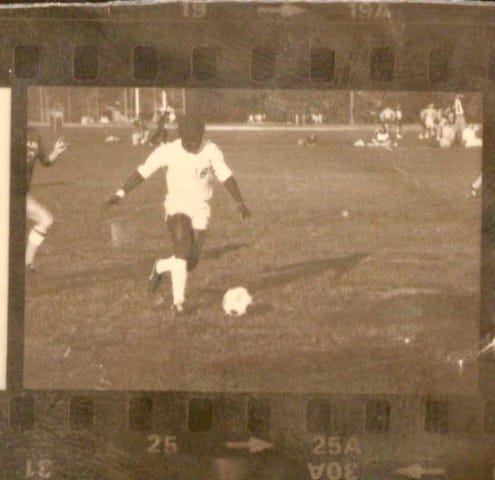
We have World Cup fever and the only prescription is…literary stories about soccer! Longtime Narratively contributor Jonathan Williamson, also chief content officer of the soccer-obsessed media company Men in Blazers, brings us this very fun and touching story about a future legend whose speed on the pitch was nothing compared to the voice that floored her teammates on a road trip.The photograph is grainy. A player streaks down the field in an all-white uniform. At her feet, a distinctly black and white paneled soccer ball, the kind no amount of lo-res could render unrecognizable. Her opponent, only partially in frame, gives chase. A number of people line the field, hands protecting their eyes from the sun, watching this woman.Tracy Chapman. THE Tracy Chapman.The photograph arrived in my inbox with a message.“I have finally received a response from the Tufts University Archive regarding Tracy Chapman’s involvement in soccer.”At Men in Blazers, the largest soccer-focused media network in North America, Tracy Chapman is held in the same rarified air as Lionel Messi. Not just a generational talent, but the Greatest of All-Time. Our CEO, Roger Bennett, has spoken about how “Fast Car,” with its longing and melancholy, reflects a lot of what it’s like to be a football fan.With the World Cup finally here, and soccer on all our minds 24/7, we tracked down the coach of that 1982 Tufts women’s soccer team, Bill Gehling. The avuncular New Englander spoke about Chapman’s single season with The Jumbos with fondness and reverence. He also passed along contact information for several of her teammates. No surprise that Tracy looms large in their minds too. It led to hours of conversations with members of that 1982 team that won nine, lost three and tied one. They all recalled a mild, unassuming freshman, armed with astonishing speed and a guitar she carried on away trips. The one memory they all shared: the first time they heard her sing.Women’s College Soccer in the early ’80s…Bill Gehling: It was the early years of women’s soccer. There may have been eight or 10 varsity programs in New England. And Tufts was among the very first. It was really in the budding years of the sport.Heather Sibbison: It was not yet the era when women were getting recruited from high schools. It was an era where you play because you love to play.Bill Gehling: We were really on the ground floor, women getting to play the sport in high schools, it was starting to grow. But even some of the players who played for me played on boys high school teams because girls high school teams weren’t available.Heather Sibbison: They didn’t even make soccer shoes for women.Bill Gehling: It was really, really the very, very beginning. And it was exciting to be part of it.Lisa Raffin: Playing at Tufts was like having an instant group of friends and an instant community. Playing sports at the Division III level, at Tufts, meant that you worked hard at your studies, you worked hard at your schoolwork, and then playing sports kept your framework together.Enter a Freshman named Tracy Chapman…Bill Gehling: She would have just signed up and said she was interested in trying out. We would have run three or four or five days of tryouts. And she had to beat out the others in the pool.Jen Luscher: Even though nobody was cut, we still had tryouts. Not enough players back then.Nicole Crepeau: Tracy and I were fabulously unskilled coming in as players, but athletic.Lynn Roth: Tracy had that great speed, but she could have used a few more foot skills.Bill Gehling: She came in and she was a fantastic athlete, super strong, super fast. Limited soccer skills at the time. But that was not rare, right? Most players in the team were relatively limited in the soccer skill area. But she was competitive. She was tough.Heather Sibbison: We were doing these drills and I remember thinking, “Wow, she is really fast.” She, effortlessly, kicked my ass in a sprint drill.Nicole Crepeau: She just blew us all away.Bill Gehling: She played forward for us.Lisa Raffin: I played the middle of the field and she played on the right side. I could feed her the ball down the line and she would streak and then be able to cross the ball back, feed it back in. I remember being like, “Wow. I could never do that.”Heather Sibbison: I can’t remember her ever yelling on the field, or talking much. She was very quiet. But very positive on the field and on the bench as well.Bill Gehling: She was an exceptional athlete, but just a solid soccer player. She was tough. She was aggressive. But off the field, she was as sweet of a person as you would ever see.Tracy Chapman, the human being…Bill Gehling: A delightful human being. She was a really, really kind, quiet person, who was also extremely driven inside.Lynn Roth: I know she came from the Ohio area, I believe. Cleveland. She didn’t say much. She led us to believe that she didn’t come from great means. So being at Tufts, it may have been a struggle a little bit. Not academically, not socially, but it’s just hard because I don’t think she came from the same economic background.Nicole Crepeau: I still remember this so clearly. Off the field, on campus. I can’t remember her wearing anything other than chinos, a pinstriped Oxford shirt, and penny loafers with pennies in them.Lisa Raffin: She was very quiet and very private. When you did get a chance to speak with her and get to know her, she had a very soft demeanor and a great sense of humor.Heather Sibbison: She was quiet with a lot of strength of character.Nicole Crepeau: She has one of the best smiles I’ve ever seen. Great attitude on and off the field. Very private person. Unlike most 18-, 19-year-olds, she didn’t talk a whole lot about herself.A freshman with her guitar…Lynn Roth: Halfway through the season, we had an overnight trip to Maine.Heather Sibbison: It was a long bus ride away, and she brought her guitar on the bus, and I remember thinking, “Oh, isn’t that cute? The freshman’s going to sing some songs.” And, you know, you always hope they’re not going to embarrass themselves.Bill Gehling: I was a little bit of a guitar player and singer myself, you know? And so, I brought my guitar to sing a song, and I did. She opened her mouth.Heather Sibbison: Everybody just went, “Oh my God.” It was the first time I’d ever heard her sing. She was incredible. We knew she was incredible from the get-go.Bill Gehling: It literally took three seconds to realize this was something completely different. A whole different level. Her voice was incredibly deep and powerful.Nicole Crepeau: I had never heard a voice like it. It was just so powerful. Unique. Kind of mesmerizing for me.Heather Sibbison: I think we all were like, “There’s a lot more to Tracy Chapman than we realized.”Lisa Raffin: It just all blew us away. Just like, I think it gave us all this jaw-dropping moment of wow.Lynn Roth: But you could also see, I don’t think she was really comfortable with doing a whole lot of that initially. She was comfortable playing. You could tell she felt at ease playing. But I don’t think she wanted to be the center of everybody’s attention.Bill Gehling: Memories tend to be fluid. I have this strange memory of her singing “Fast Car.” Then I realized I don’t think she had written “Fast Car” yet. So it must have been something else.Lynn Roth: She played a couple different songs. I don’t recall what they were, but I do know I heard “Fast Car.”Lisa Raffin: We arrive at the hotel and everybody checks in and you come down the night before the game and you sit in the bar and have a beer.Jen Luscher: There was a gentleman playing in the bar, and he was taking a break.Heather Sibbison: We were all psyched up about Tracy singing on the bus.Jen Luscher: We asked if our friend could play while he was taking his break and he said, “Sure.”Heather Sibbison: These guys did a solid and thought it was cute that we wanted one of our players to sing.Lisa Raffin: She was reluctant to go up on stage. I think all of us sort of urged her on. There was an awkward moment where the guy, the guitarist, was a little bit reluctant to give up the mic.Jen Luscher: I think she played “Rocky Raccoon” by The Beatles. I think that’s the song that she played, but I know that she also played some of her own songs. It was just quiet and confident and artistic.Heather Sibbison: They became the backup band for Tracy on the set. And we were totally psyched, like “She’s one of ours.” All of a sudden, we all knew there was something going on there that was a lot bigger than the rest of us, and a lot bigger than playing soccer.Tracy Chapman’s Football Legacy…Bill Gehling: She only played that one year. She came to me and she said that she wanted to focus on her music. I didn’t say this to her, but I always joke that I told her, “You can do your music any time. You can only play soccer once.”Heather Sibbison: A couple years later, I was walking down the street in London, near a newstand, and there was a big, I think it was Time Out, a magazine cover with Tracy on the cover of it. And I was like, “Oh my God, it’s Tracy.” That was the next time I saw Tracy — on a magazine cover. I just thought, “Wow. Not a surprise, but how cool is that?”Nicole Crepeau: I was just proud of her, and of her success, and impressed. I don’t think she’s ever let anything go to her head. I don’t think she has ever taken anything for granted. And that really impresses me to this day.Lisa Raffin: I think throughout the years where she would be on awards shows and you could see her presence on stage when she’s singing is just pure, so pure and beautiful. I wanted to call her up, but I’m like, “Maybe she won’t remember me. Why would she remember me?” It’s been so many years.Bill Gehling: It’s a wonderful story to tell. I think that’s really what it comes down to. Coaching sports allows you to have a really unique interaction with students, whatever level you coach on. It’s not just about sport, right? It’s about getting to know people. It’s about building a team. It’s about things that can have a big impact on people’s lives down the road, and you build a special bond.Jen Luscher: It’s my claim to fame, right? When anyone asks, “Do you know anyone famous?” I say, “I know Tracy Chapman.”Jonathan Williamson is the chief content officer at Men in Blazers Media Network, where he oversees all television, digital, podcast and written (newsletter and website) content. He has spent the last 11 years helping the company grow from a cuddly television show filmed in a closet into the No. 1 soccer-focused media organization in North America. Read his World Cup Diary in Men in Blazers Newsletter. And follow him on Instagram and X.
Give Me One Season to Play Here: Tracy Chapman’s Year on the Soccer Field
Before the Grammys and global fame, the singer-songwriter spent a college season on the field—just as women’s soccer was finding its footing—and left her teammates speechless when she finally sang.
1,898 words~9 min read