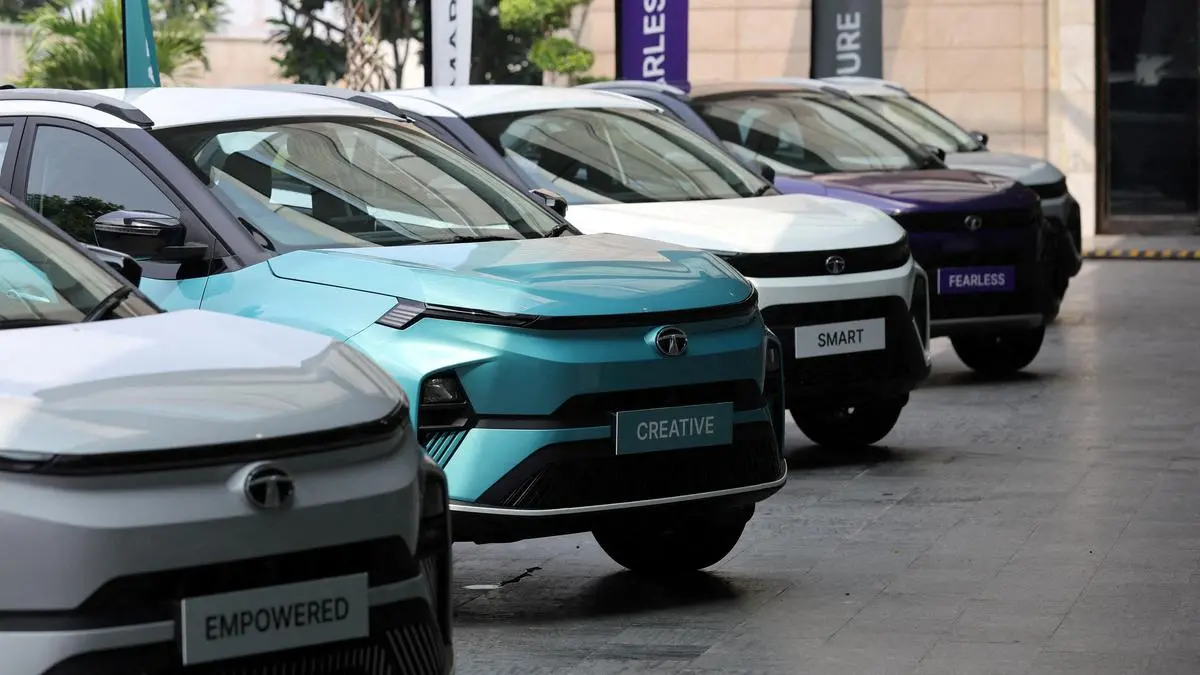
Tata Motors Passenger Vehicles (TMPV) retained its leadership with 32,283 registrations
India’s retail electric passenger vehicle (PV) registrations increased 89.3 per cent year-on-year to 82,737 units in the April-June quarter of FY27 from 43,710 units in the corresponding quarter of FY26, according to Vahan data, signalling that India’s transition from internal combustion engine (ICE) vehicles to electric mobility is entering a broader, more mainstream phase.Tata Motors Passenger Vehicles (TMPV) retained its leadership with 32,283 registrations, while Mahindra & Mahindra (M&M), MG Motor, Maruti Suzuki and VinFast all expanded electric vehicle (EV) sales, reflecting demand across a wider range of vehicle segments rather than being concentrated in a handful of premium models.Momentum also strengthened through the quarter. Retail registrations rose 9.4 per cent month-on-month to 27,320 units in May 2026 from 24,963 units in April, before climbing another 11.3 per cent to 30,414 units in June from 27,320 units in May, indicating that demand continued to build rather than fade after individual product launches. Growth also significantly outpaced that of the overall PV market.TMPV drives EV growthThe broadening market is evident across manufacturers. TMPV registered 32,283 electric PVs during Q1 FY27, up 104.4 per cent from 15,794 units a year earlier, giving it a 38.9 per cent market share.M&M nearly doubled registrations to 20,112 units (10,144 units), an increase of 98.3 per cent, while MG Motor posted 16,502 registrations (13,499 units), up 22.2 per cent. New entrants Maruti Suzuki and VinFast added 4,894 and 3,973 registrations, respectively, demonstrating that industry growth is no longer concentrated in a single manufacturer or product category.Distinct segmentsThe retail data mirrors a structural change that automakers are now observing in the market. Speaking on the sidelines of the Sierra EV launch, TMPV Managing Director Shailesh Chandra said India’s EV market has evolved from one driven by early adopters into one with demand spread across four distinct price bands.According to him, the entry-level segment below ₹12 lakh now has intrinsic demand of more than 10,000 vehicles a month, while compact EVs, mid-size electric SUVs and premium EVs each contribute another 7,000-8,000 units a month. Instead of one niche market, India now has four sizeable EV segments developing simultaneously.That evolution is also changing manufacturers’ sales mix. At TMPV, EVs accounted for 18.5 per cent of PV retail registrations in Q1 FY27, up from 12.6 per cent a year earlier, meaning nearly one in every five Tata PVs registered during the quarter was electric. M&M’s EV mix rose to 12.2 per cent, while Maruti Suzuki, Hyundai, Kia, and Toyota continue to derive the overwhelming majority of their registrations from ICE models, highlighting the uneven pace of electrification across the industry.Chandra said the median price point of India’s PV market has steadily shifted towards ₹15 lakh, making the mid-size SUV segment one of the fastest-growing parts of the market. That helps explain why manufacturers such as TMPV, M&M, MG Motor and newer entrants are rapidly expanding their electric SUV portfolios to address a much larger addressable market.Accelerating demandMonthly registration data reinforces the trend. TMPV’s EV registrations increased 10.6 per cent to 12,025 units in June from 10,870 units in May, while M&M’s registrations rose 16.9 per cent to 7,645 units (6,542 units). Maruti Suzuki’s EV registrations climbed 14 per cent to 1,896 units (1,663 units), suggesting growth is becoming broad-based rather than rotating between individual product launches.Supply constraintsThe industry’s biggest challenge is also changing. For much of the past decade, the key question was whether Indian consumers would embrace EVs. Chandra now argues that demand is running ahead of supply. He said TMPV is constrained by capacity limitations at select component suppliers rather than a lack of customer interest, with bookings exceeding production and the company working with suppliers to remove bottlenecks.Independent analysts see the same structural shift. According to Mihir Vora, Lead Analyst at Equirus Securities, electric PV penetration increased to 5.6 per cent in H1 CY26 from 3.6 per cent in H1 CY25, before rising further to 7.7 per cent in June 2026. The increase was driven by stronger consumer acceptance of electric SUVs and premium EVs, alongside improving ownership economics amid higher fuel prices.Vora expects the transition towards alternative powertrains to continue over the next 6-12 months, supported by new model launches, wider customer choice and favourable total cost of ownership. He said concerns over rare-earth magnet availability have eased after China relaxed export restrictions, while softer commodity prices have reduced cost pressures on manufacturers. Combined with resilient registration growth despite higher fuel prices, he believes the market is well positioned to sustain its momentum.Published on July 1, 2026