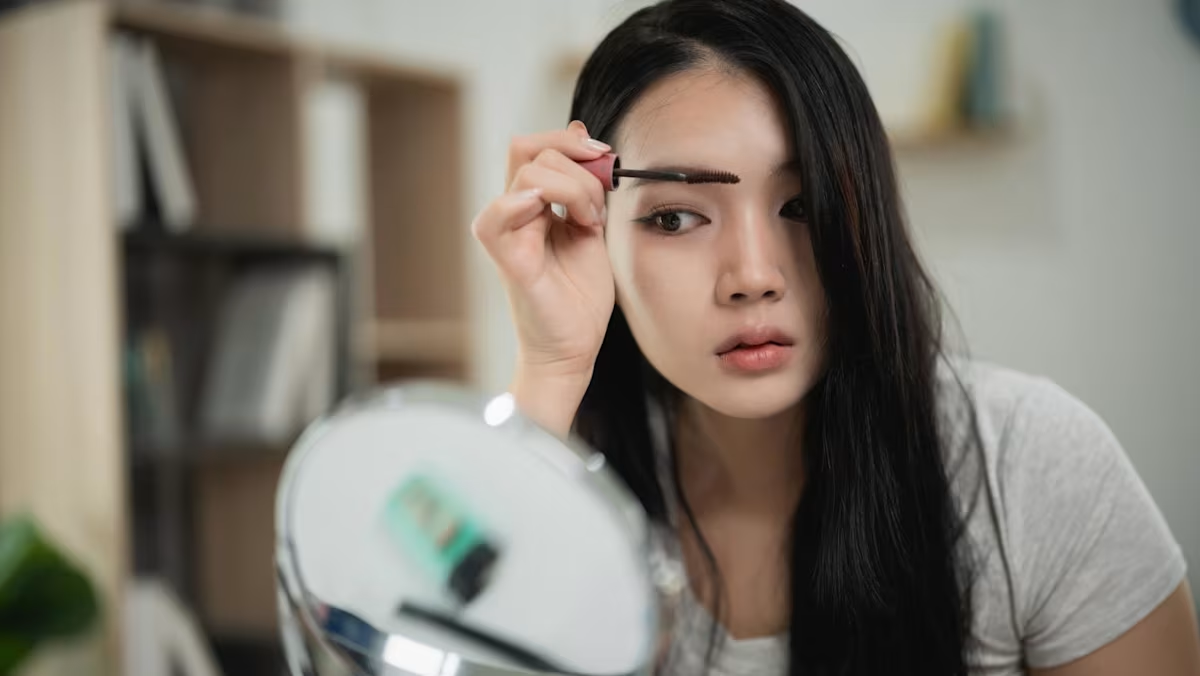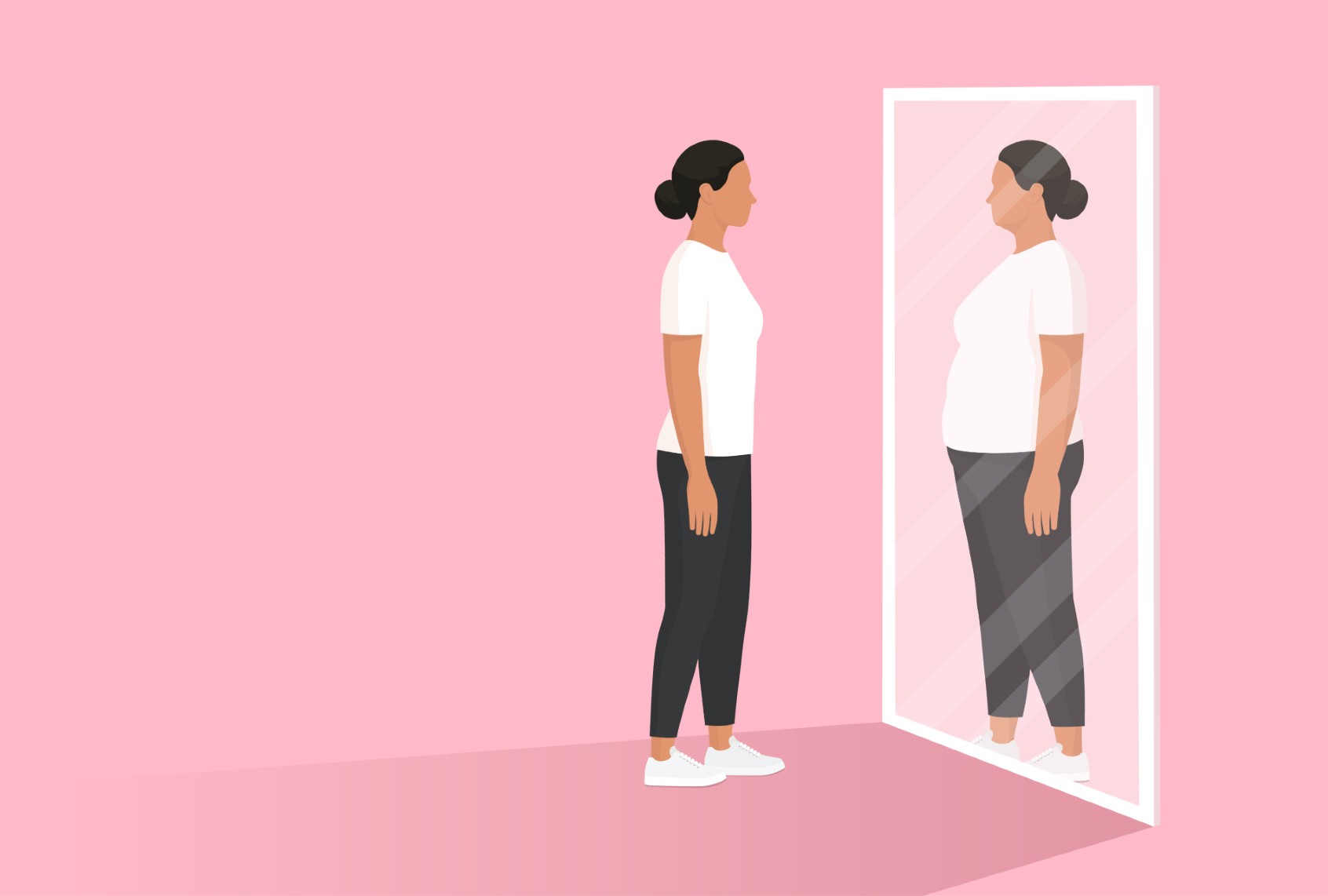
anorexia concept - woman looks at her fat reflection in mirrorgettyAsk most millennial mothers whether they want their daughters to love their bodies, and the answer is immediate and unambiguous. Yes, of course. Absolutely. These are women who grew up in the era of diet culture’s peak dominance in the 90s and early 2000s, when thinness was the unchallenged aesthetic ideal, low-fat everything lined the grocery shelves, and the word "fat" functioned as an insult rather than a descriptor. Many women remember what it cost them, and they are determined to spare their daughters the same.So, they use the language of body positivity. They say "all bodies are good bodies." They push back on diet talk at the dinner table. They buy books that celebrate diverse body shapes, and they correct their daughters when they say something critical about their own appearance.But then they stand in front of the bathroom mirror and whisper something else entirely to themselves. This is the quiet contradiction at the center of one of the most well-intentioned parenting impulses of this generation, and research suggests it may be more consequential than most mothers want to believe.What the Research Actually SaysThe relationship between a mother's body image and her daughter's has been studied for more than three decades, and the findings are remarkably consistent: it is one of the most significant predictors of how a girl will come to think and feel about her own body.A 2026 study published in Current Psychology found that when mothers convey supportive and positive messages about body image, girls are more satisfied with their bodies and avoid negative social comparisons. The inverse is equally well-documented: critical language, restrictive eating behaviors, and what researchers call "fat talk" — negative commentary about one's own or others' bodies — are associated with higher rates of body obsession and disordered eating in daughters.MORE FOR YOUResearch published by Illinois State University examining intergenerational transmissions of body image found that body image and eating concerns passed down from mothers to daughters are more common when mothers themselves express an unhealthy preoccupation with their bodies. Crucially, daughters don’t just absorb what their mothers say to them, they absorb what they observe. For example, the mirror behavior, the sigh before putting on a swimsuit, or the comment about not being able to eat something because of their diet. Not to mention, the way a mother's face changes when she sees photos of herself.A study published in the Journal of Adolescent Research and additional research from the National Institutes of Health found that maternal self-esteem, specifically a mother’s general sense of her own worth, is a significant predictor of her daughter's social competence and emotional development. Body image and self-esteem are deeply intertwined. When a mother privately holds her body in contempt while publicly modeling acceptance, daughters are often perceptive enough to register both messages simultaneously — and the private one, the unspoken one, frequently wins.The Performance of Body PositivityThere is a term in psychology that is relevant here: cognitive dissonance, which refers to the discomfort that arises when our beliefs and our behaviors are in conflict. Many mothers of this generation are living in a sustained state of body image cognitive dissonance. They genuinely believe in body positivity as a value, and they genuinely struggle to embody it.This is not hypocrisy. It is the predictable outcome of being insolated in a pressure cooker of diet culture for the first two decades of their lives, and then being asked — by a cultural shift that happened largely after their formative years — to simply undo it. The problem is that internalized body shame does not respond to intellectual reframing alone. You can believe that all bodies are worthy and still flinch when you see yours. You can refuse to put your daughter on a diet and still quietly track your own calories. You can celebrate body diversity in the abstract and still feel a particular kind of dread when your body changes.For daughters who are watching, this split is confusing in ways they may not have language for yet. Research from the University of Delaware’s Department of Women and Gender Studies found that body image concerns resulting from social pressures are linked to lower self-esteem, depressive symptoms, and disordered eating in young women. The mothers in those young women’s lives are not just one source of that pressure , for many girls, they are the primary one. What daughters learn from watching their mothers is not the lesson their mothers intend to teach. It is the lesson their mothers' bodies teach without words.A More Complicated Picture for Women of ColorThe body image landscape for mothers of color -- and by extension, their daughters -- is layered in ways that the mainstream body positivity conversation has frequently overlooked. Research published in The Professional Counselor in 2025, drawing on 12 years of studies on body image and eating disorder pathology in Black American women, found that Black women’s body image ideals differ meaningfully from white-centered norms. Black cultural beauty standards have historically encompassed a wider range of body types including curvier, fuller figures which have been part of the aesthetic framework in ways that have offered some protection from the thin ideal. Studies have found that Black college women, as a group, report greater body satisfaction and lower rates of disordered eating than white women of comparable weight. But researchers caution against interpreting this as an absence of body image struggle. The same 2025 scoping review noted that being discrepant from one’s cultural beauty ideal, whatever that ideal is, remains a significant risk factor for disordered eating. Black women who navigate the tension between Black cultural beauty standards and white-dominant mainstream standards face what the research describes, drawing on W.E.B. Du Bois’s framework, double consciousness, in which pressure from two beauty systems simultaneously, neither of which was designed with their specific bodies in mind. Research published in Frontiers in Sociology in 2025 added another dimension, finding that skin color satisfaction is a meaningful predictor of body satisfaction and disordered eating risk in Black girls. Similarly, a 2022 longitudinal study tracking 1,213 Black adolescent girls found that when participants were dissatisfied with their skin tone, they were at greater risk of disordered eating, mediated by body dissatisfaction. For Black mothers whose own relationship with colorism, hair, and skin has been fraught, the question of what they are unconsciously modeling for their daughters becomes even more urgent. A mother who has made peace with her skin tone passes something to her daughter. A mother who has not does that too.What Real Change Actually RequiresThe body positivity movement has done meaningful cultural work. But the version of body positivity that circulates most widely on social media including the affirmations, the hashtags, the "love your body" messaging is largely a cognitive intervention. It speaks to the mind. It attempts to change what we think about our bodies.What research suggests is that what daughters most need from their mothers is not better messaging. It is witnessing genuine acceptance. The difference, as researcher Amanda Arroyo has noted, is between performing body positivity and embodying it and daughters, even very young ones, are skilled at detecting the gap. What changes outcomes for daughters is not being told their bodies are worthy. It is watching someone they love treat their own body as worthy, in the small daily choices that happen when no one thinks they are being observed. This is harder than teaching. It requires mothers to do work on themselves. Not for the sake of their daughters, but for themselves. Work that is often neither glamorous nor linear. It may involve therapy. It may involve confronting the messages that were installed in them by their own mothers. It may involve grieving the years they spent at war with their bodies before they knew there was another option.For millennial and Gen Z mothers, who are more aware of intergenerational trauma than perhaps any previous generation of parents, this is both a burden and an opportunity. They understand that cycles can be broken. They understand that what they received is not what they have to transmit, but understanding that is not the same as doing it.
We Are Teaching Our Daughters To Love Their Bodies. But What Are They Learning Watching Us?
Option A: Research has long confirmed that a mother's relationship with her own body is one of the strongest predictors of her daughter's. So what happens when the message we preach and the one we model are not the same?
1,367 words~6 min read