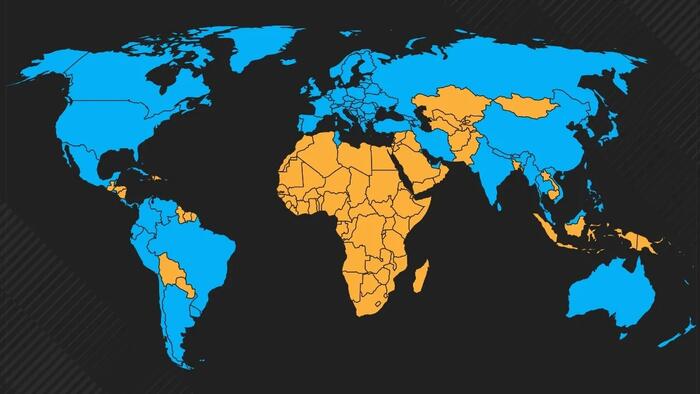
The world is becoming increasingly divided by fertility.One group of countries now has too few births to naturally replace its population, while another continues to see population growth driven by higher fertility rates. This demographic divide has major implications for aging populations, labor markets, immigration, and future economic growth.This map, via Visual Capitalist's Jeff Desjardins, shows which countries are above and below the replacement fertility rate of 2.1 children per woman, using projections for 2025 from the UN World Population Prospects 2024 Revision.While the regional patterns are striking, several countries buck the trend.Fertility Rates by CountryThe table below lists projected fertility rates for 2025 and whether each country falls above or below the 2.1 replacement threshold.CountryTotal Fertility Rate (TFR)Above or Below 2.1
(Replacement Rate)Chad5.94AboveSomalia5.91AboveDR Congo5.90AboveCentral African Republic5.81AboveNiger5.79AboveMali5.42AboveAngola4.95AboveBurundi4.68AboveAfghanistan4.66AboveMozambique4.62AboveMauritania4.56AboveMayotte4.50AboveTanzania4.47AboveBenin4.42AboveYemen4.41AboveNigeria4.30AboveSudan4.19AboveCameroon4.19AboveIvory Coast4.17AboveTogo4.07AboveUganda4.06AboveCongo4.05AboveGuinea4.04AboveEquatorial Guinea4.04AboveBurkina Faso4.00AboveZambia3.97AboveMadagascar3.84AboveEthiopia3.81AboveGambia3.80AboveLiberia3.79AboveComoros3.76AboveSamoa3.75AboveSenegal3.71AboveSouth Sudan3.71AboveGuinea-Bissau3.68AboveZimbabwe3.62AboveSierra Leone3.61AboveEritrea3.61AboveRwanda3.59AboveGabon3.54AboveMalawi3.53AboveVanuatu3.53AboveSao Tome and Principe3.53AbovePakistan3.50AboveSolomon Islands3.47AboveUzbekistan3.45AboveGhana3.30AboveFrench Guiana3.29AboveNauru3.25AbovePalestine3.19AboveIraq3.17AboveNamibia3.17AboveTuvalu3.14AboveKenya3.12AboveKiribati3.09AboveTonga3.07AbovePapua New Guinea3.03AboveTajikistan2.99AboveKazakhstan2.95AboveMarshall Islands2.82AboveIsrael2.75AboveKyrgyzstan2.75AboveEgypt2.71AboveGuam2.71AboveMicronesia2.71AboveEswatini2.68AboveAlgeria2.67AboveSyria2.66AboveBotswana2.66AboveLesotho2.64AboveTurkmenistan2.63AboveSaint Martin (French part)2.63AboveHaiti2.59AboveMongolia2.58AboveDjibouti2.58AboveJordan2.57AboveTokelau2.57AboveTimor-Leste2.56AboveCambodia2.51AboveBolivia2.50AboveOman2.48AboveNiue2.46AboveHonduras2.45AboveParaguay2.39AboveGuyana2.37AboveLaos2.36AboveSaudi Arabia2.29AboveNorthern Mariana Islands2.28AboveGuatemala2.26AboveLibya2.25AboveFiji2.25AboveAmerican Samoa2.25AboveLebanon2.21AboveSuriname2.21AboveFaroe Islands2.20AboveSouth Africa2.19AboveDominican Republic2.19AboveMorocco2.18AboveNicaragua2.18AboveWestern Sahara2.15AboveRéunion2.13AboveBangladesh2.11AboveIndonesia2.10AbovePanama2.09BelowMonaco2.09BelowMyanmar2.08BelowSeychelles2.08BelowUnited States Virgin Islands2.07BelowVenezuela2.06BelowGuadeloupe2.05BelowBelize2.01BelowCook Islands2.00BelowMartinique1.97BelowNew Caledonia1.95BelowIndia1.94BelowPeru1.94BelowNepal1.94BelowSri Lanka1.94BelowGreenland1.91BelowPhilippines1.88BelowVietnam1.88BelowGibraltar1.88BelowMexico1.87BelowPalau1.86BelowTunisia1.80BelowMontenegro1.80BelowEcuador1.79BelowGeorgia1.79BelowBahrain1.78BelowDem. People's Republic of Korea1.77BelowEl Salvador1.75BelowSt. Vincent & Grenadines1.75BelowBulgaria1.74BelowMoldova1.72BelowRomania1.71BelowArmenia1.71BelowBrunei1.71BelowQatar1.70BelowBarbados1.70BelowFalkland Islands1.69BelowIran1.67BelowAzerbaijan1.66BelowNew Zealand1.65BelowFrance1.64BelowAustralia1.64BelowSt. Helena1.64BelowUnited States1.62BelowTurkey1.62BelowColombia1.62BelowAruba1.61BelowBrazil1.60BelowIreland1.60BelowSlovenia1.58BelowAntigua and Barbuda1.58BelowSlovakia1.57BelowMaldives1.55BelowUnited Kingdom1.54BelowLiechtenstein1.54BelowMalaysia1.53BelowKosovo (under UNSC res. 1244)1.53BelowIsle of Man1.53BelowPortugal1.52BelowDenmark1.52BelowTrinidad and Tobago1.52BelowCayman Islands1.51BelowSt. Kitts & Nevis1.51BelowArgentina1.50BelowHungary1.50BelowSerbia1.50BelowKuwait1.50BelowBosnia and Herzegovina1.50BelowCape Verde1.50BelowIceland1.50BelowFrench Polynesia1.48BelowCzechia1.47BelowCroatia1.47BelowNorth Macedonia1.47BelowDominica1.47BelowRussia1.46BelowGermany1.46BelowGrenada1.46BelowCuba1.45BelowBonaire1.45BelowMontserrat1.45BelowNetherlands1.44BelowSweden1.44BelowSwitzerland1.44BelowBhutan1.44BelowTurks and Caicos Islands1.44BelowSint Maarten1.43BelowNorway1.42BelowBermuda1.41BelowLuxembourg1.40BelowWallis & Futuna1.40BelowBelgium1.39BelowUruguay1.39BelowSt. Lucia1.38BelowJersey1.38BelowCyprus1.37BelowEstonia1.37BelowGuernsey1.37BelowBahamas1.36BelowLatvia1.35BelowAnguilla1.35BelowGreece1.34BelowJamaica1.34BelowCanada1.33BelowAustria1.33BelowAlbania1.33BelowPoland1.31BelowCosta Rica1.31BelowFinland1.30BelowSaint Pierre and Miquelon1.28BelowJapan1.23BelowSpain1.23BelowBelarus1.22BelowLithuania1.22BelowItaly1.21BelowUnited Arab Emirates1.21BelowMauritius1.21BelowThailand1.19BelowSan Marino1.16BelowChile1.13BelowMalta1.11BelowAndorra1.10BelowCuracao1.07BelowBritish Virgin Islands1.06BelowChina1.02BelowUkraine1.00BelowSingapore0.96BelowPuerto Rico0.94BelowTaiwan0.86BelowSt. Barthélemy0.83BelowSouth Korea0.75BelowHong Kong0.74BelowMacao0.69BelowThe Great Fertility DivideThe divide is strikingly regional.Europe is entirely below replacement fertility, joined by most countries across the Americas and East Asia. Meanwhile, most African countries, along with parts of the Middle East, Central Asia, and Southeast Asia, remain above the replacement threshold.The map also reveals several notable exceptions.Geographic Pockets That Buck the TrendWhile regional patterns are remarkably consistent, several countries stand out as exceptions to their neighbors:Central America: Honduras, Nicaragua, and Guatemala all have fertility rates just over replacement. On both the north and south sides, virtually every other country in the Americas is below replacement.Africa: Tunisia is the sole country in continental Africa with a rate under 2.1.South America: There are two pockets of higher fertility: Peru and Paraguay, and the Guianas (Guyana, Suriname, and French Guiana).Middle East: UAE, Qatar, and Bahrain are below 2.1, while surrounding nations in virtually every direction are above replacement.South/Central Asia: A strip of connected countries, from Pakistan all the way up through Kazakhstan to Mongolia, has higher fertility. Bangladesh also stands out as higher fertility.Southeast Asia: Laos and Cambodia stand out as above replacement. Indonesia is the only country with exactly a 2.1 fertility rate, equal to replacement.Most of these outliers are countries at different stages of the demographic transition than their neighbors.Their fertility rates remain above or below replacement while surrounding countries have already moved in the other direction, creating pockets that stand apart from the broader regional pattern.If you enjoyed today’s post, see Japan’s birthrate collapse over the last 60 years in this visualization on Voronoi.