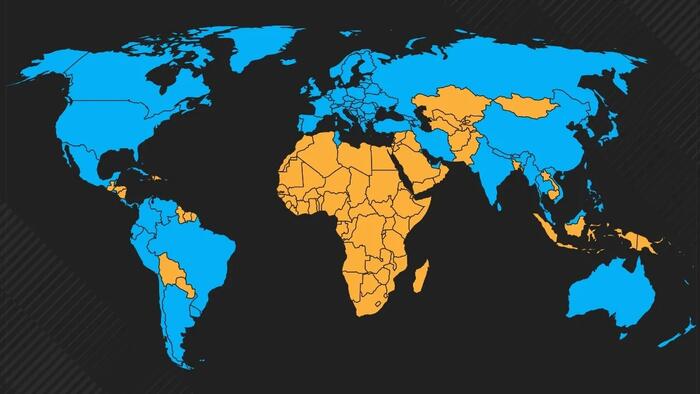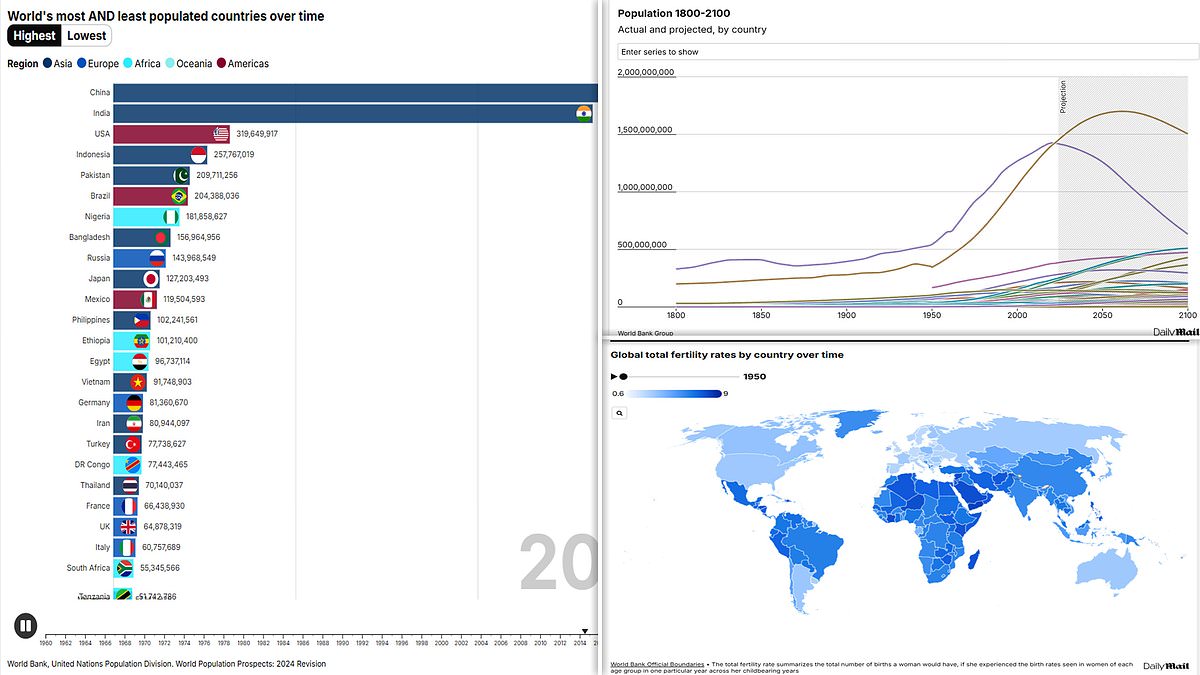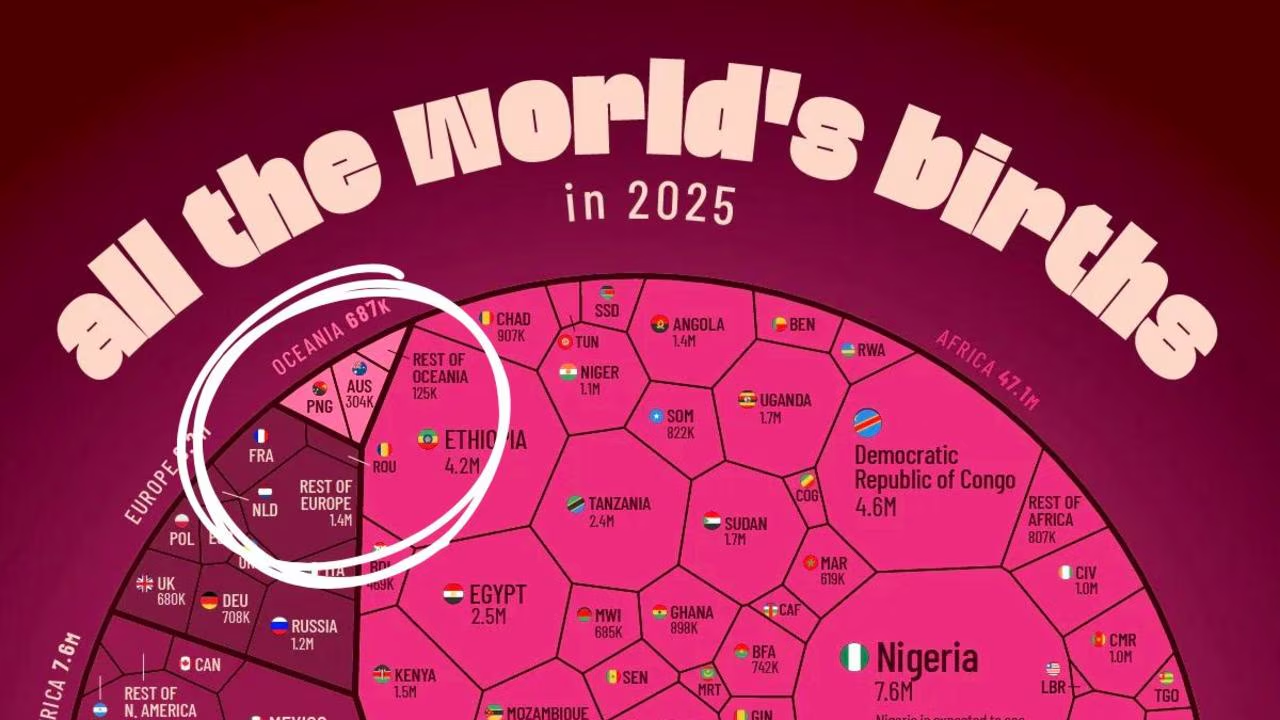
A striking global map showing where the world’s babies would have been born in 2025 reveals a demographic reality that is quietly reshaping Australia.The image, based on United Nations population projections from 2024, plots every country’s expected births last year. India alone was tipped to welcome more than 23 million babies in 2025 — accounting for about 17 per cent of all births worldwide. China, despite having the only comparatively sized population in the world, sits at roughly a third of that figure, contributing about 6 per cent of global births.Meanwhile, Australia barely registers, with only around 300,000 births, accounting for just 0.2 per cent of the global total — about a 78th of India’s figure.Asia and Africa were expected to account for 84 per cent of all births globally in 2025, while India, Pakistan and Bangladesh alone would contribute roughly a quarter of all babies born worldwide.For Australia, the implications are far-reaching; the same demographic forces visible on the map are already transforming the country’s immigration profile.This year, India officially overtook England as Australia’s largest overseas-born population for the first time in history.Australian Bureau of Statistics figures show there are now 971,000 Indian-born residents living in Australia, narrowly exceeding the 970,000 people born in England. China ranks third with 732,000 residents, followed by New Zealand and the Philippines.The milestone marks the culmination of a demographic shift decades in the making.For much of Australia’s modern history, migration patterns reflected historical ties to Britain. But with India producing more than 38 babies for every one that the UK does, the long-term direction of migration becomes increasingly influenced by demographics rather than history.As populations age across Europe and East Asia, the world’s largest pools of young workers are becoming concentrated in South Asia and, increasingly, Africa.Previously speaking to news.com.au, director of Australian National University’s Migration Hub Dr Alan Gamlen argued that “youth is becoming a scarce global resource which we’re all competing for”.Viewed through that lens, the birth map can be seen as something of a preview of where future workers, students and migrants will come from.The fertility rate problemCentral to the immigration debate is one of the defining economic challenges of the 21st century: falling fertility rates.Across much of the developed world, birthrates have fallen well below the roughly 2.1 children per woman required to maintain population levels without migration.South Korea has become the poster child for the trend, recording a low of just 0.72 in 2023. Japan, China, Singapore and much of Europe face similar pressures.Australia is hardly immune. The country’s fertility rate has fallen to near-record lows at 1.48 births per woman.Critics of high migration often argue governments should focus on boosting births among existing residents by focusing on housing affordability and cutting down migration levels.The problem – the much scarier one – is that no country has really cracked the code.Despite years of aggressive pro-natalist policies, tax incentives, baby bonuses and family support programs, countries across East Asia have largely failed to reverse fertility decline.According to demographic experts, there is little evidence governments can engineer a sustained return to replacement-level fertility once societies become highly developed.“Policies that really explicitly target reversing fertility decline have not been successful,” Philip O’Keefe, professor of practice at the UNSW School of Business and expert in global demographic transitions, told news.com.au.“Any expectation that you can significantly reverse that decline is probably not borne out by the experience.”That doesn’t mean family policies are pointless.Measures such as subsidised childcare, paid parental leave and flexible work arrangements can improve quality of life, boost workforce participation and reduce barriers facing parents.But experts increasingly view them as good policy in their own right, rather than a magic solution to low birth rates.According to a United Nations Population Fund (UNFPA) report across 14 surveyed countries, almost one-fifth of reproductive-age adults (18 per cent) believed they would be unable to have the number of children they desired. Nearly one in four respondents (23 per cent) had experienced a time when they desired a child but felt unable to fulfil the desire at their preferred time, and over 40 per cent of those people said they ultimately had to forgo having a child entirely.“What you see in surveys across these various Asian countries is when they ask young adults, couples or singles, how many kids they would like to have? Typically the answer is about half a child or more higher than they’re actually having,” Professor O’Keefe said.Housing affordability, financial pressure, job insecurity, education costs and the unequal burden of caring responsibilities all play a role.But for all the benefit of knowing why it’s happening, it doesn’t necessarily mean we know what to do about it.At the same time, developed economies are adapting in other ways.Workers today are generally far better educated than previous generations. Technological advances, automation and increasingly artificial intelligence are helping to offset labour shortages. “That fall in absolute numbers … is certainly mitigated by the fact that the quality of the younger, smaller cohorts is significantly better in terms of their human capital and thus productivity,” Professor O’Keefe said.“In addition, if you can complement the shrinking working age population with greater capital investment, including technology and AI, that should further enhance their productivity.” The Aussie case studyMigration remains a powerful tool for balancing ageing populations, and this is where Australia occupies something of a unique position.Unlike countries such as Japan, South Korea and China, Australia has historically been far more open to immigration.That openness has created a demographic buffer against the worst effects of population ageing.With overseas-born residents now accounting for 32 per cent of Australia’s population — the highest share since the 19th century — the country has access to a pool of workers and skills that many ageing economies are only just beginning to seek.Rather than signalling decline, Professor O’Keefe suggested falling fertility could also be understood as a product of a country’s success.Just a few decades ago, global fears centred on runaway population growth.Where are we now?“Women are better educated,” Professor O’Keefe said. “People are living longer, healthier lives. Infant mortality has dropped dramatically.“Falling fertility … it’s a triumph of development. These challenges are a result of success, not a result of failure.”The giant birth map might appear to some a grim crystal ball into the future, but it is also a snapshot of one of humanity’s greatest achievements.The world isn’t running out of people, it’s entering a new period where population growth is slowing because billions of people are living longer and healthier lives than ever before.The challenge now isn’t reversing that success, it’s learning how to adapt to it.
Wild global map exposes birthrate truth
A striking global map showing where the world’s babies would have been born in 2025 reveals a demographic reality that is quietly reshaping Australia.
1,097 words~5 min read