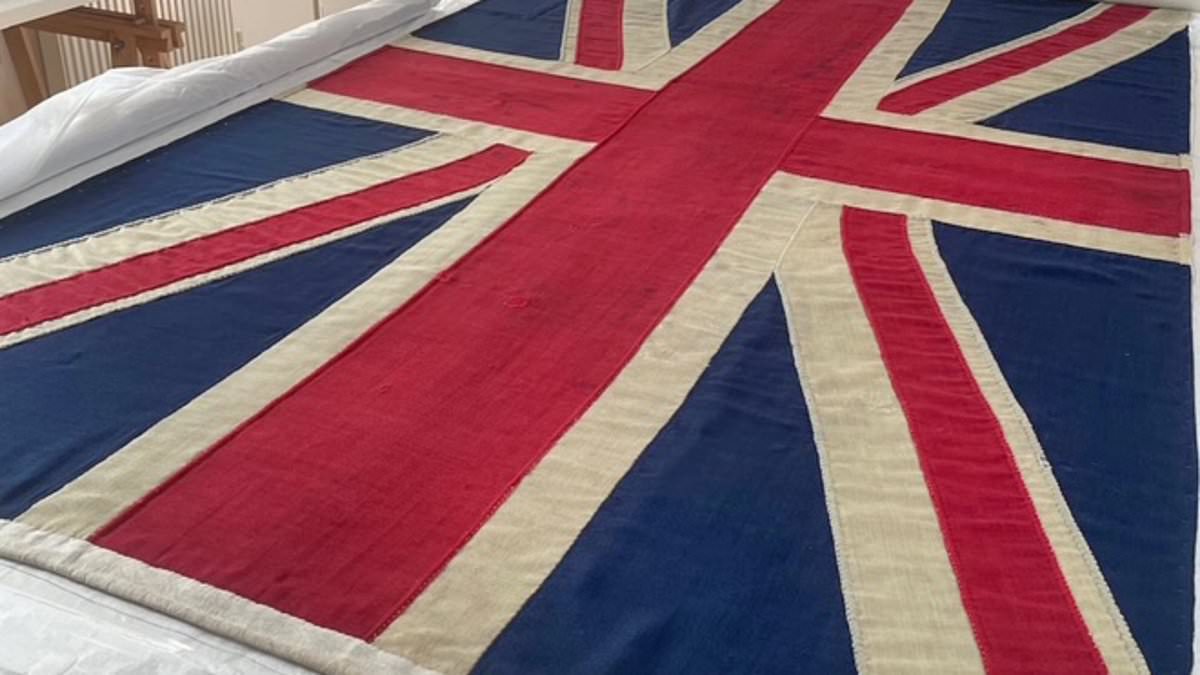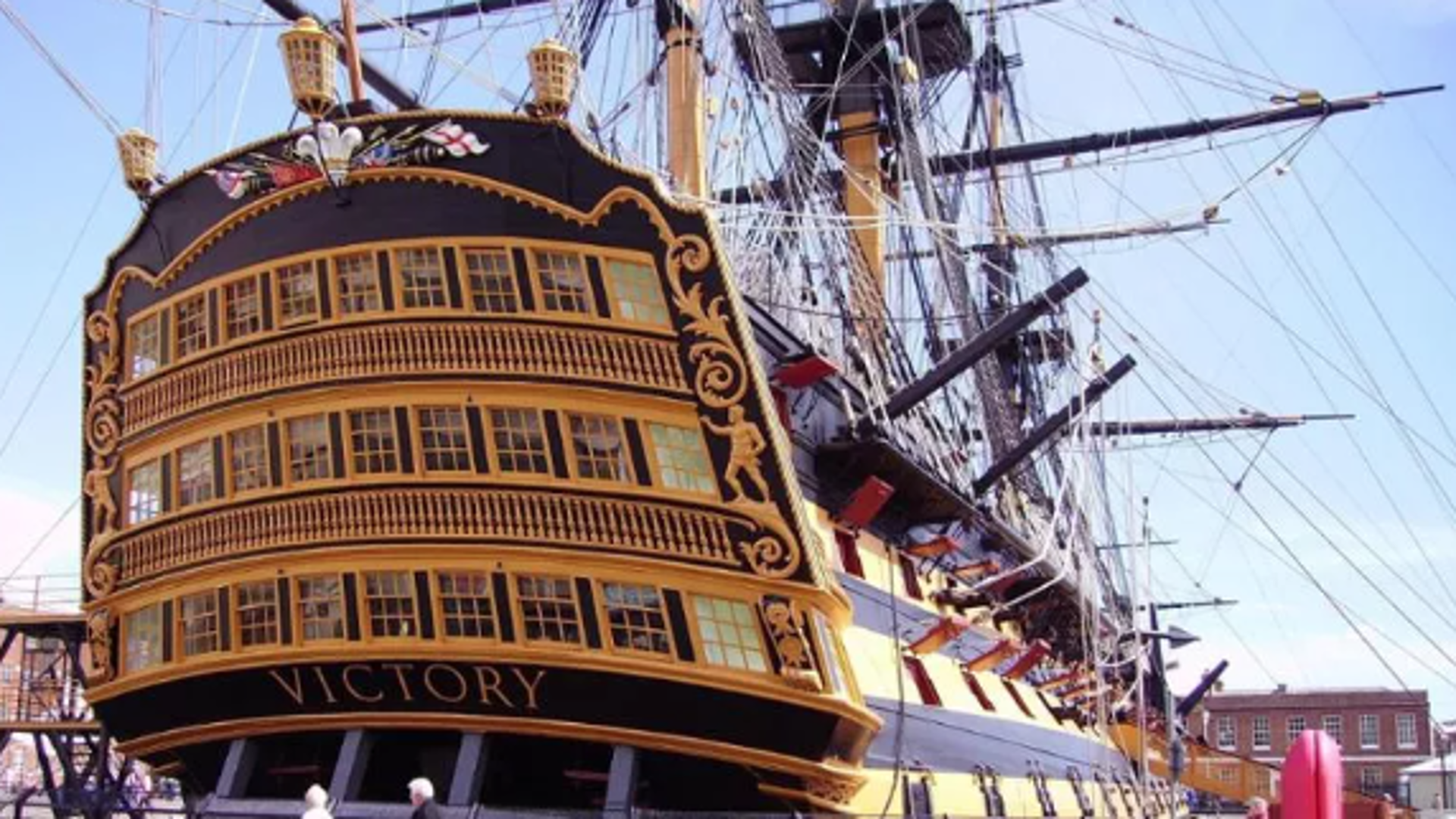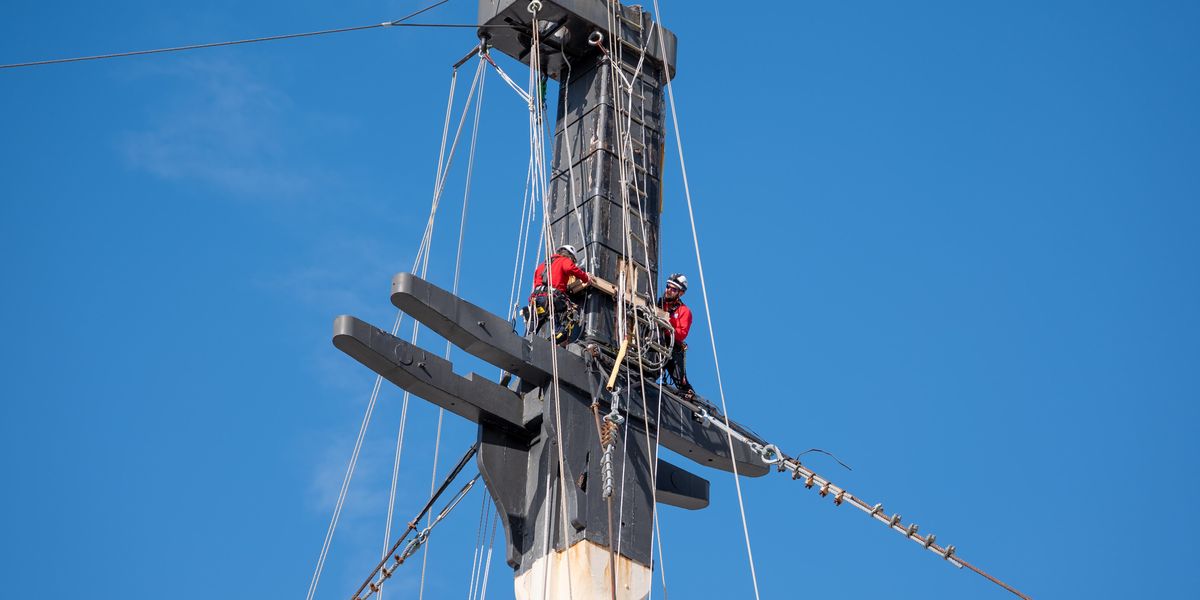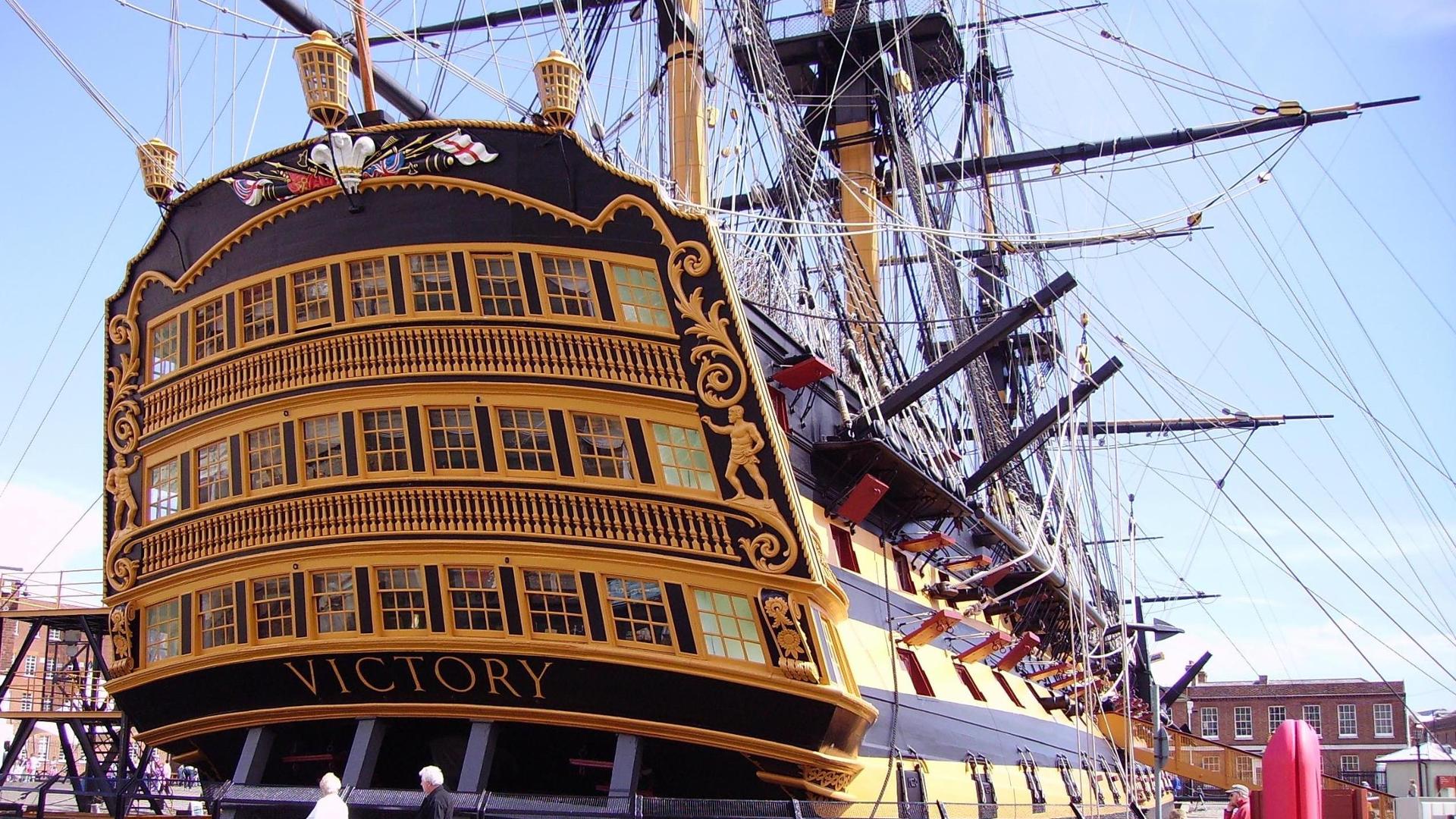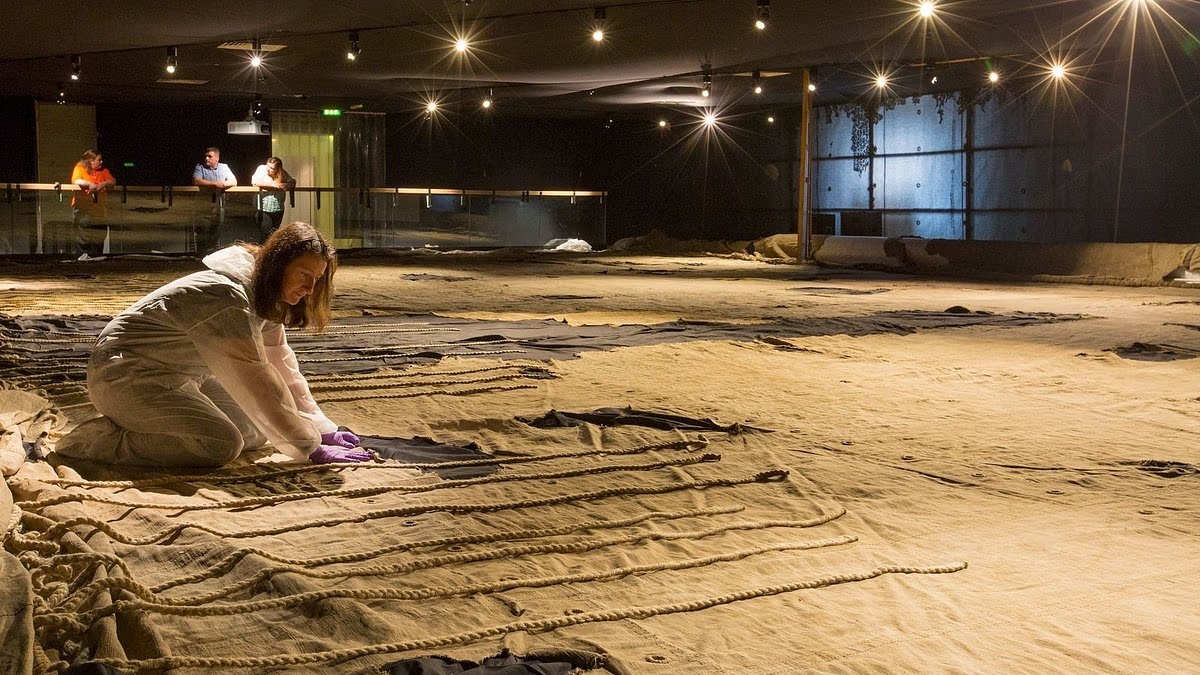
It's a fascinating relic from one of Britain's greatest military victories, peppered with 90 shot holes and a few squares cut out by 19th-century souvenir hunters.Now, the only surviving sail from HMS Victory during the 1805 Battle of Trafalgar is being brought out of storage to go on display to the public in Portsmouth.The battle-damaged 'Trafalgar Sail' is the largest single surviving artefact from the British attack against the Franco-Spanish fleet, aside from the Victory itself.With an area of 3,618 sq ft, it was the Victory's second largest sail and would have been a major target for enemy guns at the battle in which Lord Nelson was killed.The fore topsail, which is going on display at Portsmouth Historic Dockyard from this weekend, also has importance as a hand-manufactured object from Georgian times.Measuring 80ft at its base, 54ft at its head and 54ft deep and weighing an estimated 815lbs (370kg), it took about 1,200 man hours for experienced sailmakers to stitch.The sail was manufactured in the sail loft at Chatham Dockyard in Kent in 1803 and remained on Victory until the ship returned for repairs after Trafalgar in 1806.It was taken back to the sail loft in Chatham, before it was later displayed at an exhibition in 1891 and then onboard Victory for the centenary of Trafalgar in 1905. A member of the conservation team works on HMS Victory's Trafalgar Square in Portsmouth Royal Navy officers and ratings proudly holding HMS Victory's fore topsail after discovering it in a gymnasium at the Royal Navy dockyard in Portsmouth in 1962 Prince Philip views the HMS Victory sail when it was last on display in Portsmouth in 2005 Curator Sue Bickerton vacuums dust particles from a hole in HMS Victory's fore topsail in 2005The sail - dubbed 'the Turin Shroud of maritime heritage' - vanished in 1939 when Victory was turned into naval accommodation, and was lost for more than 20 years.But it was discovered again in 1962 underneath gym mats in a sail loft at Victory Barracks, a major Royal Navy shore base in Portsmouth now called HMS Nelson.The sail was returned to the Victory for display in a glass cabinet on the Orlop deck in 1962, then left the ship for good in 1993 after it was found to be deteriorating rapidly.Urgent conservation work followed to protect it at a workshop in Salisbury before it was displayed again in Portsmouth at the 1998 International Festival of the Sea.When conservators cleaned the sail, they found signatures of weavers who made the canvas in Dundee in 1800 before it was assembled and stitched in Chatham.Further restoration work followed so that the sail could be unveiled to the public again at the Trafalgar bicentenary celebrations at the Historic Dockyard in 2005.The sail was subjected to a unique and extensive dry-cleaning process which took 12 weeks to complete and was carried out by a team at Southampton University.An exhibition housing the sail in atmospherically-controlled conditions at Storehouse 10 was then opened by Prince Philip in March 2005 and ran until the October. The removal of HMS Victory's masts in April and May is the latest stage of her conservation HMS Victory, before being surrounded by scaffolding in May 2022 when the project began HMS Victory being taken by steam tug into dry dock at Portsmouth Historic Dockyard in 1922Now, officials at the Historic Dockyard have confirmed the Trafalgar Sail will go back on display for three months from this Saturday until September 30.The topsail was dubbed 'the Turin Shroud of maritime heritage' in 1998 by maritime author and expert Peter Goodwin, who was the Victory's curator at the time. As part of 'HMS Victory: The Big Repair', the £42million conservation project for the ship, new viewing platforms will also open in mid-July to give visitors a closer look.And for six Wednesdays only from July 22 to August 26, visitors will have the chance to see Nelson's silver tableware displayed inside Victory's Great Cabin.The scene will be set as if Nelson has just stepped out before dinner, with his steward preparing the table and sharing the stories behind him.Nelson led the British fleet to victory against the French and Spanish from Victory but was fatally shot by a French sniper on its quarterdeck on October 21, 1805.Victory was first floated out at Chatham in Kent in 1765. By the 1920s she was in poor condition and moved to dry dock in Portsmouth in 1922 where she remains today.The ship is said to be haunted, with some visitors to the lower Orlop deck where Nelson died claiming to feel a strong, chilling and quiet presence in the dark space.Others claim the ghosts of Nelson and his wife Frances still walk around Victory - with a paranormal investigator claiming to have filmed footage of 'Fanny' in 2018.In the latest step to conserve the historic 18th century vessel, the removal of the masts for conservation work was completed in May using a 750-tonne crane.The latest removals came after the main mast was removed in 2021 as part of the project to restore Victory, the world's oldest commissioned warship.
HMS Victory's Trafalgar sail with 90 shot holes goes on public display
The only surviving sail from HMS Victory during the 1805 Battle of Trafalgar is being brought out of storage to go on display to the public at Portsmouth Historic Dockyard.
849 words~4 min read