You have full access to this article via your institution.
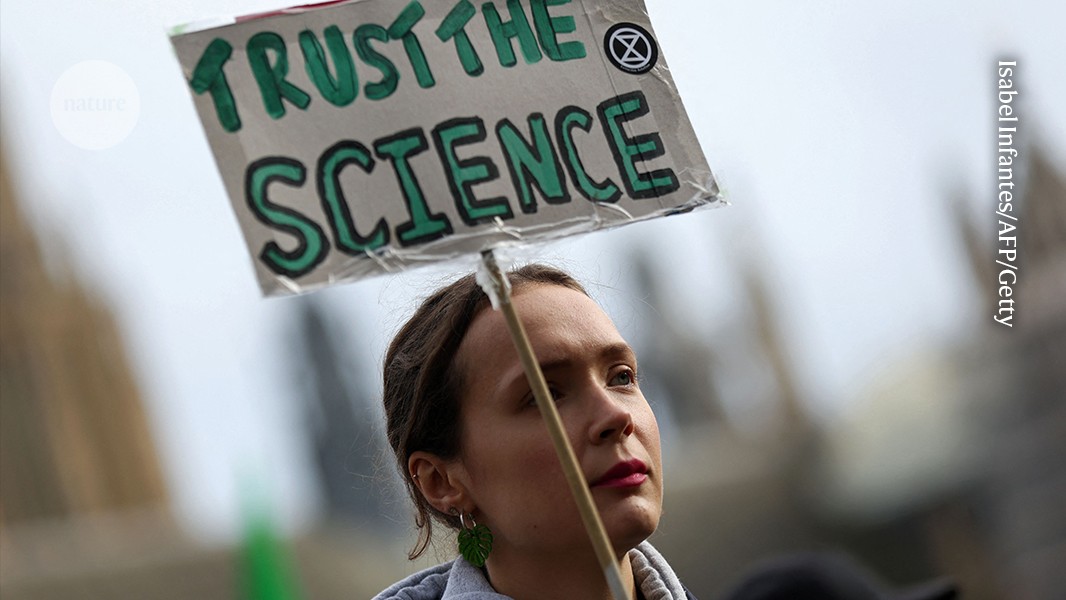
People are more likely to trust scientists when scientists trust the public and are open about uncertainties.Credit: Isabel Infantes/AFP/GettyNiels Mede is curious about how the public views science. Last month, two different Uber drivers told the science-communication researcher that they thought trust in science was low in their countries.Have people stopped trusting science? The data tell a surprising storyThis came as no surprise to Mede, who is based at Wageningen University & Research in the Netherlands. He has seen the idea that there is a crisis of public trust in science in headlines, book titles and conference agendas (and he co-led a major study on the subject1). It has gained traction from populist rhetoric that frames scientists as part of an out-of-touch and suspect elite. Distrust of science is being used by the US administration as one justification for attacking the scientific enterprise.Trust in science is important. Scientific knowledge cannot influence decisions and improve lives unless citizens and policymakers consider it trustworthy. Confidence that scientists and the scientific process produce reliable, valuable knowledge is also necessary to maintain support for public funding of research. That’s why Nature this week includes a series of articles on trust in science. Along with an extended collection online (see go.nature.com/4xwut6h), it identifies the problems and looks at how scientists can maintain the trust of the public and policymakers.How FAIR data are helping to build trust in scienceThe idea that science is experiencing a trust crisis is simplistic shorthand for more complex problems. As laid out in a Feature, the data do not bear out the idea of a global crisis. Surveys consistently show that the scientific profession is trusted — much more than most. An overview of relevant research published in June by biomedical funder Wellcome in London and public-policy think tank RAND Europe in Cambridge, UK, shows that trust in science and scientists is middling to high, not in a state of collapse (see go.nature.com/4euiees). A 2024 survey of more than 23,000 people across 32 countries, by London-based market-research firm Ipsos, showed that 56% of respondents trusted scientists (see go.nature.com/4egifnn). Only medical doctors (58%) were trusted more; politicians (15%) and advertising executives (19%) languished at the base of the chart.But levels of, and trends in, confidence in science and scientists vary by country, and are falling in some groups. In some places, trust is polarized along political lines. In the United States, it is dropping in people who identify as Republican or Republican-leaning but not in Democrats. This trend emerged around 20 years ago but accelerated during the COVID-19 pandemic. It is part of a wider loss of public trust in institutions including the media, companies and political bodies.Scientists should recognize their own political biases to build public trustOne underlying problem is that academics, including scientists, are sometimes viewed as elite and disconnected from most people — an idea amplified by some populist groups2. A survey of people living in Britain, published in April by Wellcome and political think tank More in Common in London, highlights these divides (see go.nature.com/4vqskh3). It shows that scientists are more left-wing than the general public; furthermore, 29% of respondents say that “scientists think themselves better than other people”.Confidence is also sagging when it comes to specific areas involving science. A growing number of people are questioning or rejecting vaccines. The measles vaccines has saved an estimated 59 million lives since 2000, according to the World Health Organization, but vaccine hesitancy is one key reason why six countries, including the United Kingdom, Spain and Armenia, lost their measles elimination status this year, and the US status is in jeopardy.Six ways to put the public at the heart of science and policyResearchers need to accurately diagnose the causes of these trends. Among other things, that means using more nuanced measures of views and concerns. Asking people whether they ‘trust science’ is vague — many respondents probably think of stereotypical biology and physics and say yes, even if they might also reject vaccines or a science-based policy that conflicts with their values. There is a need for more specificity and clarity in research on trust.It is important to test strategies that build trust and effectively address peoples’ specific concerns. For instance, there is a substantial body of research showing how to respond compassionately to hesitancy on vaccines (see Nature 642, 289–291; 2025). Other work is testing ways to improve the use of research in policymaking3.Researchers must also work harder to connect with wider society and throw off perceptions of elitism. One way is to increase public involvement in all steps of research, including setting its priorities — something long discussed and much too rarely practised. People are more likely to trust scientists when scientists trust the public and are open about science’s many uncertainties, as science communication and policy specialists argue in a Comment.More self-reflection in research can lead to better scienceSome problems have no easy answers. There is no incentive for politicians to support science if they can gain more votes and influence by rejecting its evidence and embracing alternative narratives. This is exacerbated by the fragmentation of the media ecosystem and rise of social media, which mean that scientists are losing influence.Inaccurate, untrustworthy information is damaging when it leads to individual decisions that harm health, such as shunning vaccines, or erodes support for planet-saving climate action and lifesaving public-health measures. Being trusted is both a privilege and a responsibility. Researchers must do more to elevate accurate findings and remember that trust is easily squandered and lost.