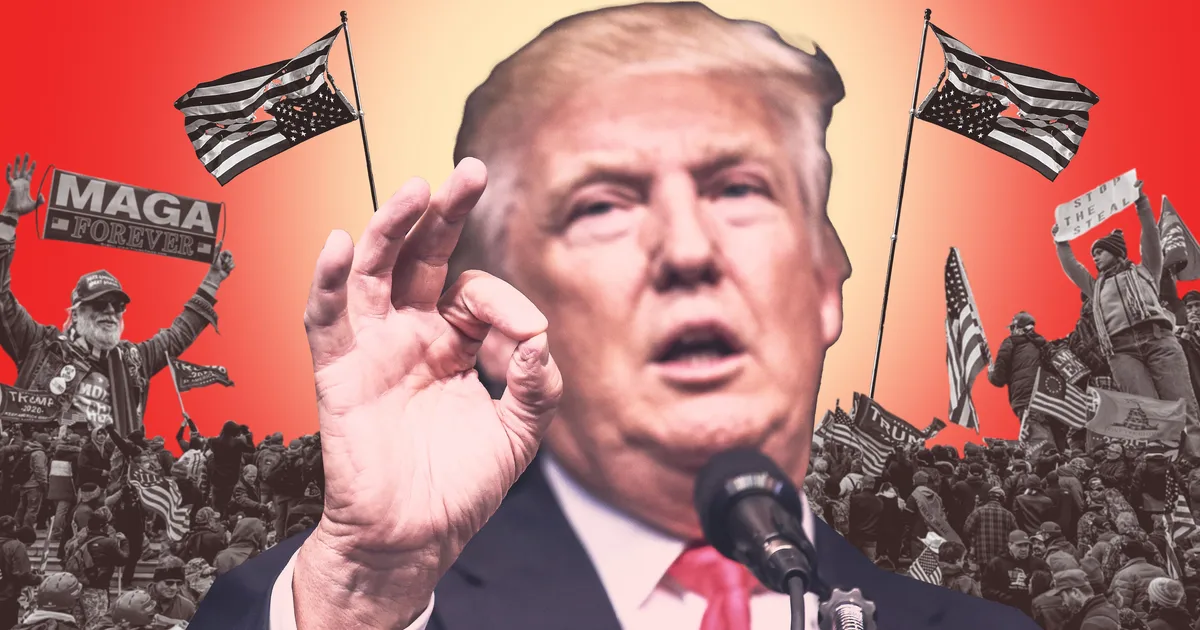
WASHINGTON — As the United States marks its 250th anniversary, it does so with a president who openly rewrites history about one of its darkest days — Jan. 6, 2021 — and embraces people convicted of what was previously considered one of the most serious crimes an American could commit: seditiously conspiring against the United States. Seditious conspiracy threatens the heart of democracy, since it involves plotting to put down the government by force or conspiring to prevent, hinder or delay the execution of the government’s laws. (It is slightly different from sedition, which is defined only as the act of forcibly trying to overthrow the government, or treason, which is defined as making an overt act of war against the U.S. or providing aid to U.S. enemies.)Of the thousands of people who stormed the Capitol on Jan. 6, just 18 were charged with seditious conspiracy. All were members of far-right extremist groups, the Oath Keepers and Proud Boys. Four pleaded guilty to the charge, and 10 others, including Oath Keeper leader Elmer Stewart Rhodes and Proud Boys leader Henry “Enrique” Tarrio, were found guilty of that and other charges after separate months-long trials in Washington, D.C. The Justice Department has since moved to wipe away those convictions entirely.Jan. 6 was certainly not the first time a group of Americans responded violently or seditiously to the U.S. government.“If you ask King George III, he would say the Founding Fathers were only in a position to write the U.S. Constitution because they had successfully engaged in insurrection,” said Marcus Gadson, associate professor of law at the University of North Carolina at Chapel Hill and author of “Sedition: How America’s Constitutional Order Emerged from Violent Crisis.” “No insurrection, no treason, no rebellion, no United States, period,” he added. This iconic painting by Emmanuel G. Leutze shows Gen. George Washington leading his troops across the Delaware River during the Revolutionary War.via Associated PressBut Jan. 6, 2021, wasn’t about forming a constitution or securing independence from a monarch. It marked the first time that a president told a mob violently attacking that government, “We love you.” It was the first time a president did nothing for 187 minutes as the Capitol was ransacked and pleas for help from lawmakers flooded in. It was the first time a president told an armed mob, during a ceremony necessary for the transfer of power, that an election had been stolen and if they didn’t “fight like hell, you won’t have a country anymore.”President Donald Trump’s whitewashing of Jan. 6 and his manipulation of the Justice Department to advance that effort pose a unique threat to the future health of American democracy, legal experts and historians told HuffPost. Without course correction, they said, it cannot be overstated how much of what the country has achieved could be lost.“Fifty years from now, 20 years, even 10 years from now, what are we going to tell students about what went on here at the dawn of the 21st century?” said Kristy Parker, former special counsel and former deputy chief of the Civil Rights Division’s Criminal Section at the Justice Department. “If people come of age in a world in which it looks like insurrections are all right and what we have when we have elections is just one side changing history about what went on — it makes it a lot harder for us to have citizens equipped to keep a democratic republic alive.”This wood engraving by W.L.S. depicts lines of Massachusetts militia firing into the ranks of Shay's rebels in Springfield, Massachusetts, in 1786.Fotosearch via Getty ImagesRebel, RebelFrom the rejection of British rule that sparked the American Revolution to early uprisings against unfair taxes to slave rebellions to the Civil War, rebellion has shaped American identity from the beginning. Early on, there was Shay’s Rebellion, when cash-strapped Revolutionary War veterans led an uprising against debt-collection efforts by the government; the Whiskey Rebellion, where Americans protested taxes on whiskey distillers; and Fries’ Rebellion, when armed farmers revolted over taxes imposed on their slaves and property. “The U.S. throughout its history, just by its very nature, E. Pluribus Unum — ‘from many one’ — has always been a tenuous proposition,” Bruce Hoffman, terrorism and insurgency expert and co-author of “God, Guns and Sedition: Far Right Terrorism in America,” told HuffPost. After a tumultuous few early years, President John Adams signed the Alien and Sedition Act of 1798 into law. The law said anyone who wasn’t an American citizen would be deported, and it banned all “false, scandalous or malicious writing” against the government. Adams’ political opponents, and later presidential successors, Thomas Jefferson and James Madison, issued state resolutions declaring that the law violated the First Amendment; by 1801, Congress let the Sedition Act expire and wouldn’t renew it again until World War I.By the end of World War II, Congress passed the seditious conspiracy law that’s still in place. It honed in on plotting action against the U.S., not just talking negatively about the government. Proving the distinction between dangerous speech and an actually dangerous conspiracy can be a thin line for prosecutors to walk. Before Jan. 6, there were fewer than a dozen successful seditious conspiracy convictions in the Justice Department’s history. In 1954, Puerto Rican nationalists who opened fire on the House floor were convicted of the charge, and Islamic militant Sheikh Omar Abdel-Rahman was convicted of it in the 1990s. However, cases were infrequent and convictions hard to land. White supremacists in Arkansas accused of trying to overthrow the government and poison a water supply were acquitted for lack of evidence in the 1980s. In 2010, members of the Christian extremist Hutaree militia in Michigan were charged and acquitted after a judge found prosecutors relied too much on protected speech.Proud Boys members walk toward the U.S. Capitol on Jan. 6, 2021. via Associated PressHoffman said after the acquittals in Arkansas, the more “stereotypical manifestations” of right-wing extremism in the U.S., like the KKK or American Nazi Party, gave rise to anti-government groups that leaned into fears of a “conspiracy of liberal global powers” attempting to dominate and control the world.The 2017 white supremacist Unite the Right rally in Charlottesville, Virginia, which killed Heather Heyer and injured 35 others, became an inflection point after Trump told the nation there were “very fine people on both sides.”Demonstrators carry Confederate and Nazi flags during the "Unite the Right" rally in Charlottesville, Virginia, on Aug. 12, 2017.NurPhoto via Getty Images“Extremists took that as a stamp of approval, as an imprimatur and that they had the top cover of the White House,” Hoffman said. Trump’s refusal to disavow far-right extremists continued into 2020, when he told Proud Boys to “stand back, stand by.” At trial, evidence showed the remark helped recruitment efforts and that Proud Boys considered it a call to action.“You could see this trajectory that culminates to Jan. 6,” Hoffman said. The Next ‘Lost Cause’ The Jan. 6 investigation was the Justice Department’s largest ever. By the time jurors convicted Oath Keepers and Proud Boys of seditious conspiracy, they had reviewed staggering amounts of evidence produced by swaths of prosecutors, investigators and FBI analysts. There were text messages seized from the Proud Boys’ secretive backchannels where they coordinated movements. Proud Boys’ trial jurors heard testimony from a filmmaker who followed them for weeks and captured Rhodes and Tarrio, who had never met before, getting together on the eve of the attack. In the Oath Keepers trial, jurors read letters in which Rhodes begged Trump to invoke the Insurrection Act and raise a militia to stop the election or else, warning Trump, “you and your family will die in prison.” They heard about Rhodes trying to pass that letter to Trump. Oath Keepers told jurors they were ready to protect Trump by force. Jurors learned how Oath Keepers arranged an arsenal of weapons to back them up. Evidence also showed that after Jan. 6 failed to reinstate Trump as president, Rhodes was continuing to stockpile guns. The seditious conspiracy case against the Oath Keepers and Proud Boys was a “legal layup,” Glenn Kirschner, a former prosecutor with the Justice Department for 30 years, told HuffPost.Stewart Rhodes (right), founder of the far-right Oath Keepers extremist group, attends a hearing with the House Select Subcommittee on January 6th in the Rayburn House Office Building on Jan. 14, 2026. The committee held the hearing to further examine the FBI’s investigation into pipe bombs left outside the offices of the Democratic and Republican national committees in 2021.Heather Diehl via Getty Images“We saw on video these Jan. 6 attackers literally trying to prevent the execution of the laws of the United States, the Electoral Count Act, the certification of a presidential election,” said Kirschner, who observed weeks of the seditious conspiracy trials in person. “I can’t imagine more compelling direct non-circumstantial evidence of sedition than what we saw on Jan 6.”“You’re goddamn right the DOJ was charging these people with seditious conspiracy,” he said. Members of the Oath Keepers stand on the East Front of the U.S. Capitol on Jan. 6, 2021, in Washington. The Capitol riot was the culmination of weeks of preparation and a moment of triumph for the Oath Keepers, federal prosecutor Louis Manzo said in closing arguments in the second seditious conspiracy trial against members of the far-right extremist group. via Associated PressTrump was indicted in August 2023 by then-special counsel Jack Smith for allegedly perpetrating three different criminal conspiracies tied to Jan. 6, including conspiracy to defraud the U.S., conspiracy to corruptly obstruct the certification and conspiracy against the right to vote and to have one’s vote counted. In his final report, Smith said Trump’s “lies” were used to “defeat a federal government function foundational to the United States’ democratic process.” But Smith stopped short of charging Trump with insurrection, finding Trump’s claim that his conduct was protected under the First Amendment might be too large an obstacle to overcome.Trump dragged out the proceedings, and the question of whether he had immunity from criminal acts went all the way to the Supreme Court. With only a few months to go until the 2024 election, justices upended years of precedent and ruled 6-3 that presidents have immunity for official acts and presumptive immunity for official acts that may fall within the “outer perimeter” of their duties. Trump escaped criminal liability for Jan. 6 since the Justice Department bars prosecuting sitting presidents. And he has committed himself fully to rewriting the narrative of Jan. 6 and wiping away all attempts to place him as a key figure in it. On his first day back in office in 2024, Trump pardoned nearly 1,600 rioters, saying, “These are the hostages.” He also commuted Rhodes’ 18-year prison sentence and Tarrio’s 22-year sentence. That day set the tone for Trump’s second term. He has called the rioters “peaceful” and “patriots,” although over 600 people were charged with assault. He has downplayed the event as a “day of love,” despite the abundance of neo-Nazi, anti-government, antisemitic and white supremacist groups present, and the fact that people erected gallows outside the U.S. Capitol and chanted “Hang Mike Pence!” He has falsely claimed there were no guns, which court records clearly dispute.On Jan. 20, 2025, his first day back in office, President Donald Trump signs an executive order pardoning about 1,500 defendants charged in the Jan. 6 attack on the U.S. Capitol.AP Photo/Evan VucciThe Justice Department — now led by Trump’s former personal lawyers, including those who represented him in the Jan. 6 criminal indictment — fired prosecutors who worked on Jan. 6 cases. The DOJ made thousands of press releases related to Jan. 6 disappear from the internet. Rhodes came to the Capitol after his pardon and with the tacit approval of the Justice Department — which, before Trump returned to power, had barred him from Washington, D.C. Tarrio told reporters last May he had a meeting with Trump in Florida where they had “a great conversation” over dinner. One pardoned Jan. 6 rioter, Elias Irizarry, has been hired to work in a Pentagon department focused on counterterrorism. Another pardoned Jan. 6 rioter, former FBI agent Jared Wise, became an adviser to the Justice Department’s self-proclaimed “weaponization working group” set up by former Attorney General Pam Bondi, another former personal lawyer to Trump. The group’s focus was to “restore credibility with the public” and promised to examine all investigations into Trump, including the Jan. 6 criminal probe. Wise resigned in April.“Rewriting history and reframing the truth of events is actually a well-worn playbook,” said Parker, the former DOJ special counsel. “This is not at all unlike what we saw after the Civil War. There was a conscious, systematic decades-long effort that went on to reframe what the Civil War was about through the Lost Cause Movement.”“What we’re seeing today very much parallels that, and the dangers of that cannot be overstated,” she added. “The vigilance that people need to have here as we come upon our 250th birthday is to remember, validate and speak about our true history and what is really going on — and not allowing things like what went on the last 10 years and certainly on Jan. 6 to be erased. That couldn’t be more important.”‘Free Rein’ or Reined In?Trump had planned to compensate Jan. 6 rioters from a $1.776 billion “Anti-Weaponization Fund” carved out of a settlement deal he reached with the IRS. Although acting Attorney General Todd Blanche told Congress the fund “wasn’t moving forward,” lawyers for the Justice Department have refused to put in writing that it is officially shuttered. A highly skeptical federal judge overseeing a lawsuit against the fund has ordered the Justice Department to issue a clear declaration by July 17. Kirschner and Parker said the way the Justice Department conducts itself now, through its obfuscations in court and its about-face on Jan. 6, is tragic. Former Proud Boys leader Enrique Tarrio (center) attends a news conference at the U.S. Capitol in Washington on Feb. 21, 2025.via Associated Press“The Trump administration is treating seditious conspiracy as not even worthy of accountability, not even worthy of punishment,” Kirschner said. “Then adding to injury to injustice, they try to set up a fund to pay the people who attempted to destroy our nation. It’s insanely destructive of what America is and it’s Donald Trump, in a layman’s sense, being treasonous and seditious himself, is how I see it.” And Trump’s rewriting of Jan. 6, and especially his penchant for claiming every election he doesn’t like or loses is rigged, is “deeply problematic,” Gadson said. What happened on Jan. 6 was a byproduct of that, and Gadson fears what will happen if people feel like they can’t win an election by working inside of the political system.As with so many things, we’ve seen this before. In the 19th century, he said, elections were particularly affected by violence. “Polling places historically have been places where violence has happened,” Gadson said. “This is part of our history that a lot of us don’t fully appreciate: when you give free rein to violent impulses, it can have really negative ramifications.”
America Was Born From Rebellion — But Not The Kind Trump Fomented
Without course correction, experts warn, it cannot be overstated how much of what the country has achieved could be lost.
2,524 words~11 min read