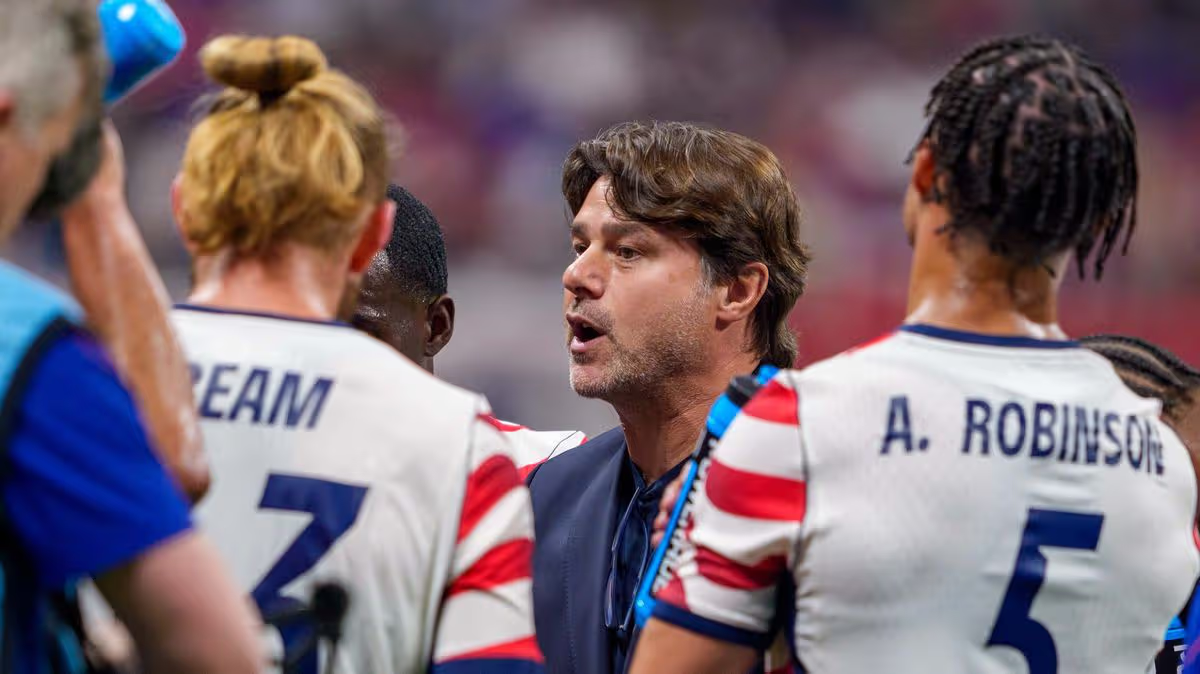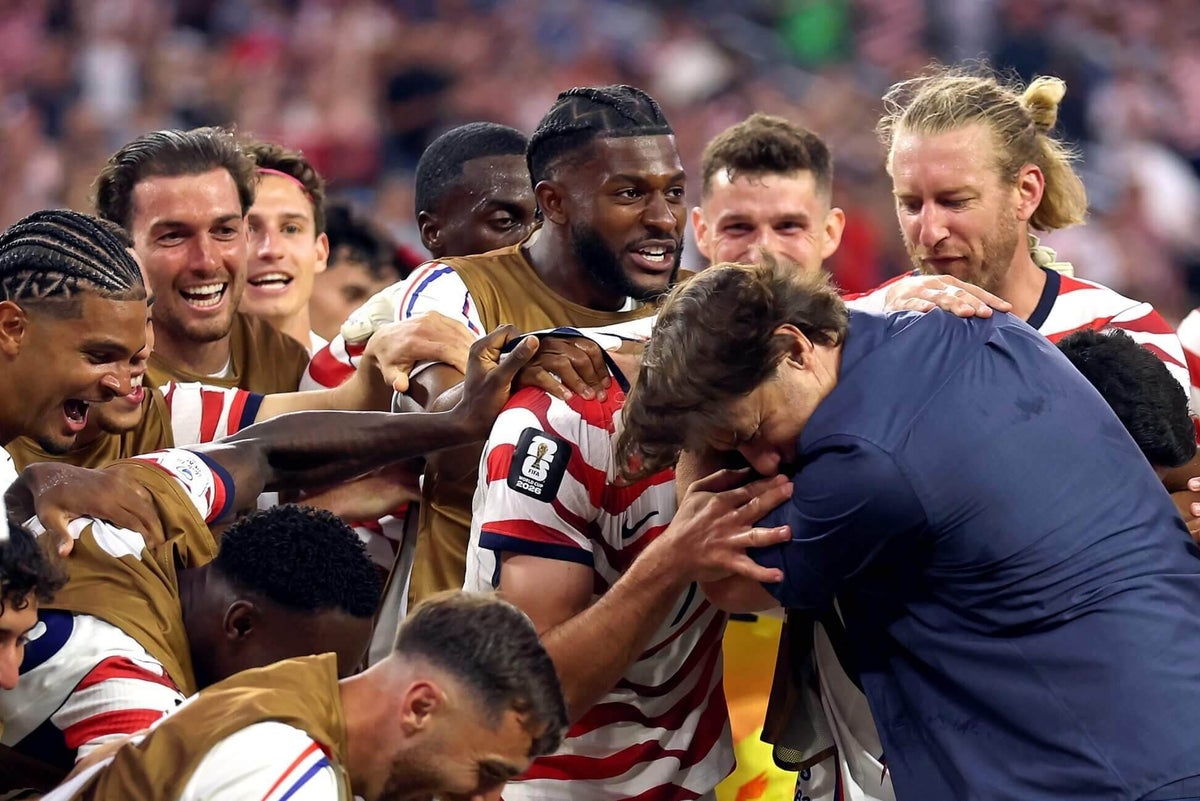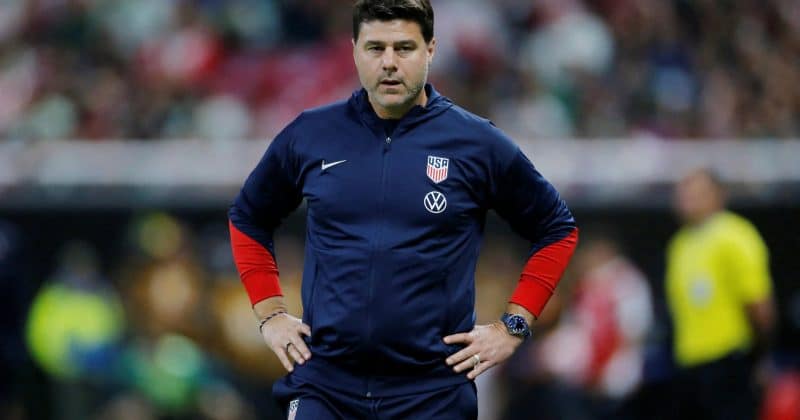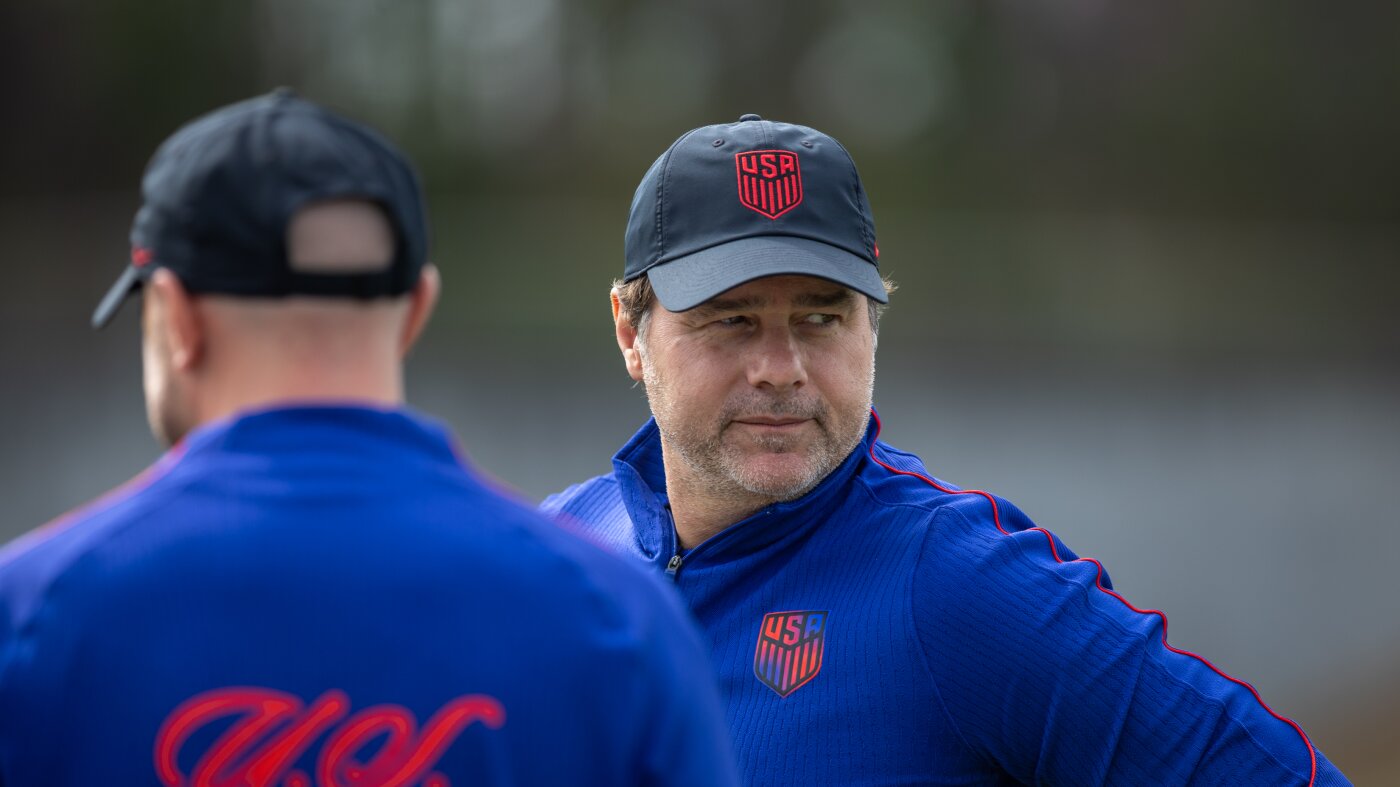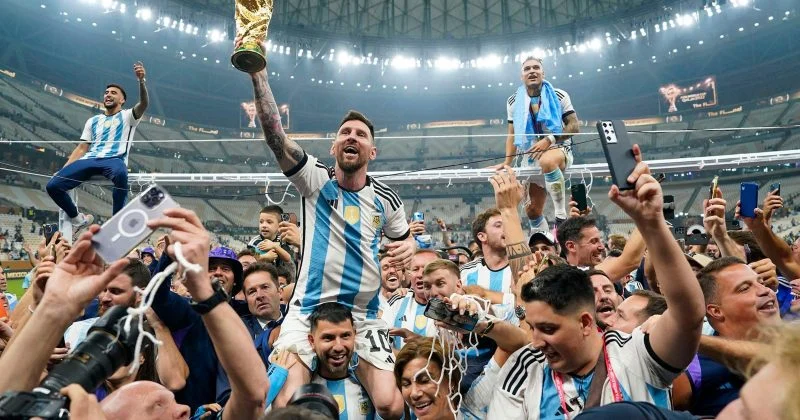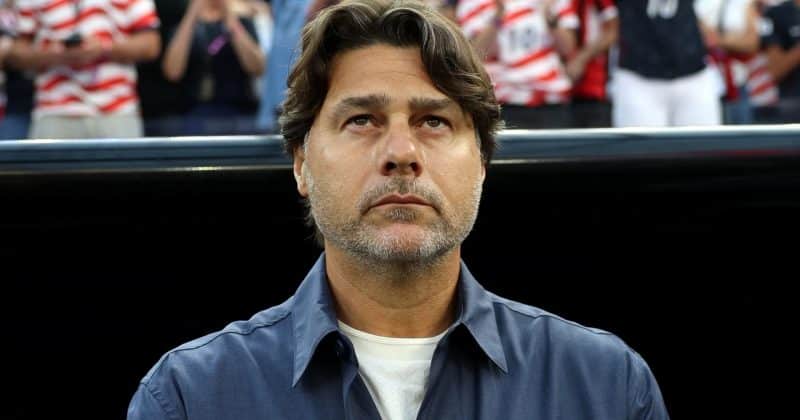
SANTA CLARA, Calif. — When Mauricio Pochettino was hired to coach the U.S. men’s national soccer team in 2024, he took over a team that had never been a serious contender. Undaunted, Pochettino, a 54-year-old Argentine, conjured up a motto he hoped would boost confidence ahead of the 2026 World Cup. He began repeating the phrase to players, the public and even President Donald Trump: Why not us?Why not the U.S. men is a question being asked more than ever before. Coming off what is considered the team’s best performance in the tournament’s group stage in recent memory, the U.S. men enter the knockout stage Wednesday surrounded by optimism that the team could be ready for its breakout moment — something that hasn’t been the case since the World Cup started nearly a century ago. Thanks to its massive talent base, top facilities and resources for coaching and training, the U.S. has regularly produced world-class teams and athletes in multiple sports. All the while, however, men’s soccer has remained a stubborn exception. Part of the problem, many inside soccer say, is that asking why the U.S. lags behind South America and European powerhouses is likely to elicit a different answer depending on whom you ask. A sampling: The country is too vast to accurately scout, the cost of youth soccer too high, the state of the national team’s talent development pipeline too broken, all thanks to too many competing interests. “The challenges remain the same as even 40, 50 years ago,” said Luis Robles, the general manager of sporting operations for MLS Next. “How do you take a country the size of the United States, identify players, develop players, bring them under one roof with a funnel towards professional teams, a funnel towards national teams? It’s a big challenge, but it’s a worthwhile challenge.”What is universally agreed upon is that things must change.U.S. coach Mauricio Pochettino applauds the U.S. fans after the match against Australia in Seattle. Soobum Im / FIFA/FIFA via Getty Images“If we want different results for the next generation, we cannot continue operating the same way we have for the last fifty years,” U.S. Soccer wrote in a frank assessment in June. It’s why the current World Cup, co-hosted by the U.S., Mexico and Canada, carries such high stakes. This World Cup on home soil, the 2028 Summer Olympics in Los Angeles and the 2031 Women’s World Cup hosted in the U.S. are collectively viewed as a rare opportunity to drive interest into the sport and attract the type of athletes and coaching capable of putting the U.S. on equal footing with the world’s best teams. Soccer ranked behind only basketball and baseball as the most-played sport in the U.S. among kids ages 6 to 12 in 2024, according to Project Play. Yet its participation rate of 7.5% was a decrease of 17.5% from a decade earlier. Soccer insiders also say they are hopeful this World Cup will generate both excitement and consensus for how to push the sport forward in the U.S. by redesigning a system that Chris Bentley, the chief sporting officer of U.S. Youth Soccer, has called “broken.” “If we can come together, I think this is one of the most, if not the most, transformational moments in U.S. soccer history,” Bentley said. “If we can come together.” Growing up in Hartford, Connecticut, Patrick Agyemang watched World Cup games intently. But playing in one felt like a far-off possibility.As a kid, he’d known of top clubs in his area that offered exposure to recruiters, but the cost made playing for them effectively a nonstarter. “The price is crazy, especially at that age,” Agyemang said. “There’s no way my family was paying thousands of dollars just for a season of soccer.” So he did what few future pros ever do — played four years of high school, then started his college career in the NCAA’s lowest division. Patrick Agyemang in a Gold Cup match against Haiti in Arlington, Texas, on June 22, 2025. Shaun Clark / Getty ImagesHe has since become one of U.S. soccer’s best success stories. Within only three years, Agyemang, a 6-foot-4 forward, went from making his Major League Soccer debut to playing in England’s second division. After Agyemang made his U.S. national team debut last year, Pochettino called his potential “very, very, very useful.” Until he injured an Achilles tendon in April, Agyemang, now 25, was under serious consideration to make the 26-man U.S. national team playing in this World Cup. Had he made it, he would have joined Cristian Roldan as the only members to have played for their high school and college teams.“I wouldn’t change it now, honestly,” Agyemang told NBC News. “I’m very happy with how far I’ve come. I think it’s inspired a lot of people. But it definitely did feel at times [that] I did get lost in the cracks.” Agyemang benefited from persistence and belief from coaches, but he said he knew of players just as talented who washed out before they could develop. Critics question whether the soccer infrastructure in the U.S., with its burdensome demands on families’ wallets and time and its nonstop schedule that rewards endurance over quality, is capable of spotting and developing a promising player from a non-affluent family raised far from a major city.The 2002 U.S. team that reached the World Cup quarterfinals featured 18 players who played in high school, with the vast majority having also played in college, but the days of the NCAA feeder system — the one that built the U.S. women’s national team into an international powerhouse — are over. In its place, young American players and their families must navigate a daunting array of choices, with no agreed-upon pathway to reach soccer’s top level.02:09Should a talented preteen join one of the 10,000 clubs affiliated with U.S. Youth Soccer, the largest youth system in the country, with more than 2.7 million players? Or join any other of a number of youth clubs outside the U.S. Soccer system? Like the Elite Club National League, U.S. Club Soccer (which isn’t affiliated with U.S. Soccer) and AYSO. Or would it be more advantageous to rise within an academy-style system modeled after European nations? The United Soccer League, Major League Soccer clubs and MLS’s NEXT Pro level all now offer academies. An AYSO x USSF Communications Clinic in Atlanta on April 4, 2024.Adam Hagy / Getty Images“There’s always a number of challenges, but I think we are highly fragmented,” said Tom Condone, the chief executive of U.S. Youth Soccer.Overlap among those systems is often scarce. Parents describe stories of traveling hours to play in tournaments, only to face opponents from their neighboring city. “The pay-to-play model only allows one section of American society to play soccer, and that’s not going away,” former U.S. goalkeeper Tim Howard told NBC News. Clubs that ask players to specialize at a young age put late bloomers at a disadvantage, said former U.S. national team coach Gregg Berhalter. “They don’t get the opportunities, and because they don’t get the opportunities, they don’t improve. Because they don’t improve, they don’t hang around, and they get out of the system,” he said.Pochettino said in a podcast appearance this spring that the U.S. needed more opportunities for free play. Weston McKennie experienced that while he was spending many years of his childhood living in Germany, where his father was stationed at a military base.“You breathe, you eat soccer, and that’s the difference,” McKennie said. “Anytime, anywhere, I had a soccer ball at my feet. And if one kid had a soccer ball and you didn’t, you guys were always playing together. You play street soccer.” Because the U.S. doesn’t have as deep a connection to the sport, it has often looked to countries that do for inspiration, said Marcelo Santos, a Brazilian-born assistant with the Houston Dynamo of MLS who formerly coached in youth leagues and colleges in the U.S. In South America and Europe, top clubs have long used academies to develop promising players. Spain, the Netherlands, Germany and England “have youth development figured out,” Howard said. Yet there are four U.S. states with more people than the Netherlands. Is it wise, or even feasible, to emulate the model used by a smaller country and scale it up to mass-produce youth development in the U.S.? Howard doesn’t think so. Santos wasn’t convinced the model of Brazil, where he grew up, was one the U.S. should emulate, because it prioritizes nurturing future superstars even at the cost of a high rate of attrition for others.Jozy Altidore, the former star U.S. striker, said: “I think we have to be even more clever and think of even more ways where we can kind of try to pull some of that talent along and identify it and say, ‘Hey, this is why you should be playing soccer.’ I think it’s not as cut-and-dried as just simply looking at Europe because of the competition for airspace for consumers that we have here.”Solutions already in place?As the world’s best teams arrived in North America in June to begin the World Cup, representatives from more than a dozen U.S. soccer associations were arriving in suburban Atlanta.Those organizations didn’t often talk with one another. But inside U.S. Soccer’s new, $250 million dedicated training facility, discussions opened for how to redesign the talent development pipeline in a plan dubbed “U.S. Way.” “No one believes the current system is meeting the moment,” U.S. Soccer wrote.JT Batson, the chief executive of U.S. Soccer, told NBC News in May, “This is going to take everyone in every community who cares about this sport to lean in and work together to help us achieve our soccer dreams.” Batson added that changes won’t happen “overnight.”JT Batson speaks at a news conference in New York City on Nov. 19, 2024. Mike Lawrence / Getty Images for USSFU.S. Soccer plans to publish a more detailed “U.S. Way” plan this summer, but it immediately described a need for stronger leadership at state and local levels to design a more “connected approach” from the bottom of the pyramid up. In one sign of previously rare collaboration, two of the largest youth organizations, U.S. Youth Soccer and U.S. Club Soccer, merged two of their leagues into the National 1 League, with the intention of reducing travel times and cost, said Condone, the U.S. Youth Soccer chief executive. “The conversations today are much more collaborative than they were five years ago,” he said. “There was this sense of what do we need to do to better align the game for the player? And it started off with just having a dinner on what makes the most sense.”The growth of MLS since its first season in 1996 is seen as a key driver in a brighter future for soccer. As teams’ values have increased and more money has been injected into the league, it has expanded its top division, and it launched a second, developmental league, NEXT Pro, in 2020 that focuses on players ages 13 to 19. It now has 50,000 players and 274 clubs. To widen players’ exposure, an online scouting platform used by NEXT Pro academies is also shared with college coaches, Robles said.He expressed confidence that this World Cup is “going to provide jet fuel momentum and more people, more bright ideas, more resources” to continue collaborations that could elevate soccer in the U.S. and in turn give its national teams a better chance at winning major tournaments. “I think there’s a lot of people who have been in this space for a long time, and somewhere in the overlap of all those people are some really great ideas, and what we’re trying to do now is sift through and find those great ideas to solve some of these challenges,” Robles said. As those talks about long-term vision continue, Pochettino’s challenge in the present is to guide the U.S. to at least its best World Cup finish in a generation. He recounted on a podcast that after his hiring, he attended a dinner with dozens of high-ranking U.S. dignitaries who wanted to know why the U.S. hadn’t produced a breakthrough moment yet on the world stage. Where was its own Messi, its own glory?“They are very conscious about that they need to do something, to create a legacy,” Pochettino said. “That is a great opportunity after this World Cup.”
Can a historic World Cup run finally fix America’s youth soccer system?
Part of the problem, many inside soccer say, is that asking why the U.S. lags behind South America and European powerhouses is likely to elicit a different answer depending on whom you ask.
2,067 words~9 min read