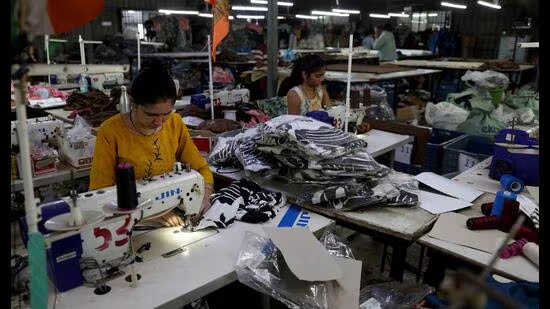
Manufacturing growth is one of India’s most cherished and elusive economic goals. Why can’t India nail it? A new report released by the National Statistics Office, preliminary findings of which were covered in HT yesterday, re-emphasise an important insight on the problem. India’s million plus cities show a reasonable negative correlation between share of manufacturing employment and hourly wage rate for salaried workers.PLFS data shows that monthly wages of salaried workers are the lowest for salaried in manufacturing. (iStock photo | Representative)Simply speaking, it means that cities which have a higher share of manufacturing employment tend to have hourly lower wage rates for their salaried workers. Why does this result matter as far as India’s lack of manufacturing prowess is concerned?Manufacturing has the highest share of salaried workers among major sectors in India if one were to exclude the public administration, defence and other services group. This makes sense intuitively because setting up a factory requires hiring workers and is not something which can be pulled off as a kitchen garden enterprise. However, workers will only feel enthused to partake in manufacturing if they believe the compensation will better than elsewhere.Data from the NSO report, which offers insights on India’s million plus cities from the 2025 Periodic Labour Force Survey (PLFS) data shows that manufacturing’s dominance in a city might be generating headwinds rather than tailwinds as far as wages for salaried workers go. Cities such as Ludhiana and Surat, where manufacturing has a more than 50% share in employment, are the worst when it comes to hourly wage rate for salaried employees. Faridabad and Agra follow closely. Anecdotally, these cities are known as India’s MSME hubs.A city like Navi Mumbai, where manufacturing employment share is just 13%, below the average for urban India, wage rates are the highest. Even Prayagraj and Patna in Uttar Pradesh and Bihar, often castigated for being manufacturing laggards, perform much better than manufacturing hubs such as Ludhiana, Agra, Surat etc. on wage rates for salaried workers.To be sure, the report for million plus cities is not the first to point this out. PLFS data shows that monthly wages of salaried workers are the lowest for salaried in manufacturing.In hourly terms, manufacturing share in employment may not be the only factor behind divergence of wages. Cities show large variation even at similar levels of manufacturing share in employment, anecdotally, by their overall economic size and dynamism. Wages in Navi Mumbai are more than twice what they are in Jabalpur with similar share of manufacturing employment. But the correlation between manufacturing employment share and wage rates is far from insignificant.Is there a fundamental asymmetry between manufacturing’s importance from a macroeconomy perspective and its attractiveness for workers from an earnings perspective? India must engage with this question seriously.
Cities with higher manufacturing share in employment lag on wages
Manufacturing has the highest share of salaried workers among major sectors in India | India News
461 words~2 min read