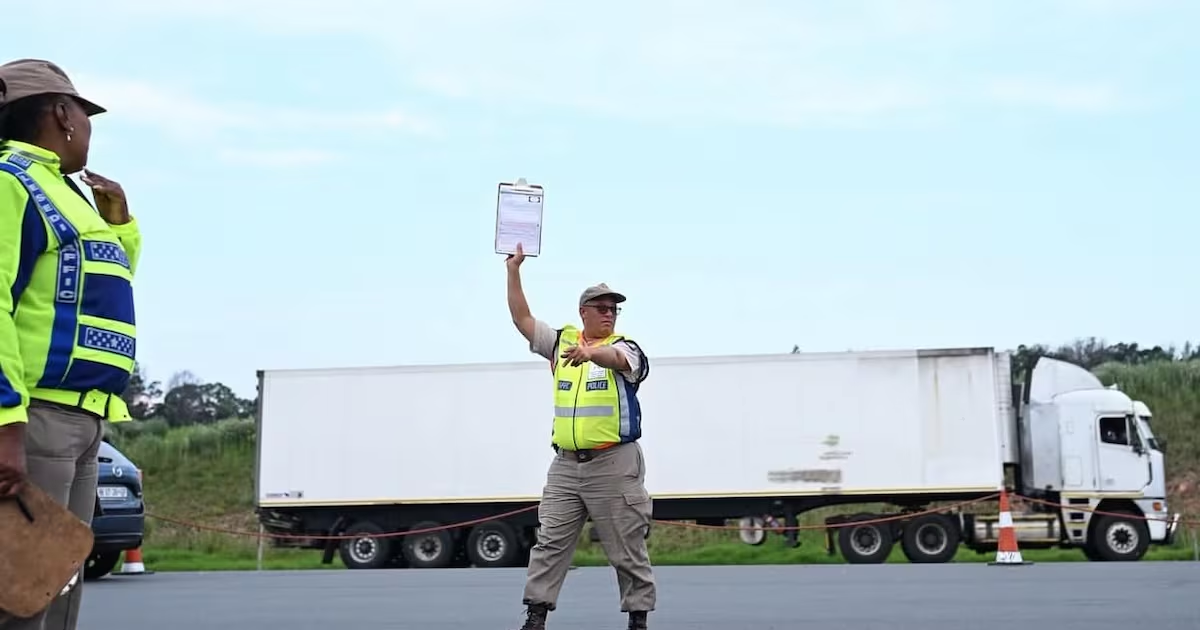
Today’s rollout of the controversial Administrative Adjudication of Road Traffic Offences Act (Aarto) system in 62 municipalities is going ahead after the latest failed court bid to stop it.On June 30 the North Gauteng High Court in Pretoria dismissed the case by the South African Local Government Association (Salga) to halt the rollout of the long-delayed system, which will include a licence demerit points system. Salga was concerned about the funding model underpinning the act and its regulations, saying the department of transport has failed to provide meaningful consultation or practical solutions. The association said municipalities were operating in an increasingly constrained fiscal environment, with limited resources to deliver essential services.The association approached the North Gauteng High Court to interdict Phase Two of the rollout, which devolves the issuing of traffic fines to additional municipalities. This placed an additional and unsustainable financial burden on councils, said Sebang Motlhabi, Salga chairperson for the public transport and roads working group.Salga noted with disappointment this week’s court ruling, the latest in a series of legal challenges to Aarto over the past two decades.“The current Aarto regulations, published in October 2025, impose financial burdens on municipalities without providing a sustainable financial model that will ensure effective implementation,” said Motlhabi.“This threatens municipal financial sustainability and risks diverting limited resources away from service delivery to cover the costs of implementing Aarto”.While disappointed at this week’s court outcome, Salga said the core issues wanted the court to provide relief on are yet to be argued, and its legal team is preparing to take the matter forward. The association said it was committed to working with government to improve road safety and strengthen law enforcement in a manner that is financially sustainable and equitable. “Road safety objectives must be balanced with the fiscal realities of local government,” said Motlhabi.Aarto is the government’s plan to removes the burden of minor traffic offences from traditional criminal courts and handle them administratively. With Aarto, drivers will be allocated points for offences and face suspension or cancellation of their licences if they accumulate too many, in addition to a fine. If this happens repeatedly, the licence is cancelled and the driver must, after a prescribed period, redo their learner’s and full driving tests from scratch.Aarto has been piloted in Tshwane and Johannesburg for more than a decade without the licence demerit system, but several previous attempts to expand its implementation have been delayed. The department of transport postponed the nationwide rollout from December 2025 after acknowledging shortcomings in municipal readiness, officer training, systems integration, back office capacity and funding. The organisation undoing tax abuse (Outa), a long time Aarto critic, earlier this week said the rollout remained clouded by uncertainty, with no comprehensive readiness report or implementation plan released and key regulations outstanding.On June 29 the government published proclamations 322 and 323 of 2026, giving effect to Phase 2 of the Aarto Act, together with the Aarto Amendment Act. The implementation officially commence on July 1 2026 in the municipalities listed in the proclamations.There are 62 municipalities listed including Tshwane and Joburg, but no municipalities within the Western Cape have been included in this phase of implementation.Licence demerit points are not part of the July 1 Aarto rollout and will be implemented during a later phase.
Aarto rolls out as Salga’s court challenge falls short
Municipalities warn rollout could divert resources from essential services
544 words~2 min read