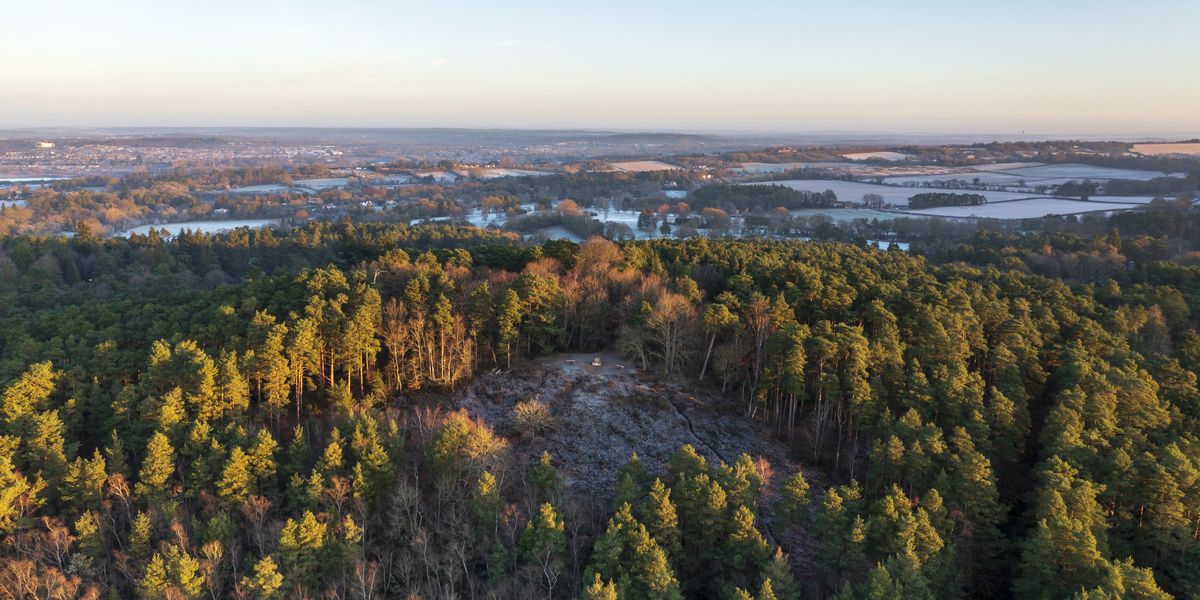
London has almost everything a heart could desire: non-stop entertainment, glorious dens of culinary indulgence, even more glorious dens of iniquity, parks and greenery, while always the near-constant whiff of history echoes around its famous streets.Yet for a Wicklow man born in the foothills of that county’s undulations, and one who naturally enjoys strenuous hiking, London has one glaring deficiency: there are few hills worthy of the name. Everything is so depressingly flat.There are a few piddly hills, mostly dotted around London’s north and west. There is a steep walk up to Harrow school that the locals call a hike, but any half-fit Wicklovian could conquer it before breakfast, walking backwards, while reading a book.Highgate Hill is neither high nor is it much of a hill by any sane measure; it’s more notable for its high ratio of Russian oligarch residents. The gradient of Primrose Hill, meanwhile, is about as scary as that place sounds.I live in south London, where Shooter’s Hill near Greenwich or Sydenham Hill near Crystal Palace are as good as you’ll get, which is to say – not very.So for an Irish man looking to get his bandy legs back in shape for an upcoming hiking trip to Kerry, there was only place to go: the North Downs of Surrey.About 45 minutes southwest of my neighbourhood by train is the very English-sounding station of Box Hill & Westhumble. From there it is a 10-minute walk to the foot of the eponymous Box Hill. It’s not Everest, but it does the trick.The first time I went, I noticed a warning-cum-advertisement in chalk on a blackboard as I passed the Burford Bridge Hotel near the beginning of the ascent. It pointed to the bar, where it said you’d find nice pints, contrasting this with the challenge of the “massive f***ing hill” to which it pointed in the other direction.I gave the sign a mountainy-man’s smug grin, eschewed the pints, and veered off the path to bound up the rough steps carved into the face of the ancient chalk hill.It had been a while since I had tried anything as steep. Within minutes, my smugness vanished as I panted like a dog. The Box Hill face has a gradient of 15 per cent, equivalent to setting a treadmill to its maximum incline and pounding it for 800 metres.[ Who could be the main players on Andy Burnham’s team?Opens in new window ]Just before the top, I stopped to pant some more on a grassy ditch. The “ditch” I had literally stumbled upon was really the grassy top of 120-year-old moat built around a fortification – the Box Hill Fort – that tells us much about a fear that still dominates English thinking: invasion.Towards the end of the 19th century, the French struck up an alliance with the Russians, which terrified Victorian Englanders, who feared an invading force could land on the southwest coast and easily march on poorly defended London. Their thinking was that if the capital fell, the empire would soon follow.Meanwhile, Britain’s navy was underfunded and decrepit compared to its rivals. The only thing for it was to build a massive defensive line to protect London.Between 1889 and 1903, the English built a network of forts on a 70-mile curved trajectory around the city. Each fort was to be stuffed with weaponry as well as thousands of picks and shovels. If an invading force threatened those could be easily retrieved by local volunteers to quickly dig a deep 70-mile trench to stop the invaders.By 1906, the scheme was already redundant. The fear of invasion receded in 1904 when Britain signed the Entente Cordiale with the French, while a rush of fresh investment in a new class of dreadnought battleships restored confidence in the navy’s ability to protect the British homeland from the sea.But to this day, that fear of invasion and war still dominates a part of the British, or more specifically the English, psyche. Bear that in mind as you observe the debates this week in Westminster over outgoing UK prime minister Keir Starmer’s new defence plan.[ Andy Burnham’s pledge to boost England’s north has a familiar ringOpens in new window ]The British, and specifically the English, fear an attack from Russia, perhaps as soon as 2030. Their military forces are underfunded and decrepit, just as they were when Box Hill Fort was conceived.On Tuesday, Starmer announced a plan to boost defence spending by £15 billion (€17 billion), which is a little over half of what military chiefs believe is necessary. Starmer’s riposte is essentially: by 2029 the military budget will be £80 billion while under the Tories it was £54 billion – what more do you expect me to do?Starmer made promises to US president Donald Trump and their Nato military alliance about the speed at which Britain would crank up spending on its armed forces. It seems those promises are unlikely to be met, but that will soon be Andy Burnham’s problem.Just like 1889, Britain – mainly England – feels vulnerable to attack. That is the psyche of the moment, the thread running through its politics.Meanwhile, I conquered Box Hill multiple times in preparation for the mountains of Kerry, which, alas, will probably conquer me.
Evidence of the English psyche’s greatest fear lies in Surrey’s hills
Britain believes it hears the war drums beating, which is why defence spending dominates Westminster thinking
871 words~4 min read