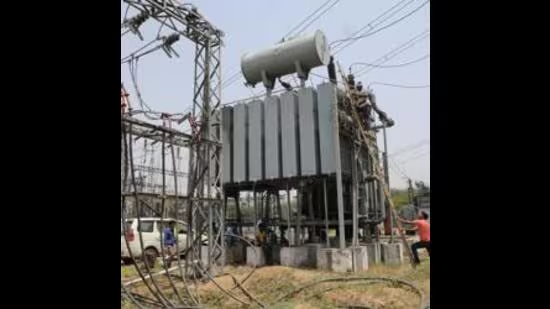
The Punjab State Power Corporation Limited (PSPCL) continued to grapple with soaring electricity demand on Tuesday amid an intense heatwave and ongoing paddy transplantation season, recording its highest-ever daily electricity supply of 3,862 lakh units (LU).To bridge the gap, PSPCL drew as much as 11,852 MW from the northern grid on Tuesday during peak hours while its own generation stood at around 6,000 MW, including 1,582 MW from its thermal power plantsPunjab’s peak power demand touched 17,035 MW on Tuesday, just shy of the season’s record 17,147 MW registered a day earlier.According to PSPCL data, the record supply, surpassing the previous all-time high of nearly 3,600 LU recorded a day earlier, still fell short of meeting demand, forcing it to impose unscheduled power cuts to maintain grid stability.On Tuesday, the total demand stood at 3,964 LU with an official deficit of 102 LU despite extensive purchases from power exchanges. On Monday, the shortfall stood at 126 LU against the supply of 3,683 LU.PSPCL officials said the actual demand was significantly higher than the recorded figures. “Around 800 MW of demand was being suppressed through load management and scheduled power cuts,” the official said, requesting anonymity.Farmers decry erratic supplyThe outages sparked protests by farmers under the banner of the Kisan Mazdoor Morcha (KMM) and Samyukta Kisan Morcha (SKM) at several places, including Hoshairpur, Jalandhar, Patiala and other districts. The protesters said the outages were affecting irrigation during the crucial paddy sowing season.“Farmers who had already sown paddy saplings are facing immense hardship as they are neither getting canal water nor electricity to run tubewells for irrigation,” said SKM activist Mukesh Kumar in Jalandhar.In Hoshiarpur, members of the Bharti Kisan Union (Doaba), led by its state president Manjit Singh Rai, staged a two-hour dharna outside the office of the executive engineer (XEN). KMM Punjab leader Sarwan Singh Pandher said protests were held at around 31 places. Addressing a gathering in Amritsar, Pandher alleged, “The government had promised daytime power supply, but farmers are not even getting a sufficient supply. We demand 16 hours of electricity supply for agricultural motors so that crops are not damaged.”Costly power purchases to bridge gapTo bridge the gap, PSPCL drew as much as 11,852 MW from the northern grid on Tuesday during peak hours while its own generation stood at around 6,000 MW, including 1,582 MW from its thermal power plants. Private independent power producers contributed around 3,036 MW, and hydel stations, including Ranjit Sagar Dam, contributed 995 MW.According to official data, it purchased about 659.93 lakh units of electricity at an average price of ₹8.25 per unit and another 384.80 lakh units at an average rate of ₹4.49 per unit, taking the day’s total expenditure at around ₹75 crore.PSPCL director (generation) Punerdeep Singh Brar said every effort was being made to supply uninterrupted power to farmers.“However, when our drawal from the central pool exceeds the prescribed limit of 10,700 MW, we receive warnings. In such situations, we have no option but to impose power cuts to maintain grid discipline,” he said.PSPCL managing director Basant Garg said to meet the unprecedented demand, the utility was drawing approximately 11,500 MW from the central pool and expressed hope that the advancing monsoon would ease the situation.“We expect the monsoon to become active over northern India in the coming days. This will lower temperatures, reduce demand, and provide respite to the state,” he said.Chief minister Bhagwant Mann said the state’s power grid was working efficiently to meet the demand.“Punjab’s power grid is functioning efficiently and has successfully met a peak electricity demand of more than 17,000 MW. All thermal power plants are functioning at full capacity, canals are flowing at 106% capacity, and paddy transplantation is nearing completion,” he said during an event in Dhuri.IMD forecasts rain relief from July 2The India Meteorological Department’s current forecast predicts a gradual increase in rainfall activity across the state within the next few days.The southwest monsoon is likely to advance into parts of Punjab over the next four to five days, bringing much-needed relief from the prevailing hot and humid conditions, according to the IMD’s forecast on Tuesday.“Favourable atmospheric conditions are developing for the monsoon’s further advance into parts of Punjab, Haryana and Chandigarh during the next three to four days,” the MeT department said.“Rainfall is likely to intensify from July 2, with moderate showers at many places across Punjab till July 6. Heavy rainfall is likely at isolated places in Punjab on July 2, 3, 4 and 6. The expected spell of rain is likely to provide respite from the prolonged heatwave and soaring electricity demand, while also benefiting the ongoing paddy transplantation season,” the release said.
Punjab: Power shortfall despite record supply sparks farmers’ protest
PSPCL’s record supply of 3,862 lakh units falls short of demand, forcing unscheduled power cuts; according to officials, the actual demand was significantly higher than the recorded figures
775 words~4 min read