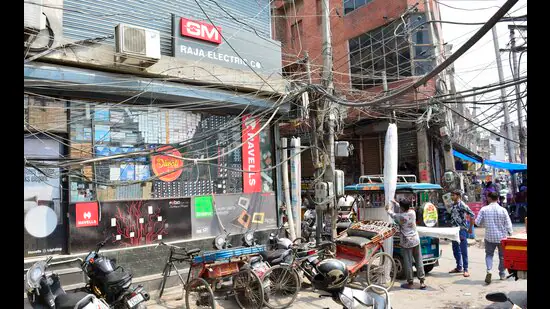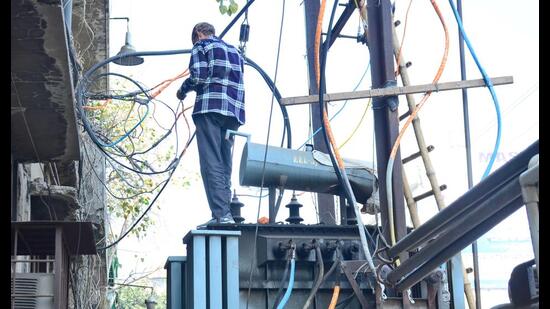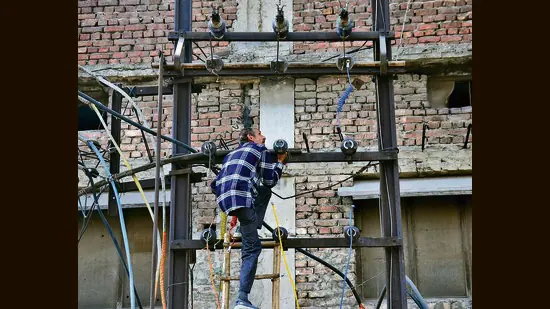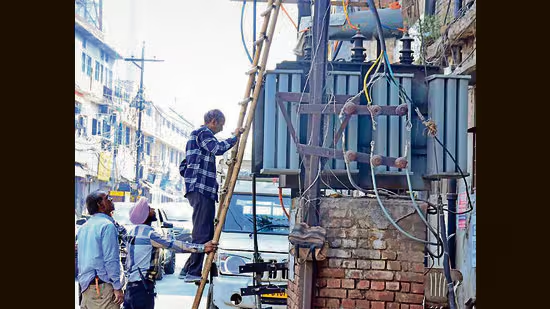
From villages struggling to irrigate freshly transplanted paddy to industries facing overnight power curbs and urban residents enduring repeated outages, electricity disruptions have intensified across Ludhiana as soaring demand continues to strain Punjab’s power network. With the return of scorching temperatures and peak paddy transplantation season pushing the state’s electricity demand beyond 17,000 MW, power officials have warned that load-management measures and intermittent outages may continue until weather conditions improve.Industries have also been hit by load-management measures. (HT File)The impact is being felt across the district.Farmers in several villages have complained of inadequate power supply for agricultural tubewells during the crucial paddy transplantation period, while industries across Ludhiana have been subjected to scheduled night-time feeder shutdowns to maintain grid stability.Residential localities, too, have witnessed repeated outages, voltage fluctuations and transformer faults over the past few days, disrupting both electricity and water supply in several areas.The growing public anger was evident on Sunday when members of the Bharatiya Kisan Mazdoor Union staged a protest outside the 66-kV Gausgarh Grid, alleging that they were not receiving the promised eight-hour power supply for agriculture despite the ongoing transplantation season. Union leaders warned of intensifying their agitation if the situation does not improve within the next few days.Industries have also been hit by load-management measures.Over the weekend, PSPCL imposed scheduled overnight shutdowns on several Category-II and Category-III industrial feeders across Ludhiana, including areas such as Miller Ganj, RK Road, Link Road, Moti Nagar and Textile feeders, to manage power shortages and maintain grid security.Upkar Singh Ahuja, president, Chamber of Industrial & Commercial Undertakings (CICU), said, “MSMEs are already battling labour shortages, weak global demand, rising raw material prices and logistics costs. Frequent power cuts have made the situation even more difficult. Production comes to a standstill during outages, delivery schedules get disrupted and operational costs increase. While we understand that power demand has surged due to the heatwave and paddy season, the entire burden should not fall on industries. The government must make alternative arrangements to ensure uninterrupted power supply.”According to the latest figures released by the Power System Control Centre (PSCC) on Monday evening, Punjab’s electricity demand touched 17,147 MW, among the highest recorded this season. The state drew 11,359 MW against a scheduled allocation of 10,594 MW, resulting in an overdrawal of 765 MW, while its own gross generation stood at 5,788 MW.The increase has been rapid. On June 10, Punjab’s demand stood at 16,059 MW, with an overdrawal gap of 247 MW and gross generation of 5,255 MW. Within less than three weeks, demand has risen by more than 1,000 MW, placing significant additional pressure on the transmission and distribution network.Residents across Ludhiana say the frequent outages have disrupted daily life, with repeated power cuts, voltage fluctuations and transformer faults affecting both electricity and water supply.Shweta Singh, a resident of Agar Nagar, said, “Power cuts have become frequent over the past few days. Even brief outages make life difficult because the weather is extremely humid. Water supply is also affected whenever electricity remains suspended for long.”Jahnvi Malhotra, a resident of Focal Point, said, “There is no fixed schedule for the outages. Electricity goes off several times a day, making it difficult to work from home and manage household chores. With the heatwave continuing, even a couple of hours without power becomes unbearable.”Power officials attributed the spike to the combined impact of rising temperatures and the ongoing paddy transplantation season. Agricultural tubewells are operating for longer hours across rural Punjab, while electricity consumption in cities has surged because of extensive use of air-conditioners, coolers and other appliances. The increased load has also resulted in transformers operating beyond their designed capacity in several locations, leading to frequent faults and longer restoration times.Chief engineer (Central Zone) Jagdev Singh Hans said the utility was closely monitoring the evolving situation and deploying additional field teams to minimise disruptions.“Electricity demand has increased sharply because of the prevailing heatwave and the ongoing paddy transplantation season. The entire power system is under considerable pressure, but PSPCL is continuously monitoring the grid and strengthening field operations to ensure maximum possible supply. Special attention is being given to overloaded transformers and vulnerable feeders so that faults can be rectified at the earliest. Temporary load-management measures may become necessary in some areas to maintain overall grid stability,” Hans said.Officials said Punjab continues to depend significantly on power drawn from the northern grid, while generation constraints at thermal and hydel stations have further tightened availability. With forecasts indicating that hot weather is likely to persist, electricity demand is expected to remain elevated over the coming days, meaning Ludhiana residents, industries and farmers may continue to face intermittent outages until pressure on the grid eases.
Ludhiana: Residents bear brunt of prolonged power cuts amid soaring demand
With the return of scorching temperatures and peak paddy transplantation season pushing the state’s electricity demand beyond 17,000 MW, power officials have warned that load-management measures and intermittent outages may continue until weather conditions improve
781 words~4 min read