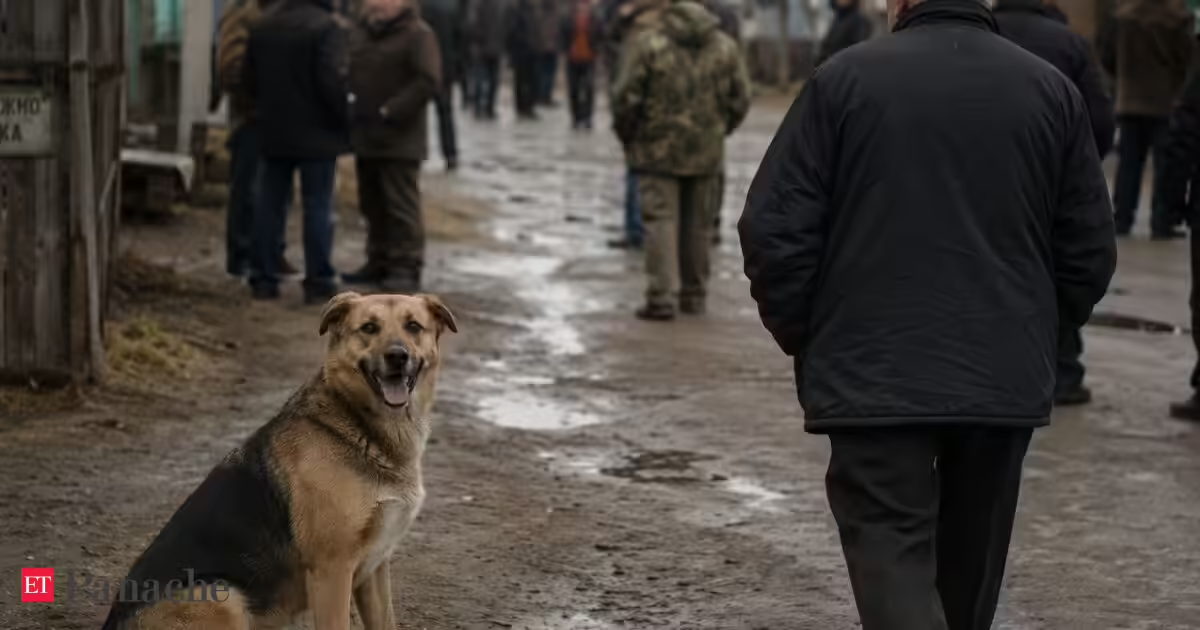
Russia's traditional sayings have travelled across generations not because of who first said them, but because people kept finding truth in them. Many of these proverbs were shaped by everyday life in villages, farms, and close-knit communities where observation often meant survival. One such piece of folk wisdom continues to remain relevant even today as it speaks about trust, hidden intentions, and the dangers that are not always easy to notice."Do not fear the dog that barks loudly and bares its teeth; fear the one that stays silent, wags its tail, but creeps up quietly from behind."This proverb does not come from a single author. It is a traditional Russian proverb that has been passed down through oral tradition for generations before being documented in collections of Russian folklore during the 19th century. Like many old sayings, it uses a simple image from daily life to explain a much larger truth about people and situations.At first glance, the proverb seems to be talking about dogs. But the real message is about human behaviour. A barking dog makes its presence known. It warns you that it may become aggressive, giving you time to react or protect yourself. The silent dog, however, appears calm and harmless until it gets close enough to attack. In the same way, the proverb suggests that people who openly express disagreement or anger are often easier to understand than those who quietly hide their intentions while pretending to be friendly.A lesson about hidden dangerThe main lesson behind this Russian proverb is that the greatest threats are often not the loudest ones. Open hostility can usually be recognised and prepared for. The more difficult challenge comes from people or situations that appear harmless while concealing harmful intentions.This idea applies to many parts of life. Someone who constantly praises you but secretly works against you can be more dangerous than a person who openly disagrees with you. The same thinking can also be extended beyond relationships. Harmful habits, poor decisions, or unhealthy routines often develop quietly without immediate consequences. By the time their effects become visible, the damage may already have been done.The proverb encourages people to pay attention not only to words but also to actions and behaviour over time. Trust should be built carefully rather than based only on appearances or pleasant conversations.The imagery used in this proverb comes from the realities of rural life in Russia and other parts of Eastern Europe. Working dogs were an important part of farms and villages, helping guard homes, livestock, and property. People living in these communities understood dog behaviour through everyday experience.A dog that barked loudly usually announced its presence before attacking. That warning gave people a chance to stay away or defend themselves. A quiet dog approaching from behind could present a much greater risk because there was little time to react.A proverb shaped by oral traditionUnlike quotations from famous writers or leaders, this saying has no recorded date or place of origin. It belongs to Russia's long tradition of oral folklore, where wisdom was shared through conversation rather than books.For centuries, proverbs were used to teach younger generations practical lessons about life, relationships, work, and decision-making. Many survived unchanged because they remained useful regardless of changing times.Researchers and folklorists began recording many Russian proverbs in published collections during the 19th century. By then, these sayings had already been circulating among ordinary people for generations, making it impossible to identify a single creator.Similar ideas found across culturesAlthough this specific wording comes from Russian and broader Slavic folklore, its central message appears in many cultures.An often-cited Latin proverb recorded by the Roman historian Quintus Curtius Rufus carries a remarkably similar warning: "Beware of a man who does not talk and a dog that does not bark." Even though the imagery differs slightly, both sayings caution against hidden danger rather than obvious aggression.English also has expressions that touch on related ideas. One familiar saying suggests that appearances can be misleading, while another reminds people not to underestimate quiet individuals. Although these expressions are not identical, they reflect the same broader understanding that visible threats are not always the most serious ones.A glimpse into Russian cultureRussia, officially known as the Russian Federation, is the world's largest country by land area, stretching across Eastern Europe and Northern Asia. Covering more than 17 million square kilometres and spanning 11 time zones, it is home to over 140 million people and more than 160 ethnic groups.The country's rich tradition of folklore reflects its long history and cultural diversity. Proverbs have played an important role in everyday life, preserving practical advice and moral lessons through simple, memorable language. Many of these sayings continue to be shared today because the situations they describe remain familiar across generations.
Proverb of the day from Russia: 'Do not fear the dog that barks loudly and bares its teeth; fear the one that stays silent, wags its tail, but creeps up quietly from behind...' Russian folk saying on why quiet threats can be more dangerous than obvious ones
The Russian proverb, "Do not fear the dog that barks loudly and bares its teeth; fear the one that stays silent, wags its tail, but creeps up quietly from behind," teaches that the greatest dangers are often hidden rather than obvious. Rooted in traditional Russian folklore, the saying reminds people to be cautious of deceit, concealed intentions, and silent threats, offering a life lesson that remains relevant in relationships, workplaces, and everyday life.
791 words~4 min read