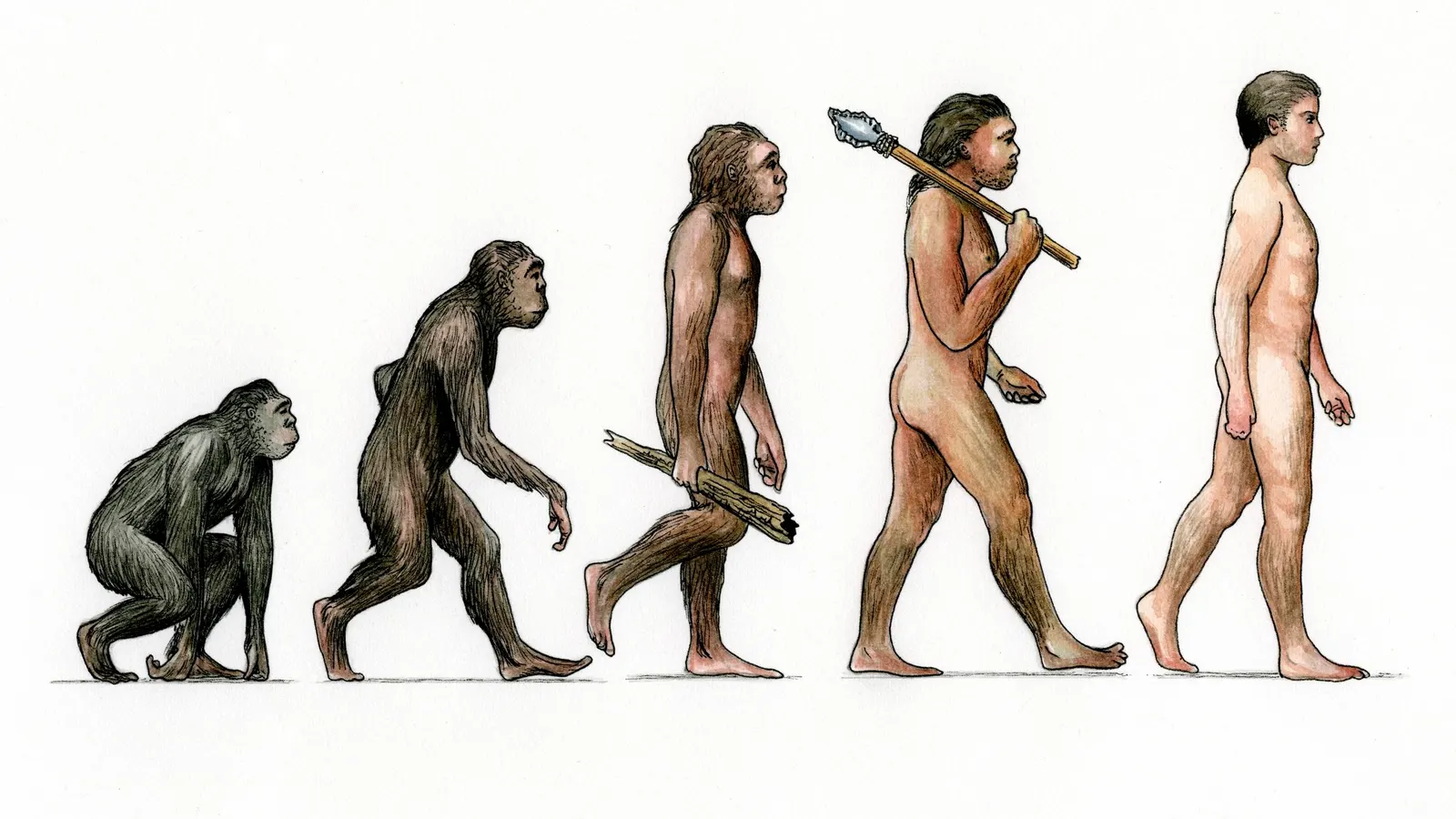
Evolution never actually stopped — every species alive today is still being quietly reshaped by selection pressure, generation after generation. We just live far too briefly to ever watch it happen.Print Collector/Getty ImagesEvery species alive today is the product of billions of years of continuous change. Evolution has sculpted every eye, venom gland and feathered wing on the planet, and it has never stopped. And yet to most people, the living world looks completely static. Nothing seems to be changing. The bird on a telephone wire looks exactly like the bird in a century-old field guide. Why, if evolution is always running, does it appear to have flatlined?The short answer is that evolution runs on a clock calibrated to geological time, and human lifespans are vanishingly small ticks on that clock. But the longer answer reveals something more interesting: the invisibility of evolution isn’t just a matter of patience. It’s a structural feature of how natural selection works, and when you understand that structure, evolution stops looking frozen and starts looking like something that’s happening everywhere, all the time, just beneath the threshold of what we can see.The ‘Invisible’ Clock Evolution FollowsEvolutionary biologists think about change in terms of generations, not years. For a species like the African elephant, with a generation time of roughly 25 years, a thousand years of evolution covers only about 40 generations. In other words, a stretch during which meaningful change is possible but rarely dramatic. For a species like us, with a generation time of around 25–30 years, a thousand years represents only 30 to 40 generations. You would need to observe dozens of human lifetimes stacked end-to-end just to accumulate the generational turnover that bacteria accomplish in a single afternoon.This is why bacteria are the organisms that most visibly evolve in front of us. A bacterial population can cycle through thousands of generations in a year, which is exactly why antibiotic resistance, a textbook example of natural selection in real time, as explained by a 2022 review in Nature Reviews Microbiology, emerges so quickly. The evolution isn’t different in kind from what’s happening to birds or mammals. The clock is just running faster.MORE FOR YOUEvolution’s Selection Pressure ProblemEven given enough time, evolution requires a second ingredient: selection pressure strong enough to move a trait across a population. Natural selection only focuses on traits that affect survival and reproduction. In stable environments, where most individuals are surviving and reproducing successfully on roughly similar terms, selection pressure can be weak or absent for long stretches. Without it, gene frequencies drift slowly and mostly randomly, a process biologists call genetic drift — real evolution, but directionless and almost imperceptibly gradual.What accelerates visible evolution is environmental disruption. When a habitat changes, when a new predator arrives or when a disease sweeps through, selection pressure spikes and populations can shift with surprising speed. A 2010 profile in PNAS summarizing four decades of field research documents exactly this in the Galápagos finches, whose beak sizes measurably shifted across just a few generations in response to drought-driven changes in food supply. The underlying machinery of evolution didn't speed up. The pressure on it did.When Cities Become Evolutionary LaboratoriesThe clearest evidence that evolution hasn’t stopped comes from an unlikely place: the urban sprawl of Puerto Rico. Over the past few decades, biologists studying crested anole lizards in San Juan have documented something remarkable. A 2023 study published in PNAS found that city-dwelling anoles have developed longer limbs than their forest-dwelling relatives, an advantage for sprinting across open, treeless urban spaces, and their toe pads have grown larger and more intricate, allowing them to grip smooth surfaces like concrete, glass and painted metal. When researchers tested the urban lizards’ heat tolerance, they found the city animals stayed active at temperatures roughly two degrees Fahrenheit higher than their forest counterparts. In evolutionary terms, a measurable physiological shift tracked to just a few decades of urban pressure.The anoles aren’t an outlier. House finches in Tucson, Arizona have developed longer and wider beaks than rural populations, suited to cracking sunflower seeds from backyard feeders. A mosquito form known as the London Underground mosquito, which thrives in sewers and subway tunnels and bites humans rather than birds, was long held up as a textbook example of rapid urban evolution. A 2025 study published in Science upended that story: its origins trace back over a thousand years, likely to early agricultural societies in the Mediterranean. The subway didn’t create it. It just found a new home there, which is itself a remarkable evolutionary story. Cities, it turns out, are functioning as high-intensity evolutionary pressure cookers. The habitat is novel, the food sources are artificial, the temperatures are elevated and the predators are different. Selection pressure, as a result, is unusually strong, and the pace of change has surprised even researchers who study it.What the urban examples make clear is that we can watch evolution happen when the pressure is high enough and the generation times are short enough. The lizard and the finch aren’t exceptions to the rule. They’re the rule, made visible.The Visibility Threshold Of EvolutionThere’s a deeper reason evolution seems invisible, and it has to do with what we’re actually looking at. Most evolutionary change happens at the level of gene frequencies within a population, in that, a slow statistical drift in which version of a gene is more or less common. That kind of change leaves no visible trace until it accumulates enough to shift a measurable trait. And even then, individual animals within a population vary so widely that a small directional shift in a trait’s average is lost in the noise of that variation. You would need careful measurement across generations to detect it.What we do notice, what feels like evolution to most people, is the dramatic end product: a fin becoming a limb, a reptile becoming a bird, an ape becoming a human. Those are the stories the fossil record tells in compressed hindsight. But they unfolded across millions of years and millions of generations, with no single step large enough to observe. Evolution produces its most spectacular results precisely because it has so long to work with such small increments.Think you understand how evolution really works? Find out how much you actually know with this science-backed quiz: Evolution IQ Test
Why Do We Never See Evolution Happen In Real Time? An Evolutionary Biologist Explains
Evolution is always happening — so why can't we see it? A biologist explains the timescale problem, election pressure, and species quietly evolving in cities right now.
1,050 words~5 min read