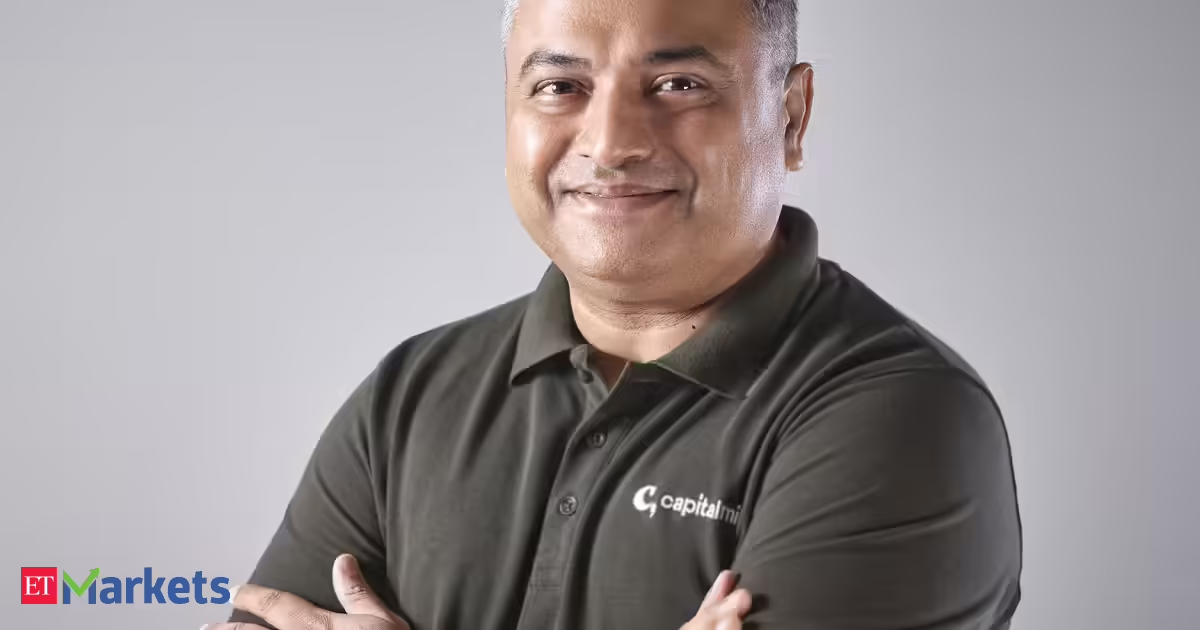
SynopsisIndia's equity markets are poised for a strong performance as falling commodity prices and easing supply chain issues are set to boost corporate earnings. Deepak Shenoy of Capitalmind Mutual Fund anticipates improved margins and sales volumes for businesses. While risks like monsoon vagaries and global inflation persist, the medium-term economic outlook remains robust, with asset-heavy sectors expected to lead market growth.ETMarkets.comIndia's equity markets are entering a phase of greater earnings visibility, with falling commodity prices and easing supply constraints expected to support corporate performance in the coming quarters, according to Deepak Shenoy, Founder and CEO of Capitalmind Mutual Fund.Commodity relief on the horizonSpeaking to ET Now, Shenoy noted that with crude oil trading below the $75 mark, the broader cost environment for India Inc. has improved meaningfully. He pointed out that recent disruptions had made the current quarter's results harder to forecast, as companies grappled with pressure on both margins and sales volumes.However, the outlook beyond this quarter looks considerably brighter. Shenoy highlighted that prices of key industrial metals, including gold and silver, have declined alongside other commodities, easing input costs for downstream manufacturers. He added that the availability of critical components, which had been in short supply for months, is also beginning to normalize. According to Shenoy, demand has remained resilient throughout the disruption, with supply-side bottlenecks being the primary constraint on growth. He expects clearer commentary from companies once quarterly results begin rolling in.Risks still lingerDespite the improving picture, Shenoy flagged several risks that could derail the recovery. A weak or erratic monsoon remains a wildcard for the broader economy, while geopolitical tensions continue to resurface periodically. Globally, demand-driven inflation in Western economies could still prompt central banks to raise interest rates further, even as domestic inflation pressures have eased somewhat. Even so, Shenoy expressed confidence in India's medium-term trajectory, suggesting the economy is on solid footing over a five-year horizon, even if equity markets take longer to fully reflect that strength.Valuations: A tale of two marketsOn valuations, Shenoy drew a sharp distinction between largecaps and the broader mid- and smallcap universe. He explained that he would be willing to pay significantly higher multiples, in the range of 20 to 22 times earnings or more, for companies growing around 25% annually, but would avoid similar multiples for businesses expanding at GDP-level rates of 10-12%. He noted that midcaps and smallcaps currently offer more disproportionate growth opportunities than largecaps.You Might Also Like:Shenoy also pointed to credit growth in the banking system reaching 18%, a level not seen in over a decade, as a meaningful signal. He attributed much of this growth to industrial capital expenditure, with banks channeling funds into corporate hands for capacity expansion, a trend he believes supports double-digit nominal GDP growth ahead.Banking sector leadership may shiftOn private banks, Shenoy addressed recent leadership changes at major lenders, including HDFC Bank, but downplayed concerns over governance disruption given their scale. He argued that retail-focused private banks are facing intensifying competition from public sector banks and smaller private players across credit cards, auto loans, and home loans, eroding the structural advantages they once held.He cautioned against expecting large private banks to return to historical valuation multiples of three to four times book value, suggesting a more realistic range going forward is between two and 2.5 times book, even in optimistic scenarios. Shenoy attributed this shift to margin compression and rising competitive intensity, even as overall credit growth in the sector accelerates.Outlook: Asset-heavy sectors to leadLooking further ahead, Shenoy predicted a structural shift in market leadership, with asset-heavy sectors such as manufacturing, defence, and infrastructure expected to outperform over the next five to ten years as capital expenditure cycles gather pace. He believes the composition of benchmark indices like the Nifty will look markedly different a decade from now, reflecting this rotation toward capital-intensive industries.You Might Also Like:Read More News on(What's moving Sensex and Nifty Track latest market news, stock tips, Budget 2025, Share Market on Budget 2025 and expert advice, on ETMarkets. Also, ETMarkets.com is now on Telegram. For fastest news alerts on financial markets, investment strategies and stocks alerts, subscribe to our Telegram feeds .) Subscribe to ET Prime and read the Economic Times ePaper Online.and Sensex Today. Top Trending Stocks: SBI Share Price, Axis Bank Share Price, HDFC Bank Share Price, Infosys Share Price, Wipro Share Price, NTPC Share Price...moreless(You can now subscribe to our ETMarkets WhatsApp channel)Read More News on(What's moving Sensex and Nifty Track latest market news, stock tips, Budget 2025, Share Market on Budget 2025 and expert advice, on ETMarkets. Also, ETMarkets.com is now on Telegram. For fastest news alerts on financial markets, investment strategies and stocks alerts, subscribe to our Telegram feeds .) Subscribe to ET Prime and read the Economic Times ePaper Online.and Sensex Today. Top Trending Stocks: SBI Share Price, Axis Bank Share Price, HDFC Bank Share Price, Infosys Share Price, Wipro Share Price, NTPC Share Price...moreless
Midcaps and smallcaps currently offer more disproportionate growth opportunities than largecaps: Deepak Shenoy
India's equity markets are poised for a strong performance as falling commodity prices and easing supply chain issues are set to boost corporate earnings. Deepak Shenoy of Capitalmind Mutual Fund anticipates improved margins and sales volumes for businesses. While risks like monsoon vagaries and global inflation persist, the medium-term economic outlook remains robust, with asset-heavy sectors expected to lead market growth.
816 words~4 min read