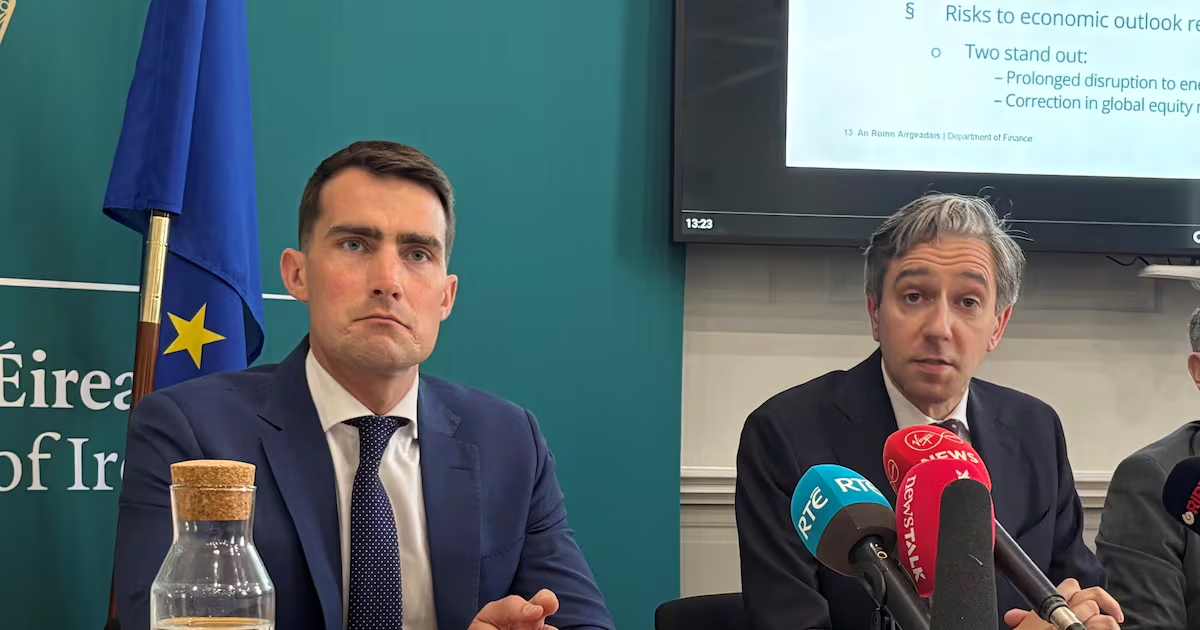
What income tax savings might we see in Budget 2027?Increase in standard rate bandIncrease in personal tax creditsBring the marginal rate of tax down from 52.2 per centAbolition of 3 per cent self-employment surchargeRe-introduction of pay-related social insurance (PRSI) ceiling on earnings in excess of €75,000Increase in small benefits exemption to €2,000With more than one million taxpayer “units” paying tax at the higher rate of 40 per cent on their incomes and an ongoing cost-of-living crisis, the pressure is on to deliver some form of relief in this October’s budget.Workers got no benefit last year from a cut in income taxes; this year, the Government is expected to avoid a repeat of that. After all, one tax is already due to go up in October: from the first of that month, PRSI will go up by 0.15 of a percentage point.While no figure has yet been put on the amount of money that will be available for tax cuts in Budget 2027, it now appears that there will be a move on this front.Speaking earlier this month, Minister for Finance Simon Harris said “economic progress must be felt not only in headline statistics, but in people’s pay packets and in their daily lives”, adding that increasing the point at which workers start to pay the higher rate of income tax had helped people keep more of what they earn.“We will consider further increases in that threshold as a practical way of ensuring wage growth translates into higher take-home pay,” he said. That is in line with what’s going on in other countries as inflation erodes people’s take-home pay. In Germany, for example, finance minister Lars Klingbeil is understood to be considering plans to raise the threshold at which the top tax rate, 42 per cent, applies, from €70,000.So what might be done to keep more of workers’ money in their pockets and out of the tax net? And how much might workers benefit?Bracket creepFirst, a word of caution: while tax reforms might be a welcome feature of Budget 2027, calling them “tax cuts” – regardless of Government rhetoric – might not be accurate.As our table shows, the numbers paying tax at the higher rate continue to rise, with more than one million “units” now paying tax at 40 per cent on at least some of their income. That is likely to indicate a higher number of people, as a “unit” can cover either individual taxpayers or those who are jointly assessed.Earnings are rising, but if tax bands don’t increase at the same pace, the real value of any wage increase people get is eroded.As we still don’t have indexation under which bands would be adjusted in line with inflation each year – the personal tax credit, for example, at €2,000, hasn’t been changed since 2024 – the lack of change seriously erodes what you get to bring home. Known as bracket creep, this happens when earnings rise, but tax bands don’t move at the same pace, pushing more taxpayers into higher tax brackets without an equivalent real improvement in their take-home pay.Any adjustment in this year’s budget is likely to be more akin to bringing bands into line with inflation – as opposed to offering hard-pressed taxpayers any real reductions in their tax burden.Potential for change Now to the potential changes. Policy in recent years has backed away from adjusting the actual rate of tax – the last time the higher income tax rate was changed, was back in 2014, when the then top rate of 41 per cent was cut by one percentage point. Instead, the focus has been on increasing the income level at which you move into the top tax bracket.Widening the bands, then, is seen as most likely. KPMG wants the entry point to the marginal income tax rate to align with the average wage, while Deloitte has suggested an increase in the band to €50,000 over the next three years, or an increase of about €2,000 a year.There have been suggestions of late that Harris wants those who earn €1,000 or less a week to pay tax only at the standard rate; this would suggest an increased band of €52,000, but it might take some time to get there. The last time this was done was back in the 2025 budget, when the standard rate band increased by €2,000 to €44,000. This saved taxpayers who were earning at least €42,000 some €400 a year.Increasing the upper end of the current standard rate tax band by €1,000 to €45,400 would cost €265 million in a full year, or almost €400 million if it were increased by €1,500. Doing the latter would put an extra €300 in your pocket over the course of a year, or some €600 for an eligible couple.This is a cheaper – if less beneficial – option than amending actual rates of tax. After all, cutting the tax rate can be an expensive endeavour. Figures from Revenue show that cutting the 20 per cent rate to 19 per cent would cost more than €1 billion in the first year. And bringing the 40 per cent rate down to 39 per cent would cost a further €567 million.Nonetheless, the top marginal rate remains particularly high – at 52.2 per cent, when USC and PRSI are included – putting it among the highest in the European Union, says Deloitte. In its pre-budget submission, the Irish Tax Institute says the upper limit on income taxes and social insurance should be no more than 50 per cent. Such a move would “somewhat ease cost-of-living pressures and support household consumption”, the representative body says. Deloitte also suggests a top combined rate of 50 per cent.This could be achieved by a cut to the marginal rate and a reduction in the universal social charge (USC).Reducing the rate of USC is expensive – cutting the 3 per cent rate to 2 per cent, for example, would cost almost €500 million a year. So another option is to widen the bands. Income of less than €13,000 is exempt from the charge. Pushing this up to €14,000 would keep more income earners outside of the USC net at a cost of €6 million in a full year.Targeting middle-income earners, another option could be to increase the level of earnings at which people start to pay the 3 per cent rate. At present, this applies to earnings of between €28,700 to €70,044. Increasing this by €1,000 to between €29,700 and €71,044 would cost €48 million in a full year.There could also be an increase in tax credits. Revenue figures show that increasing the single person’s credit by €100 would cost €127 million in a full year.Social insuranceAs previously mentioned, the rate of PRSI is due to rise this October; now some want to bring back the old PRSI ceiling. In its pre-budget submission, KPMG wants to see the reintroduction of PRSI contribution caps at €75,000 for employees and €100,000 for employers. This applied up to 2011 when it was abolished. It saved better-paid workers’ money by capping the amount of their income that is liable to the charge. Something the Government might also opt to look at is the three percentage point surcharge that self-employed people must pay on income over €100,000. The surcharge means that a PAYE worker earning €110,000 will pay €40,692 in total taxes this year, but if they are self-employed, they will pay an extra €300, or some €40,992 in taxes.The surcharge doesn’t bring in that much extra revenue, but it is repeatedly cited as being unfair.In its submission, Chartered Accountants Ireland argues that the surcharge “is inequitable and should be abolished”, citing the 2021 programme for government, in which it conceded that the surcharge “is unfair and proposals will be considered to ameliorate this over time as resources allow”.The Institute of Taxation also wants to see tax treatment aligned for all workers, arguing that the surcharge “does not comply with the principle of horizontal equity”.Reform small benefit exemptionThe small benefit exemption allows employees to benefit from a non-cash benefit of up to €1,500 a year – and pay no tax on it. According to PwC, the exemption “has been widely used and well understood”. But now there is a call for change.The Small Firms Association (SFA) wants the ceiling – last raised by €500 to €1,500 in January 2025 – increased to up to €2,000 a year. For a higher-rate taxpayer, this would work out at savings of €210 – provided, of course, that their employer gives them a benefit in the first place.The SFA would also like to see the introduction of smaller payments, or “incidental benefits”, which could be given tax free to employees. The association suggests a value of up to €75 for these, arguing that they should not be included in the overall €2,000 small benefit amount.There have also been calls to change the current system, under which employees can claim the relief for up to five benefits a year. According to PwC, this creates “unnecessary administrative complexity without delivering meaningful exchequer protection”.It wants to remove this “numerical cap”, as it would “give employers greater flexibility to recognise employee contribution”.
Income tax cuts are coming – but how much will they mean for you?
Various approaches open to Government but any change is likely to do little more than keep take-home pay rising more or less in line with inflation
1,526 words~7 min read