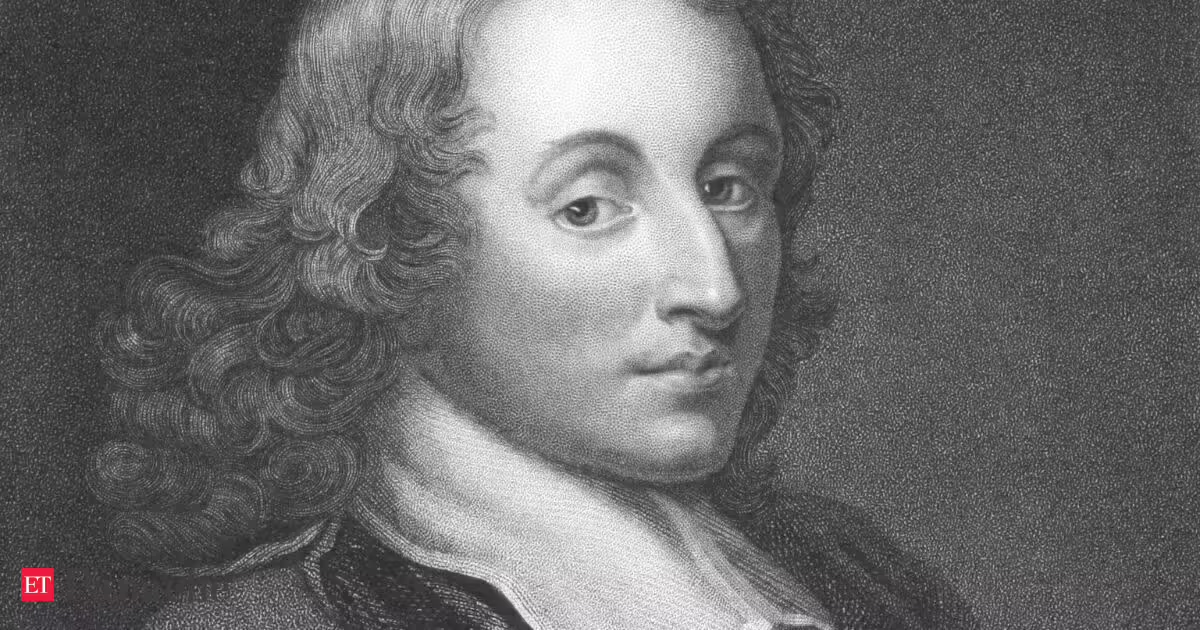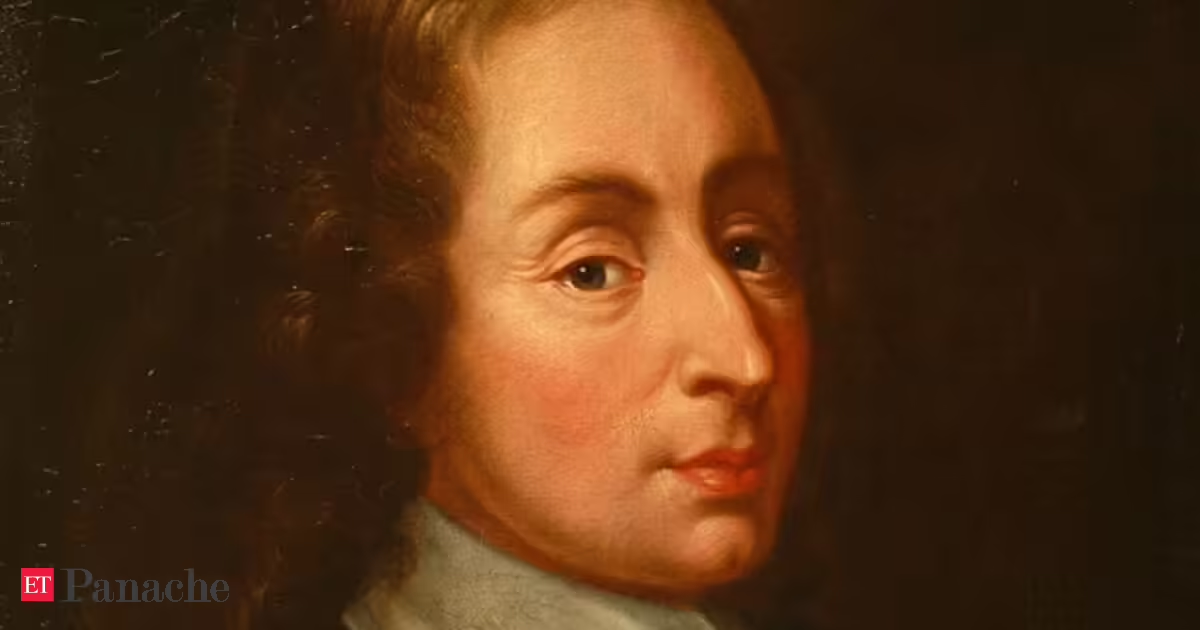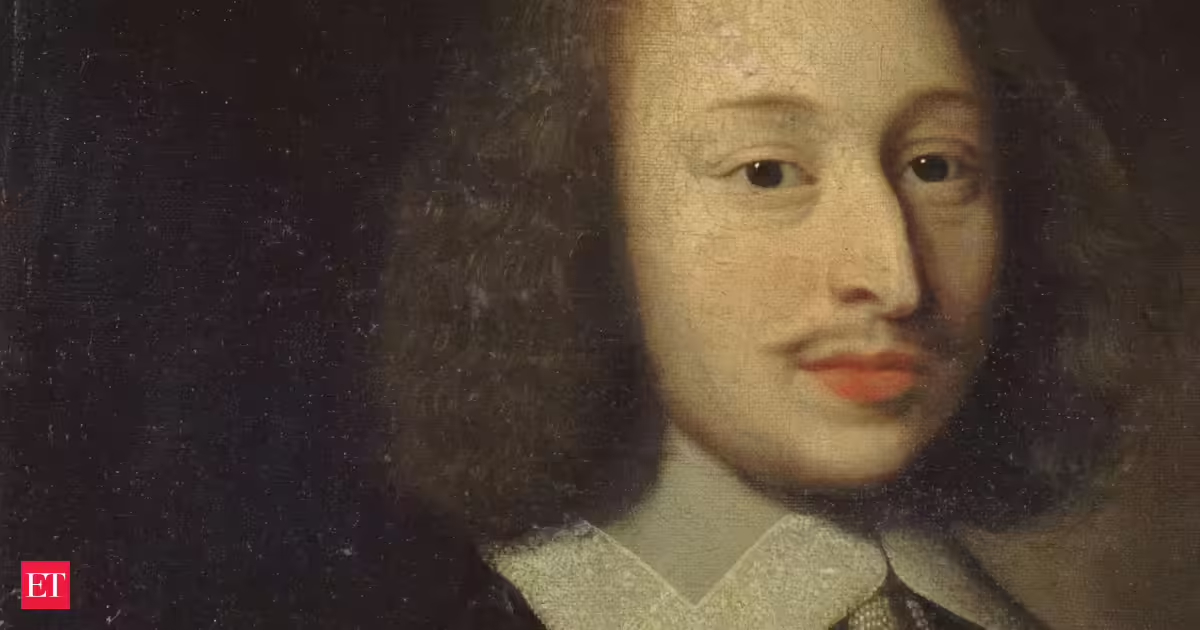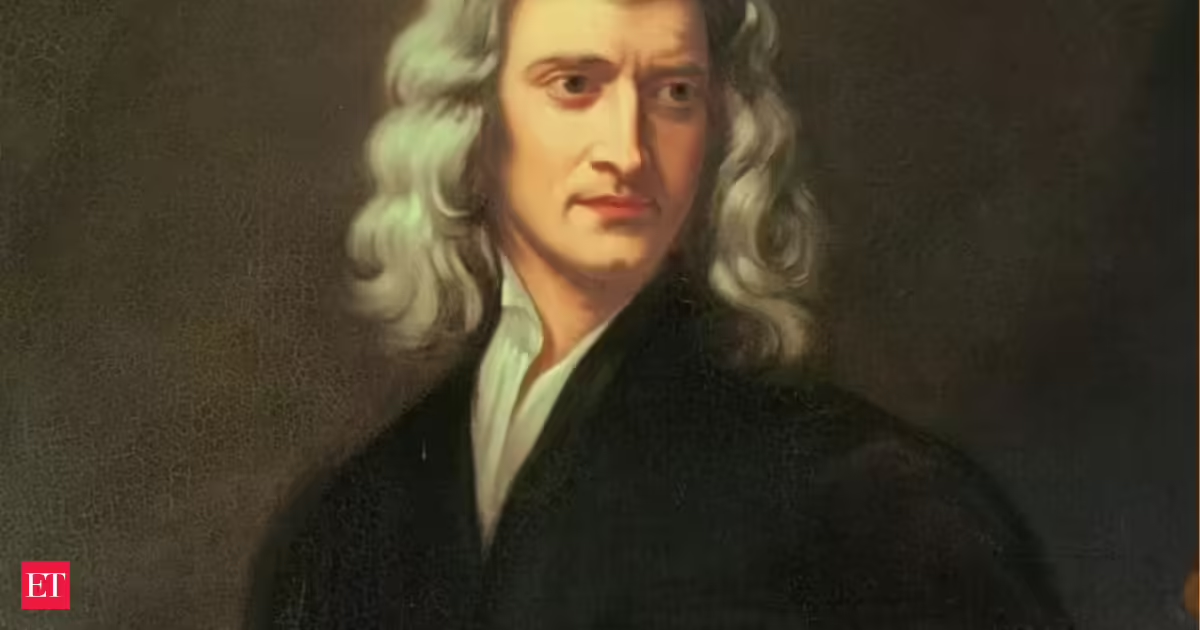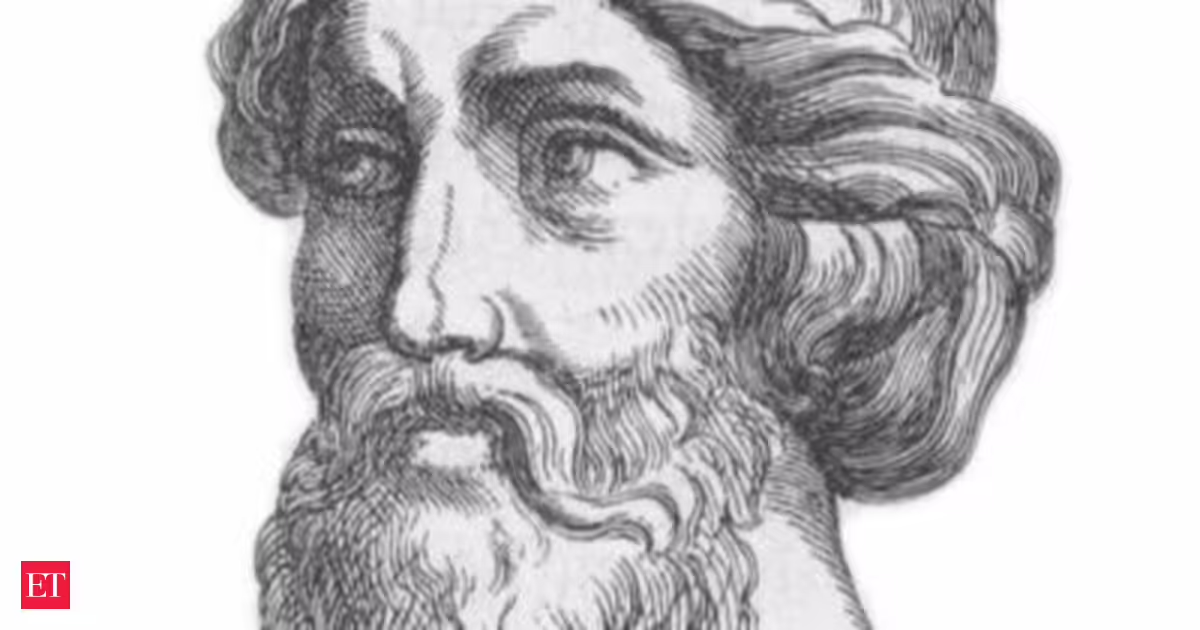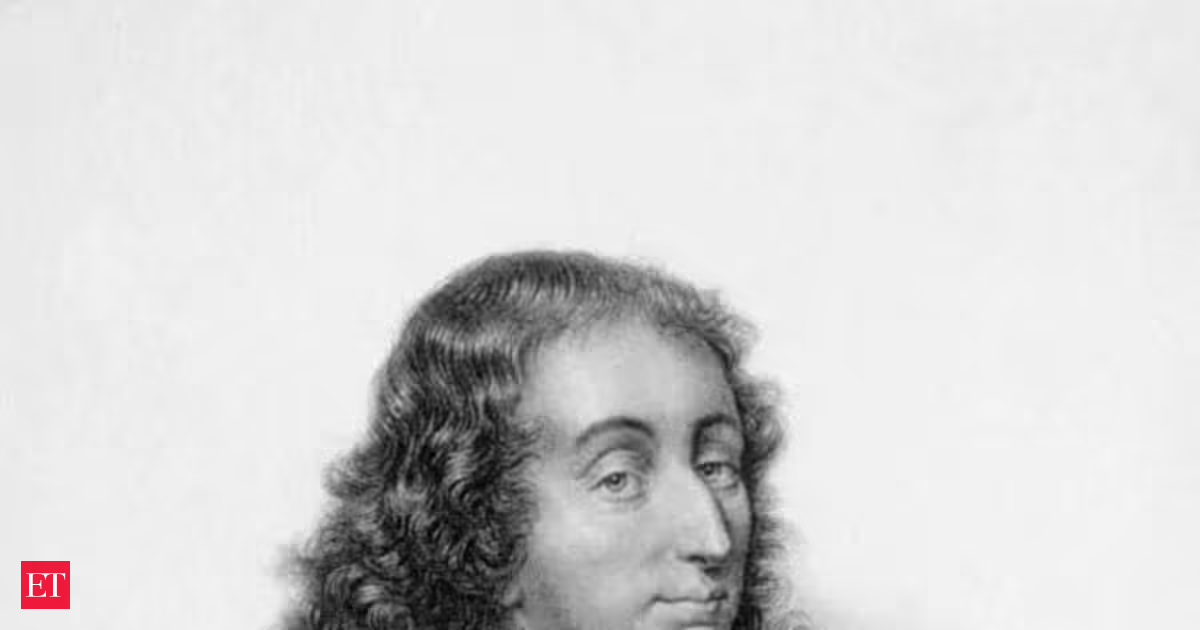
Quote of the day by Blaise Pascal forces us to stop and ask a question most of us avoid: who is actually in charge — the heart or the mind? When Pascal wrote these words in his unfinished masterwork Pensées in the 1650s, he was not talking only about romantic love. He was pointing at something far more unsettling. He was saying that beneath all our logic, calculations, and rational frameworks, something older and deeper is guiding us.Pascal, the 17th-century French mathematician and philosopher, understood that human beings are not purely rational creatures. The heart operates on its own quiet logic — one that the mind cannot always decode or control. This article explores the quote's deeper meaning, Pascal's extraordinary life, and the life lessons hidden inside his most celebrated words."The heart has its reasons of which reason knows nothing." — Blaise Pascal, Pensées Pascal spent his final years writing personal thoughts on human suffering and faith. These notes were published after his death in 1662 as a book called Pensées. His most famous philosophical argument is known worldwide as Pascal’s Wager. He used mathematical logic to examine religious belief. He stated that we are forced to gamble our lives on faith.His life teaches us that intellect and intuition must live together. A person can calculate the laws of the universe. Yet, they must still respect the mysteries of human emotion. He died in great pain at age 39. He left behind a legacy that bridges the gap between cold science and warm human experience.Deeper Meaning Behind the Blaise Pascal Quote of the Day on Heart and Reason To understand this concept deeply, we must look at how we experience reality daily. Reason builds logical arguments. It relies heavily on evidence, facts, and predictable outcomes. Meanwhile, the heart operates on a plane of direct experience and deep intuition. Pascal argued that the highest truths are felt rather than mathematically proven. Another famous line from his writings states that it is the heart which perceives God and not the reason.This duality shapes our human relationships in profound ways. We do not choose a partner based solely on a spreadsheet of traits. Instead, an inexplicable emotional spark guides our ultimate choices. Logic might warn us of risks. Yet, the heart willingly takes a leap of faith anyway. Pascal suggests this is not foolishness. It is a different, higher form of comprehension that protects our humanity.Pascal lived in a world on fire with new ideas. The Scientific Revolution was reshaping how Europeans understood nature, medicine, and the cosmos. René Descartes had declared that reason was the highest human faculty — that clear, logical thinking was the path to truth. Pascal, himself one of the greatest mathematical minds of his era, knew the power of reason intimately. He had invented a mechanical calculating machine, the Pascaline, at just nineteen years old. He had corresponded with Fermat to lay the foundations of probability theory. He understood numbers the way a musician understands sound. And yet, Pascal came to believe that reason had a ceiling. In Pensées, he wrote to convince skeptical, educated readers that faith in God was not irrational. His argument was subtle and brave: the heart, he said, perceives certain truths directly — truths that logic alone cannot reach. Love, faith, beauty, and moral conviction are not conclusions we reason our way into. They arrive through a different faculty entirely. The heart has its own epistemology, its own way of knowing, and reason often shows up late to that conversation. This is not anti-intellectualism. Pascal was not dismissing the mind. He was mapping a territory that the mind cannot enter alone. In doing so, he gave language to something every human being has felt — the moment you knew you were in love before you could explain why, the moment grief hit you like a wave before your brain had processed the loss, the moment you believed something deeply without being able to prove it. The heart, Pascal said, gets there first.Who Was Blaise Pascal — The Man Behind the Wisdom? To understand the quote, you have to understand the man. Blaise Pascal was born on June 19, 1623, in Clermont, France, a city now known as Clermont-Ferrand. His mother died when he was just three years old. His father, Étienne Pascal, was an unconventional man who believed children should not be forced into formal education too early. He actually banned mathematics books from the house, deciding young Blaise was not to study the subject before age fifteen. The ban backfired spectacularly. By age twelve, Pascal had begun teaching himself geometry in secret, independently rediscovering that the angles of a triangle sum to two right angles — a result Euclid had proven centuries earlier. When his father discovered this, he was so astonished that he gave the boy a copy of Euclid and allowed him to attend the intellectual salons of the mathematician Mersenne. By sixteen, Pascal had presented original theorems in projective geometry, including what is now called Pascal's Mystic Hexagon, to an audience of Paris's leading scientific minds. His adult life was a war between his enormous intellectual gifts and his fragile, pain-ridden body. He suffered from migraines, digestive illness, and chronic pain that made sleep difficult and work sometimes impossible. In 1646, two devout young men cared for his father after an injury, and their quiet faith left a permanent mark on Pascal. He experienced what he called a religious conversion, the first of two that would reshape his life entirely. The second conversion came in November 1654, after a terrifying carriage accident left him psychologically shaken even though he was physically unhurt. On the night of November 23, 1654, Pascal experienced a two-hour mystical vision so overwhelming that he sewed a record of it into the lining of his coat, keeping it next to his body for the rest of his life. After that night, he turned almost entirely toward God, theology, and the human condition. He died on August 19, 1662, at just thirty-nine years old, in intense pain, as a tumor spread from his stomach to his brain. His Pensées — literally "Thoughts" — was assembled from fragments after his death. It was never finished. What survived was a collection of shards, brilliant and raw, that have been read and argued over for more than three centuries.The Life Lessons Hidden Inside Pascal's Most Famous Quote Pascal's words carry lessons that go far beyond philosophy classrooms. The first lesson is about humility. If even reason — the tool we trust most — cannot fully account for what the heart knows, then certainty itself becomes a more complicated possession. Pascal spent his life moving between two worlds: the world of proof and the world of faith. He never abandoned either. He held them in tension, and that tension produced his deepest thinking. The second lesson is about the limits of self-explanation. We live in a culture that prizes self-awareness and the ability to articulate our feelings. We are supposed to know why we do what we do. But Pascal suggests that self-knowledge has a floor. Some of what drives us — what we love, what we fear, what we believe — operates below the level of verbal explanation. That is not a failure of introspection. It is a feature of being human. The third lesson is about trust. Pascal's wager, his famous argument for belief in God, rests on a probabilistic logic — but his deeper point was that some commitments cannot wait for certainty. You cannot reason your way into loving someone. You cannot calculate your way into having faith. At some point, the heart moves and the mind must follow. Pascal called this not weakness but wisdom. Among his other celebrated observations: "We are usually convinced more easily by reasons we have found ourselves than by those which have occurred to others." This speaks to intellectual ownership — the difference between borrowed conviction and genuine understanding. And: "Our nature consists in movement; absolute rest is death." Pascal believed restlessness was not a flaw but a sign of life, the soul's refusal to settle for anything less than what it was made for. Blaise Pascal died young, in pain, and largely misunderstood by the rationalists of his day. But the quote that has outlived him by more than three and a half centuries keeps finding new readers because it names something real. The heart has its reasons. And those reasons — quiet, stubborn, and immune to argument — may be the most important things we ever act on.
Quote of the day by the man who revolutionized probability theory, Blaise Pascal: "The heart has its reasons of which reason knows nothing." - Most influential and inspiring life lessons on love, wisdom, faith, and human nature
The quote of the day by Blaise Pascal reminds us that human life is rarely governed by pure logic. His famous words state that the heart has its reasons of which reason knows absolutely nothing. This profound insight explores the eternal conflict between human emotion and the analytical mind.
1,430 words~7 min read