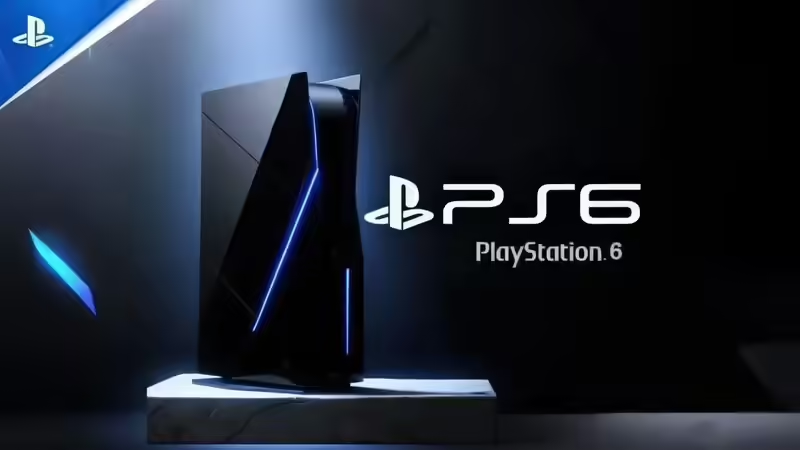
Photo credit: wccftech.comThe PlayStation 6 reportedly costs close to $1,000 in components to build, up from around $760 a few months ago, according to the hardware leaker KeplerL2 - a figure that lands before assembly, shipping, marketing or a single rupee of retailer margin. Sony has stayed silent on all of it. The console remains unannounced. Yet the number has set the gaming industry on edge, because of what it implies about a generation of hardware arriving into the worst memory market in decades.Treat the figure with the caution a forum leak deserves, and the story still matters. The reason sits one layer beneath the headline. Apple met the same memory crunch this year and chose the obvious exit: it raised prices and protected its margin. Sony has no such exit, or at least no painless one, because the console business runs on a model that assumes the hardware is sold at a loss. A bill of materials approaching $1,000 takes a strategy the industry has leaned on for twenty years and bends it close to breaking. This is the rare leak that reveals a structural problem rather than a spec.What the leak actually saysStart with the claim and who made it. KeplerL2, a leaker with a track record on PlayStation silicon, posted on the NeoGAF forums that the PS6's bill of materials - the combined cost of every component in one console - has risen by roughly $200 since an earlier estimate, taking it from about $760 to close to $960. Several outlets that track his record treat the figure as credible, while stressing it stays a projection rather than a confirmed cost.The detail that trips people up is what a bill of materials leaves out. It counts the parts. It skips assembly, the packaging and logistics of moving a box across the world, the retailer's cut, and the enormous sunk cost of research and development. So a $960 component bill describes the parts alone, rather than the finished console's price. Read the other way, it means a launch price meaningfully higher than that if Sony wants to avoid bleeding money on every unit - analysts reading the same leak put the implied sticker somewhere between $1,100 and $1,200.The leaked silicon explains where the money goes. KeplerL2 has previously described the PS6 as carrying 30GB of GDDR7 memory and a 1TB SSD, built around an AMD chip codenamed Orion. Those two storage and memory lines are precisely the components caught in this year's price storm. He also makes a sobering point about timing: the specs are locked, the Orion investment is already committed, and a delay would buy Sony cheaper parts only if memory prices fall, which few expect soon.Why memory is the culpritThe villain here is the same one stalking the rest of consumer tech. AI data centres are consuming the world's supply of high-speed memory and flash storage, and the resulting scarcity has pushed prices up several times over, with little relief in sight. KeplerL2's revision tracks that curve directly - the $200 jump in the PS6's build cost maps onto the months in which memory contract prices spiked hardest.The forecasts make grim reading for anyone shipping hardware in 2027. Micron's chief executive has warned that memory costs will stay elevated for around five years. Microsoft has been blunter still about its own consoles: it has said storage and memory prices have already risen more than 2.5 times and that it expects another doubling by the autumn of 2027, with the market set to recover only beyond the end of 2028. A PS6 built in that window inherits the worst of it.The cruelty for a console is that memory is structural, rather than a trim level a maker can shave. A phone can ship with less RAM at the low end. A console targets a fixed performance bar that developers build against for years, so the 30GB of GDDR7 is effectively locked in if the machine is to do what its games demand. Downgrading that memory would mean downgrading the generation itself, which leaves Sony tied to it. That rigidity is exactly why the memory line on the bill of materials hurts so much: it is both expensive and fixed.This is the same flood that forced Apple's hand earlier this year, surfacing in a different product. The difference is what each company can do about it.Why consoles struggle to do what Apple didHere is the analytical heart of the matter. Apple sells hardware at a healthy margin and, when components spike, passes the increase to the buyer while keeping that margin intact. The console business inverts that logic. For two decades, Sony and Microsoft have sold their machines at or below cost - a loss leader - and recovered the money later through game sales, accessories and subscriptions. The hardware is the bait; the software and services are the catch.The maths of that model assumes a manageable gap. Consoles have traditionally been subsidised by only around $100 to $200 a unit, a loss the maker swallows to build the install base that fuels years of software profit. A bill of materials near $1,000 detonates that assumption. Subsidise a $1,000 console down to a palatable $700, and Sony eats roughly $300 a unit across tens of millions of machines, a number that turns the install-base strategy into a haemorrhage. Price the console to cover its cost, and the sticker climbs toward $1,100 or beyond, which throttles the very install base the software business depends on.That is the trap, and it has no comfortable floor. Apple's dilemma was how much of a price rise its customers would tolerate. Sony's dilemma is sharper, because its whole business is engineered around selling the box cheaply enough to get it into living rooms, then earning out over a decade. A console priced like a premium laptop breaks the funnel at the top. Fewer machines sold means fewer copies of games sold, fewer subscriptions, fewer in-game purchases - the loss compounds rather than recovering.Microsoft faces the identical squeeze with its next-generation hardware, and its public messaging has already conceded that prices will climb. The shared predicament hints at where both may turn: toward subscriptions and the cloud, where a player pays monthly for access rather than once for an expensive box. A $1,000 build cost is, in that sense, the strongest argument cloud gaming has ever been handed.The numbers that make it worseThe projections beyond the base figure deserve a careful, conditional reading, because each one stacks an assumption on the last. If memory keeps climbing through to a rumoured 2027 release, some readings of the leak suggest the build cost could reach $1,400 to $1,500 a unit. Those are estimates built on estimates, and worth treating as a worst-case rather than a forecast. The direction, though, is the point: every projection points upward, and every analyst modelling it sees the curve holding upward until at least 2028.The delay question only deepens the bind. The instinctive response to an unaffordable launch is to wait, yet KeplerL2 argues a delay would help Sony only if component prices fall, and the consensus says they will rise first. A later launch on locked specs could cost more to build, rather than less. Indian retail trackers have noted Sony is reportedly weighing a slip to 2028 or even 2029 precisely because of the chip crisis, which would push the PS6 into a window where memory may finally ease - at the cost of stretching the ageing PS5 generation years past its prime, with developers already pressing against its ceiling.Sony, in short, faces a choice between launching into the teeth of the shortage and waiting it out while rivals and the cloud erode its position. Neither path is clean.Sony is already raising pricesThe leak lands in a year that primed the ground for it. Sony pushed through a fresh round of console price increases from April 2026, and they were steep. In the United States, the standard PS5 rose to $649.99 and the digital edition to $599.99, while the PS5 Pro jumped to $899.99 - a $150 increase that pushed the mid-cycle machine into genuinely premium territory. Sony has openly acknowledged that it is monitoring the global memory market while it weighs PS6 pricing and timing.The wider market has handed both console makers cover to go higher. Microsoft raised Xbox hardware prices by $100 to $150 and signalled more increases ahead. And Valve priced its new Steam Machine above $1,000, the controller sold separately, becoming the first mainstream gaming device to cross a line that once seemed unthinkable. Each of these moves softens the shock of the next. By the time a $1,000-plus PlayStation arrives, the four-figure console will already feel less like an outrage and more like the going rate.That normalisation is its own quiet story. A price that would have triggered a backlash in 2020 now reads as continuity with a market that has been climbing for two years.What it means for IndiaFor Indian players, the warning lands harder, and the existing prices show why. The PS5 disc edition carries an official price of around Rs 54,990, with the digital edition near Rs 44,990, and even those figures sit higher than a straight conversion of the dollar price thanks to import duty and tax. The PS5 Pro tells the starker tale: Sony has yet to launch it officially in India, and grey-market and retail listings run anywhere from roughly Rs 80,000 to past Rs 1,00,000.Now apply the mechanism that already inflates every imported gadget in India. A console reaches the country as a finished import, carrying customs duty and 18 per cent GST before any local margin, on top of a dollar base that the memory crunch has already pushed up. Run a PS6 with a build cost near $1,000 through that stack and the rupee outcome climbs steeply. The precise figure waits on Sony's pricing and the rupee, so treat it as an estimate, yet a PS6 landing comfortably north of Rs 1,00,000 - plausibly in the Rs 1,10,000 to Rs 1,30,000 band at launch - sits squarely within the range these numbers imply.At that level the calculation changes character. A PS5 at Rs 54,990 is a serious purchase for an Indian household, but an attainable one for the committed gamer. A PS6 past Rs 1,00,000 reframes the console as a luxury object, competing for the same wallet as a high-end phone or a used motorcycle. The mainstream Indian gamer, the one Sony would need to build an install base in a price-sensitive market, may simply be priced out - the same way the memory crunch lands heaviest on the buyers with the least cushion. India has long absorbed console pricing as a premium tax. A four-figure-dollar PS6 turns that tax into a wall.That wall is also why the cloud question matters more here than almost anywhere. In a market where a four-figure-dollar console prices out the mainstream, streaming a game library for a monthly fee, rather than buying an expensive box outright, may be the route that actually scales. India's uneven broadband complicates the pitch, yet the economics push hard in that direction. The same build cost that threatens the console in the West could quietly accelerate the shift to subscriptions and cloud in price-sensitive markets like this one - turning a hardware problem into a services opportunity for whoever moves first.The sceptic's readA fair counter deserves room. This is a forum leak, unconfirmed by Sony, and bills of materials are moving targets - component prices ease, manufacturing yields improve, and the cost of building any console falls across its life. The $1,400-to-$1,500 projection in particular rests on a chain of assumptions that may crumble. Sony also retains levers the panic tends to ignore: a leaner SKU, a heavier push into PlayStation Plus and cloud streaming to recover margin elsewhere, a battery of bundle economics, or simply the patience to wait for memory to normalise.History adds perspective too. The PlayStation 3 launched in 2006 at $599, a price widely judged ruinous at the time, and the platform recovered. Sony has survived a costly launch before and learned from it. The counter-counter is that 2006 had no AI-driven memory shortage with a five-year warning attached, and no rival cloud model waiting to absorb the players a pricey box turns away. The strategic squeeze is real. The exact numbers are soft. Both can be true.What to watchThe signal worth tracking is Sony's eventual response rather than the next revised leak. Watch whether Sony holds the 2027 window or slips the launch to let memory cool, whether it leans harder into subscriptions and cloud to offset an expensive box, and whether GTA VI and the rest of the generation's heavyweight software arrive in time to justify the upgrade at whatever price emerges. The through-line connects back to the same root that forced Apple's hand: a memory market reshaped by AI, squeezing every device that needs RAM and storage. Apple could pass the cost to its customers and move on. Sony's harder task is to find a way to sell a console that may cost nearly $1,000 to build while sparing its players a price-out and itself a loss on every sale. The PS6, whenever it arrives, will be the clearest test yet of whether the loss-leader console can survive the age of expensive memory.end of article
Why the PS6 Could Cost Nearly $1,000 to Build as Memory Soars
A trusted leaker puts the next PlayStation's component bill close to $1,000 before Sony adds a cent. The deeper problem is that consoles, unlike Apple, were built to swallow that cost rather than pass it on.
2,229 words~10 min read