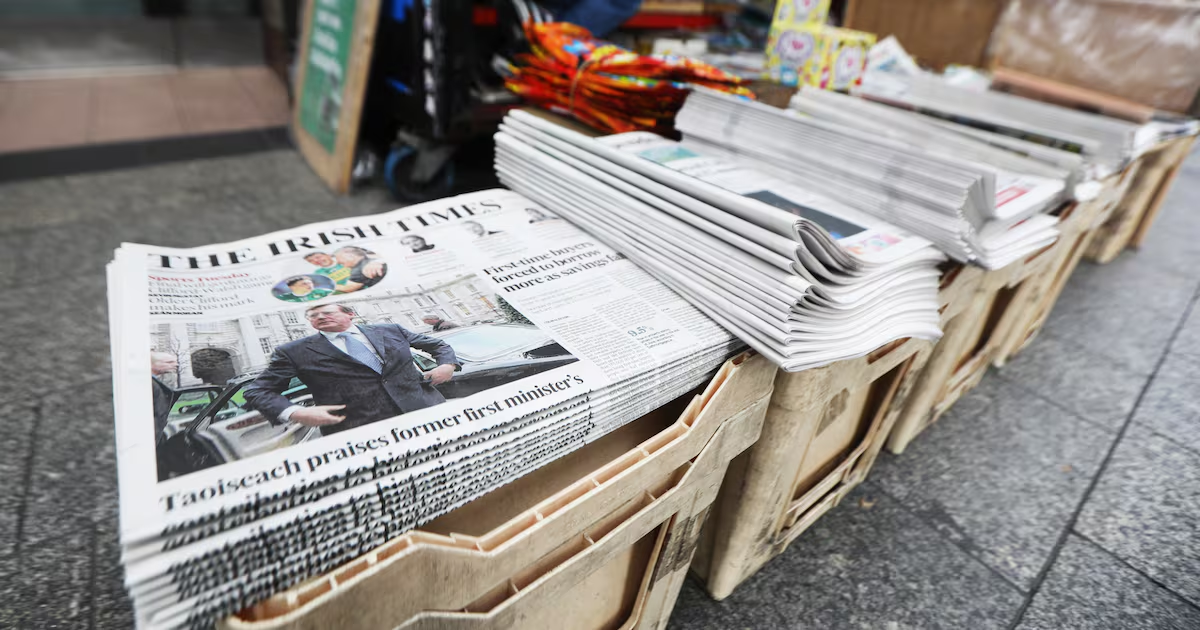
People in Ireland are more likely to trust individuals than political parties, the civil service or the media, according to a report from the Central Statistics Office (CSO).The findings of a nationwide survey on trust, carried out last year by the CSO, were published on Monday.They show that almost eight in 10 respondents (78.7 per cent) said they trusted most people, down from 82.5 per cent in 2023, when the previous survey was carried out. Trust in the electoral system was ranked next highest at 77.3 per cent. The percentage of respondents who trusted the courts and the legal system (68.2 per cent) and An Garda Síochána (69.5 per cent) were largely unchanged from 2023. Trust in the civil service was down from 66.5 per cent in 2023 to 64.2 per cent.A similar proportion of respondents trusted the national government (43.8 per cent), local government (44.2 per cent), the Oireachtas (45.9 per cent) and the media (46 per cent). People aged 50 and over had higher levels of trust in the national government than younger age groups. However, trust among this cohort fell from 58.3 per cent in 2023 to 51.1 per cent last year. By comparison, trust among respondents aged 18 to 29 increased from 31.4 per cent to 36.3 per cent during the same period, narrowing the gap between the younger and older age groups.Younger respondents were more likely to trust the electoral system than older respondents, with 82.8 per cent of those aged 18 to 29 trusting it, compared with 76.9 per cent of those aged 50 and over.Trust in international organisations, such as the United Nations, decreased from 63.7 per cent in 2023 to 57.4 per cent last year. The survey monitors people’s self-reported trust in different institutions and levels of government across countries in the Organisation for Economic Co-operation and Development (OECD). In Ireland, the CSO conducted the online survey from September 29th to November 15th last. Questionnaires were sent to 6,000 people and 2,197 valid responses were recorded.Respondents were asked to rate their trust in people, government and public institutions on a scale of zero (’not at all’) to 10 (’completely’). This was the third round of the survey with previous rounds taking place in 2021 and 2023.Commenting on the latest results, CSO statistician Sarah Crilly said: “Our analysis shows that a higher percentage of respondents had trust in most people when compared with trust in other institutions that were included in the survey, such as political parties, the civil service or the news media.”The survey found poorer levels of trust regarding healthcare and the use of artificial intelligence (AI).Almost four in 10 (37.2 per cent) men were satisfied with the healthcare system, compared to fewer than three in 10 women (27.4 per cent).Four in 10 (40 per cent) respondents thought it likely the Government would provide appropriate support to affected people in the event of an economic crisis, while just under half (48.1 per cent) of respondents thought it was unlikely.Almost two-thirds of men (63.7 per cent) and nearly half of women (49.1 per cent) reported they understood AI well and could explain it to others. About half of respondents (49.9 per cent) were not confident in the Government’s future use of AI in providing services that are better tailored to individual needs, while 33 per cent said they were confident.
People ‘have more trust in individuals than political parties, civil service or media’
CSO report finds older people are more likely to trust government, while younger people have more faith in electoral system
558 words~3 min read