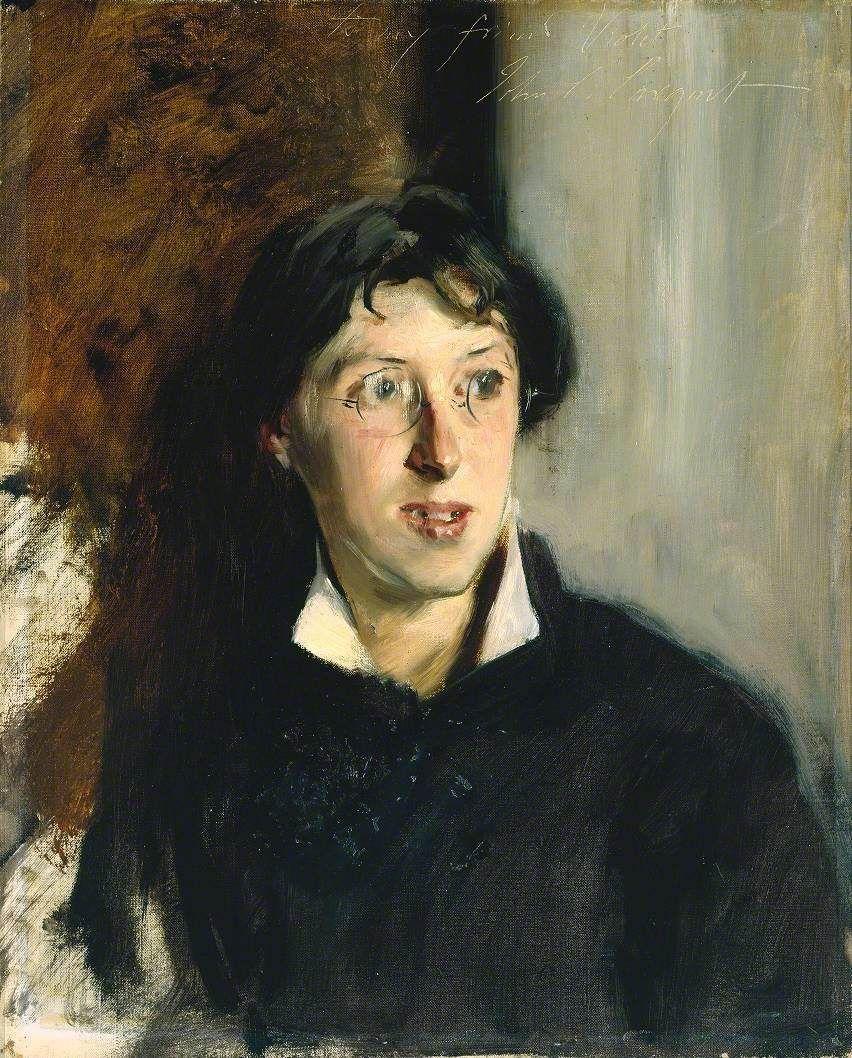
Vernon Lee’s ghost stories explore what it takes to resist male gaslighting and what it means to believe women.Hauntings by Vernon Lee. Smith & Taylor Classics, 2025. 198 pages.Did you know LARB is a reader-supported nonprofit?LARB publishes daily without a paywall as part of our mission to make rigorous, incisive, and engaging writing on every aspect of literature, culture, and the arts freely accessible to the public. Help us continue this work with your tax-deductible donation today!A WOMAN SITS alone, unarmed, on a living room couch near a bay window. Outside, a man drags a male witness to that window to gaze at the menacing sight through the glass: the woman sitting by herself. “Do you believe [me] now?” the man whispers. Before the witness can stop him, he thrusts open the window, leaps inside, and shoots the woman dead. Having sought rather than avoided the witness’s presence, the murderer insists his actions were justified.The horror evoked by this scene in Vernon Lee’s 1886 novella “Oke of Okehurst” (sometimes published as “A Phantom Lover”) feels visceral to those of us who have watched ICE agents kill Minnesota citizens during President Donald Trump’s federal occupation of the city of Minneapolis. In the case of Renée Nicole Good, an unarmed woman fatally shot through her car window by ICE agent Jonathan Ross, government officials offered Ross’s cell phone footage as evidence to justify his use of deadly force. Vice President J. D. Vance encouraged Americans to watch the video: “Many of you,” he posted on X, “have been told this law enforcement officer wasn’t hit by a car, wasn’t being harassed, and murdered an innocent woman. The reality is that his life was endangered and he fired in self-defense.”Both forms of political terrorism—the murder and the rewriting of its meaning—are part of the administration’s efforts to impose authoritarian rule. Fascism demands control not just over our lives but also over our truths. Vance attempted to redefine reality, to gaslight us by dictating who poses a mortal threat (a queer woman who gently mocked a white man) and who deserves the status of sympathetic victim (the white man mocked by the queer woman). The goal is to make you believe his words over your own eyes and ears.Vernon Lee (1856–1935) knew what it felt like to be gaslit by a powerful man. Born Violet Paget, Lee was a late-Victorian lesbian art critic, essayist, and fiction writer whose vast oeuvre lay dormant until feminists began recovering its treasures in the 1980s and ’90s. Her literary revival continues apace. Recent critics have drawn attention to her meditations on the psychology of art and her unpopular pacifism during World War I, but above all, they have pointed to her reign as the “forgotten master of the ghost story.” Now, a new edition of Hauntings (1890), Lee’s first collection of supernatural tales, keynoted by “Oke of Okehurst,” sets out to introduce her fiction to a wider audience.Allison Miriam Woodnutt (née Smith) and Brandon Taylor of Smith & Taylor Classics aim to show horror fans that Lee’s ghost stories aren’t just masterful; they’re also masterfully queer. The editors place Lee’s collection in conversation with contemporary queer horror authors Gretchen Felker-Martin and Kayla Kumari Upadhyaya. In a refreshingly dialogic afterword, Felker-Martin and Upadhyaya discuss the modern resonances of this “really gay collection,” noting the characters who lack traditional heterosexual relationships, those who lose their minds after witnessing violations of gender norms, and those who fatally refuse to conform. Each story, they say, supplies the kind of “shadow queerness” one finds in literature written “in the closet.”The problem with this vision of Lee as a “shadow queer” is that she was anything but shadowy—in her personhood or her prose. As queer scholar Dustin Friedman puts it, Lee came “as close to fulfilling the modern definition of lesbian identity as any late nineteenth-century woman could.” She wore masculine clothing, maintained well-known partnerships with other women, never married, and adopted a male pen name in public and private. In short, she lived an openly queer life. And the ghost stories she wrote from 1885 to 1890 reflect a distinctly political turn in her life and writing. You’ve just never heard about it. Behind Hauntings lies a forgotten scandal that upends our understanding of the author and what her fearlessly candid queerness might mean for readers living in Trump’s America today.¤Vernon Lee was still in her twenties when she made a name for herself as an authority on Italian culture during a decade when the aesthetic movement was gaining ever-wider popularity. By 1884, Lee had published three books of essays on art and was the only female aesthete being mentored by the likes of Henry James and Walter Pater. Among elite tastemakers, she emerged as an anomaly: a prolific, respected female intellectual without formal training working in a field dominated by Oxford-educated men, an unmarried woman resistant to marriage, and a peripatetic, France-born British expat who lived primarily in Florence, Italy. There was no one quite like Vernon Lee.While anomalous, she was far from isolated. In 1880, Lee fell in love with Anglo-French poet A. Mary F. Robinson. The pair managed their long-distance partnership through travel, with Lee spending summers in London at the Robinson house and Robinson spending autumns in Florence with Lee. The Robinsons, who were firmly ensconced in Bloomsbury circles, afforded Lee a major professional opportunity: access to the high-society parties of England’s aesthetic elite. She could now compose narratives drawn from the daily lives of London artists, rather than just from books, museums, and occasional encounters on the Continent. Together, Lee and her lover aspired to challenge theories of art that rejected ethical obligations in favor of the fashionable “art for art’s sake” mantra. Robinson wrote poetry designed to raise awareness of rural poverty, whereas Lee took a riskier tack: critiquing aesthetic discourse from within. Her star was rising so fast that she thought she could count herself among the movement’s leading voices.At this turning point, a confident, ambitious, and well-supported young Lee decided to write her first novel. Who knows, maybe she could reform aesthetic culture and become the next Henry James? The resulting debut was Miss Brown (1884), a thinly veiled roman à clef that skewered famous members of the Pre-Raphaelite Brotherhood—the boys’ club of British painters and poets who had called for a return to the styles of the Middle Ages and the Renaissance. Miss Brown tells the darkly satirical story of a disillusioned English artist named Walter Hamlin who tries to transform Anne Brown, an orphaned, penniless, half-Italian nursemaid, into his personal muse and celebrity wife. Teenage Anne agrees to Walter’s Pygmalion scheme in hopes of becoming a teacher. Instead, she finds herself tormented by the lecherous man she can’t escape. When—spoiler alert—Anne agrees to marry her benefactor to save him from social ruin, she recoils at his touch in a scene that suggests their union will involve marital rape.Lee based the character of Hamlin on a notorious womanizer, Pre-Raphaelite co-founder Dante Gabriel Rossetti, whom she likely felt safe satirizing since he had died in 1882. Perhaps to soften the blow further, she took her villain’s surname (Hamlin) from her own family line. But the targets of her critique, including famous living Brits, were obvious. Miss Brown condemned what Lee interpreted as a socially sanctioned abuse of power in the real lives of aristocratic male artists: preying upon working-class girls hired as models. Think Harvey Weinstein but with gentlemanly painter-poets. Yes, this analogy is egregiously ahistorical, but it is not without value. In Victorian England, as in the modern United States, teenage girls without educational, professional, or financial resources were extremely vulnerable to men who made grand promises in exchange for access to their bodies.The extraordinary thing about Miss Brown is that, almost 100 years before second-wave feminists developed a vocabulary for sexual violence, Lee marshaled psychological realism in service to a perspective that could illuminate it: that of a teenage girl objectified, sexualized, controlled, gaslit, and groped without her consent, not by just any man but by a character portrayed as a widely beloved artist. Forbidden from using explicit language thanks to the 1857 Obscene Publications Act, Lee relied on the words available to her—“sin,” “baseness,” “shamefulness”—to signify unwanted sex acts and deployed narrative context to make her meaning clear. Initially, she seems to have aspired to write popular realism in the Jamesian vein, but she ended up (wittingly or unwittingly) producing a psychological horror story that doubled as a feminist protest novel.The response was disastrous, amounting to a fallout with the British public. Lee knew Miss Brown would be controversial, had in fact courted controversy in the spirit of reform. But she did not anticipate her critics’ brazen disregard for observable reality. Disbelieving the evidence of sexual harm Lee had carefully investigated and fictionalized, reviewers accused her of moral corruption. She was chastised for being obsessed with sex, devoid of humor, and responsible for writing a story so unrealistic as to be inconceivable. Even Henry James, her beloved mentor, joined the chorus. He took her to task for failing to be funny: “[Y]ou take the aesthetic business too seriously, too tragically, and above all with too great an implication of sexual motives,” James wrote; “you have impregnated all those people too much with the sexual, the basely erotic preoccupation: your hand has been violent, the touch of life is lighter.” In this formulation, Lee was the “violent” one: she had “impregnated” all those powerful men with sexual predation that didn’t exist outside her imagination.While Miss Brown claimed plenty of admirers (mostly women) and versions of the book were published in the United States and France, the British backlash proved devastating. Lee was shamed, shunned, and forced to find new publishers on the Continent. In my co-edited book Victorian Gaslighting: Genealogy of an Injustice (2026), I delve into the details of this saga and how broader hysteria panics affected Lee and fellow queer aesthete Oscar Wilde differently. What matters for readers of Hauntings is that Miss Brown marks a watershed in her literary life, one that we are bound to misunderstand if we fail to name its actual contents.Miss Brown is the Victorian anti-rape novel no one has ever heard of. You’ve never heard of it because scholars have labeled it something else entirely: a naive mistake chalked up to its author’s youth, an embarrassing case of tactlessness by a social outsider, a flop that nearly cost an otherwise talented critic her career. Instead of perceiving the novel as a bold act of feminist whistleblowing, scholars have dismissed it as the work of a puritanical sexphobe. Vernon Lee, they say, was a bit of a prude, not a political activist. Among the casualties of this critical legacy is an accurate understanding of the literature she wrote in the wake of Miss Brown—most importantly, the four tales gathered as Hauntings.The post–Miss Brown years, especially 1887 and 1888, are generally interpreted as the saddest, least productive of her life. Lee was, after all, grieving both the debacle of her literary debut and the tragic death of her friend Annie Meyers, one half of a queer couple (the other half being Alice Callander) whom she deeply admired. Meyers had partly inspired the character of Anne Brown, whose portrayal became a kind of homage to Lee’s late friend, which made the harsh critiques of her heroine doubly painful. Lee’s output during this period was slim and full of false starts: she began four novels but ultimately abandoned them all. Most heartbreakingly, her love affair with Mary Robinson fell apart when Robinson married a French academic, James Darmesteter. Every pillar of support seemed to be crashing down around her, one after the other.Vernon Lee created Hauntings during a time of loss, doubt, and grief, that’s true. But the shadows obscuring Miss Brown prevent us from noticing something else that’s true: she composed these stories while recovering and rebuilding from a political trauma. Gaslighting is always political, defined as it is by a psychosocial battle for the power to assert one’s reality. In Lee’s case, the stakes were high, for healing involved not only her mental health but also her financial stability, public profile, and social and professional relationships. No matter what she wrote in the aftermath of Miss Brown, her choices would have political repercussions. What we know now, thanks to Sophie Geoffroy’s 2020 and 2024 editions of her private letters, is that Lee remained determined not to sacrifice her queer feminist truths for the sake of popular appeal. She found a way forward by cultivating new connections, especially in France and with other female intellectuals.Lee forged new bonds with French editors and translators, who published her work when English editors wouldn’t. Two of the four tales in Hauntings appeared first in French, and all four were eventually published in both languages. During these years, she also met captivating women (e.g., Marie-Thérèse Blanc, Janey Sevilla Campbell, Mary Augusta Wakefield, Marion Terry, and Clementina “Kit” Anstruther-Thomson) whose identities and relationships inspired the queer longings in Hauntings. (Anstruther-Thomson eventually replaced Robinson as Lee’s long-term partner.) Meanwhile, she increased her political activity through relief work, correspondence about social issues, and a renewed study of political economy. In Florence, she began visiting hospitals and helping secure housing for poverty-stricken women and children. The destitute girls Lee met at Santa Maria Nuova hospital likely inspired the tale “Dionea.” Lee never gave up on influencing English culture from afar. In October 1885, she penned a detailed letter to P. W. Bunting, editor of The Contemporary Review, condemning the silence surrounding William T. Stead’s campaign to raise awareness of child sex trafficking. Spread the word about the horrors of child rape, she implored Bunting—only then will people believe it.Hauntings can be seen as a particular type of triumph: the comeback. Its lead tale, “Oke of Okehurst,” was a huge hit, appearing in London, Paris, and Boston. Lee considered it one of the finest stories she had ever written. Her comeback hinged on her faith in herself, her intimacy with other female intellectuals, and her strategic embrace of a genre about belief, a phenomenon she knew to be much scarier than ghosts.¤In the preface to Hauntings, Vernon Lee ends with a line that Upadhyaya hails as “iconic”: “My ghosts,” Lee explains, “are what you call spurious ghosts (according to me the only genuine ones), of whom I can affirm only one thing, that they haunted certain brains, and have haunted, among others, my own and my friends’.” These tales, in other words, jettison the paranormal in favor of the psychological, the supernatural in favor of the historical. Lee’s revisionary approach diverges from her initial experiment with the genre in “A Culture Ghost” (1881), which contains a pretty standard spectral character (a long-dead 18th-century musician whom the protagonist thinks he sees and hears in an abandoned mansion). Hauntings, by contrast, explores how the past haunts people’s minds through strange children, disturbing voices, and archival relics. Lee seems to goad the Miss Brown haters with a challenge: if you prefer realism without reality, how about if I give you ghost stories without ghosts?The spurious ghost in “Oke of Okehurst” is a dead ancestor whose legacy amuses an unhappy wife and terrifies her jealous husband. Cousins William and Alice Oke, an aristocratic English couple, have hired an artist to paint their portraits, and the painter narrates the story through his reflections on the time spent scrutinizing his hosts at their old English manor house. On his visits, the unnamed and unreliable artist stokes domestic tension arising from a fatal love triangle in the couple’s ancestral past. Two of the Okes’ 17th-century ancestors, Nicholas and Alice, murdered a poet named Christopher Lovelock who was in love with Alice. William Oke blushes at the mere mention of this history, whereas Alice finds it fascinating. She studies the couple’s portraits, pores over Lovelock’s surviving writings, and identifies with the Alice Oke of 1626. She even dresses like her ancestor, to the horror of William and the artist. She’s crazy, the latter thinks.Then something dangerous happens. Alice starts making fun of her husband. Her teasing evolves from occasional jabs to an ongoing joke about spotting the ghost of Lovelock around the house. The artist sympathizes with William, portraying him as a pitiable victim of his wife’s indifference, selfishness, and possible madness. Despite unwavering support from his houseguest, William begins to crack. The pressure of Alice’s ridicule and her unconcealed romantic preference for a dead man become too much for him to bear. He sees visions and accuses Alice of walking around Okehurst with another man. Lovelock is all too real in his mind. Finally, William summons the artist to the bay window to watch him kill Lovelock’s ghost—that is, Alice herself.It is difficult to read this story without thinking of the Margaret Atwood–inspired adage “Men are afraid women will laugh at them. Women are afraid men will kill them.” It’s also difficult not to think of Renée Good. Like Alice Oke, Good dared to taunt a man in front of other men. Like Alice, she plainly did not want or need the man standing outside her car window. And like Alice, she did not fear him. Neither Lee’s fictional William Oke nor ICE agent Jonathan Ross could tolerate the shame of being denied power over women to whom they felt entitled.The links between “Oke of Okehurst” and Miss Brown are important as well. In Miss Brown, Lee invited (and optimistically expected) her readers to believe her—that is, to believe the realities of sexual violence that she had articulated through fiction. By taking rape seriously, she was modeling her own belief in a dark, frightening phenomenon that, like ghosts, most people prefer to dismiss or mock. Instead of asking us to believe women, “Oke of Okehurst” asks us to consider the costs of believing only men. Those costs, it turns out, are deadly.Today, Vernon Lee has come back from the dead: her work has survived almost 150 years of critical knockdowns. Her ghost stories have done more than survive—they have achieved a lasting appeal that goes beyond generic quirks and queer subversions. Now more than ever, as fascism takes hold around us, we must recognize their political resonance. We need stories that explore what it takes to resist gaslighting and what it means to believe. Hauntings will have you wondering: If you should ever come across an Alice Oke or a Renée Good, will you believe her? Will she laugh? Will she live?¤Featured image: John Singer Sargent, Vernon Lee, 1881, is in the public domain. Image has been cropped.LARB ContributorShareLARB Staff RecommendationsBefore and After the Pelicot TrialOn Manon Garcia’s new book about the recent case, and what it tells us about Jeffrey Epstein’s crimes and the complicity of men in general.Lori MarsoApr 1The Art of Queer Liberation: On the Enduring Power of Manuel Puig’s “Kiss of the Spider Woman”Puig’s was the first Latin American novel to link political liberation with the dignity of queer love.Carolina De RobertisNov 9, 2021
A Queer Icon for the Authoritarian Ages | Los Angeles Review of Books
Vernon Lee’s ghost stories explore what it takes to resist male gaslighting and what it means to believe women.
3,174 words~14 min read