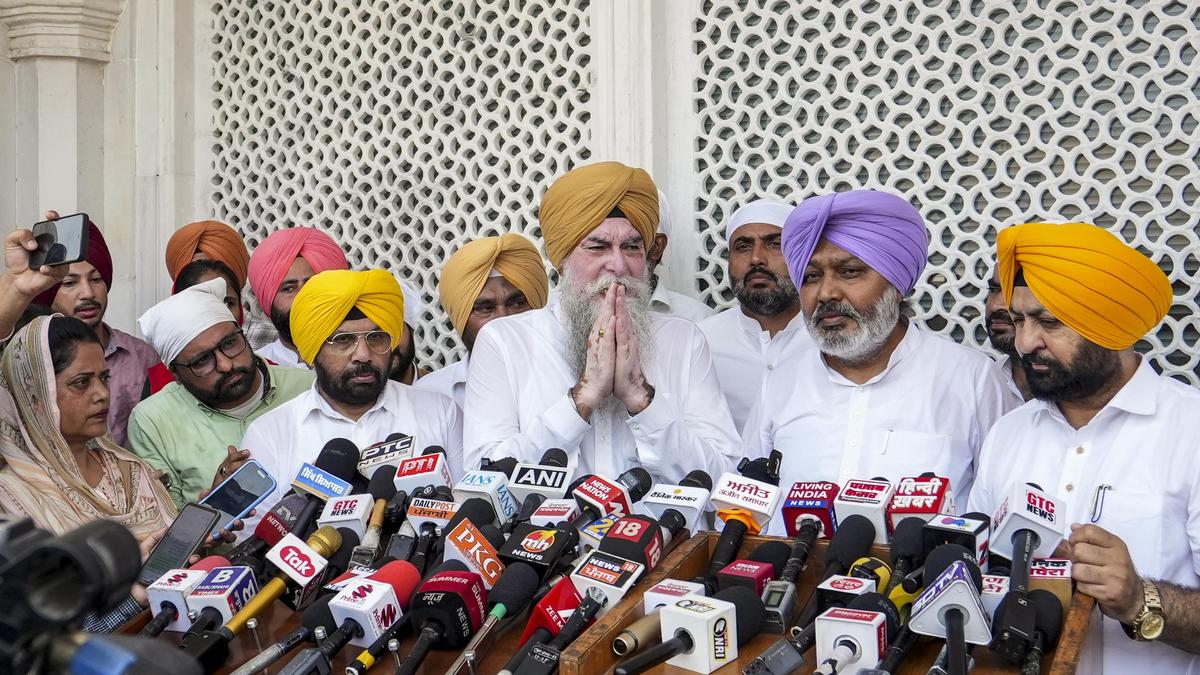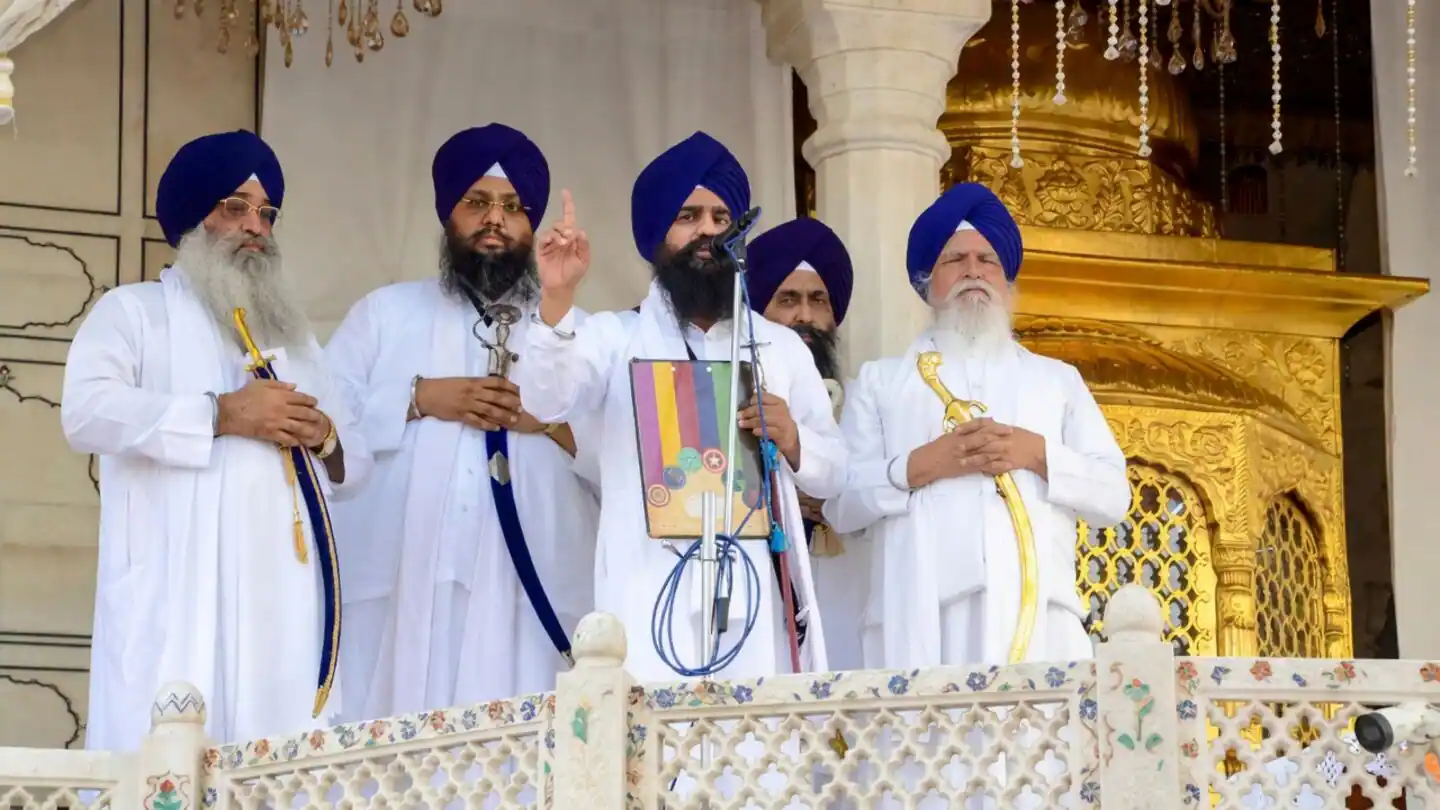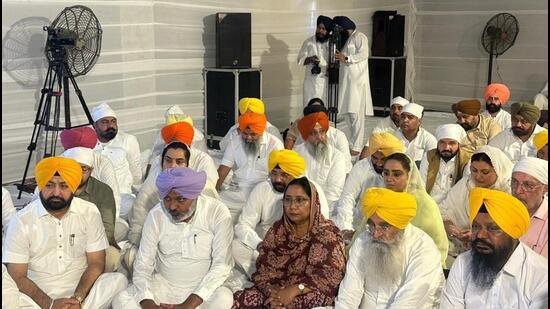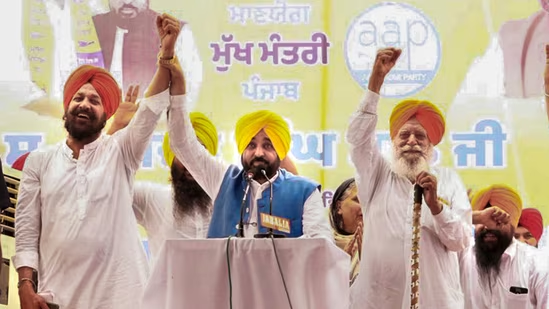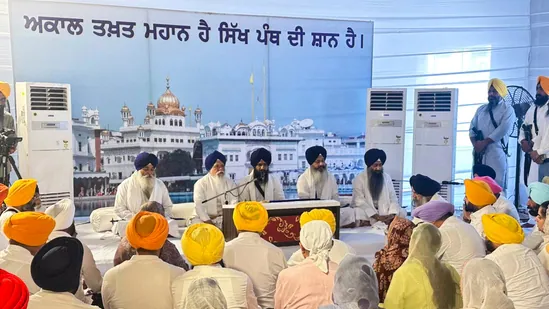
All 78 Sikh members of Punjab's 117-seat assembly — including CM Bhagwant Mann, his Sikh cabinet colleagues and speaker Kultar Singh Sandhwan — appeared before the Akal Takht, the supreme temporal seat of Sikhism, in Amritsar on Monday over a law they had passed two months earlier.AAP MLAs during proceedings at the secretariat of the Akal Takht in Amritsar on Monday, June 29, 2026. (PTI Photo)By the end of the sitting, the legislators present had agreed to re-amend the legislation in line with Sikh sentiments, after the Akal Takht gave the Punjab government one month to act on a formal list of objections.Here is what the law does, why it became a point of dispute with Sikh clergy, and what was decided when the matter reached the Akal Takht.Why the religious hearingThe Akal Takht is not a government body but the highest temporal authority in Sikhism, seated inside the Golden Temple complex in Amritsar. It is headed by a jathedar — currently the acting jathedar is Giani Kuldeep Singh Gargajj — who, along with four other senior clergy known as the Panj Singh Sahiban, can summon any Sikh and issue binding religious directives. A Sikh who defies such a directive can be declared ‘tankhaiya’ (guilty of religious transgression).The latest dispute concerns the Jaagat Jot Sri Guru Granth Sahib Satkar (Amendment) Act, 2026, which amends an original 2008 Act governing protection of the Guru Granth Sahib, Sikhism's holiest scripture, from acts of sacrilege ('beadbi').Earlier attempts to introduce stricter punishment for sacrilege — by the SAD-BJP government in 2015 and the Congress government in 2018 — were returned by the Centre, which held that a national criminal-law amendment could not single out one religion's text.The AAP government had also introduced the Punjab Prevention of Offences against Holy Scriptures Bill, 2025, which was referred to a Select Committee before being superseded by the 2026 Act.The bill for the 2026 law was tabled by CM Mann during a special one-day assembly session at Anandpur Sahib on April 13, choosing the place and date for religious reasons. This town is where on Baisakhi, April 13, 1699, Khalsa Panth or a codified Sikh religious identity was established by Guru Gobind Singh.The act and was passed unanimously. It received the governor's assent within days.The law provides strict pubishments:Life imprisonment and a fine of ₹5–20 lakh where sacrilege is committed through criminal conspiracy intended to disrupt peace or communal harmony.Up to 20 years' imprisonment and a fine of ₹2–10 lakh for the offence of sacrilege itself.Up to five years' imprisonment and a fine of up to ₹10 lakh for other offences under the Act.The law also requires the Shiromani Gurdwara Parbandhak Committee or SGPC (considered a mini-Parliament of Sikhs) to maintain a central register tracking every printed copy ("saroop") of the scripture, including a unique identification number, the date of printing and publication, the date and place of supply, the place of storage, and the name and address of the custodian.Such custodians are required to ensure safe custody, prevent damage, misuse or loss, observe Sikh Rehat Maryada or code, and immediately report any incident of damage, disappearance or suspected sacrilege to police and management authorities.Why it became a dispute with Sikh clergyThe Akal Takht's stated objection is not to the punishments. Its position is that the law was drafted and passed without consulting the Akal Takht, the SGPC or the wider Sikh Panth, and that this consultation is required for any legislation touching the Guru Granth Sahib, news agency PTI has reported.Akal Takht secretariat in-charge Bagicha Singh said that on the Jathedar's instructions, official notices were sent to all Sikh MLAs and ministers via email and WhatsApp on June 17 and 18, with a separate communication sent to speaker Sandhwan on June 23.Among the specific objections Gargajj raised was the Act's replacement of the word "bir" with "saroop" to describe a copy of the scripture; he told the legislators that the Vidhan Sabha had no authority to decide matters of Sikh terminology, and that only the Akal Takht could rule on such questions.Speaking to reporters ahead of Monday's proceedings, he accused the AAP government of coming between the Guru and the Sikh. Gargajj pointed out that provisions in the law place Guru Granth Sahib, Sikh sentiments and concerns related to the Guru Sahib, the internal administrative system of Sikhs, the SGPC, Sikh Sangat, 'granthi's, 'pathis', gurdwara committees and other 'sewadars' within a legal framework in the manner of “accused persons”; that amounts to direct government interference in Sikh affairs, he had said.Gargajj had said that while there may be laws for those accused of sacrilege, no law can be imposed on the Guru Granth Sahib and the Sikh sangat (wider community).He had also said that making public on the SGPC's website information regarding who has the sacred 'birs' of Sri Guru Granth Sahib is “highly objectionable” because it could expose the personal information of devout Sikhs, claiming that “anti-Sikh forces and mischievous elements may misuse it”.The Akal Takht had first raised these objections on May 8, when speaker Sandhwan was summoned and given a 15-day deadline to bring amendments. Written objections were formally conveyed to the government on May 11. The government did not bring amendments within that window, which Gargajj said amounted to the state ignoring the Akal Takht and Sikh sentiments.What happened at Monday's meetingGargajj directed the Punjab government to resolve the objections within one month through fresh amendments in the Assembly, and asked it not to interfere in religious affairs, PTI reported. He handed the assembled legislators a formal list of objections. All the MLAs present agreed to re-amend the act in line with Sikh sentiments.Those who appeared included cabinet ministers Harpal Singh Cheema, Ravjot Singh, Gurmeet Singh Khudian, Baljit Kaur, Balbir Singh and Harbhajan Singh; speaker Sandhwan; MLAs Kuldip Singh Dhaliwal and Inderbir Singh Nijjar; Leader of the Opposition and Congress MLA Partap Singh Bajwa; also Congress MLAs Pargat Singh, Rana Gurjit Singh, Barindermeet Singh Pahra, Tript Rajinder Singh Bajwa and Sukhpal Singh Khaira; and Akali MLA Ganieve Kaur Majithia.Five non-Sikh ministers — Sanjeev Arora, Aman Arora, Barinder Kumar Goyal, Lal Chand Kataruchak and Mahinder Bhagat — were not required to appear in person and were instead asked to submit written explanations.Rebel Akali MLA Manpreet Singh Ayali said the government should have acted when the jathedar first flagged the issue. AAP MLA Gurdit Singh Sekhon said the legislators had come to clarify their position, while maintaining that the law's underlying intent — stricter punishment for sacrilege — was sound.Also read | Akal Takht gives Punjab MLAs one-month ultimatum to amend anti-sacrilege ActA separate, parallel controversyThe Akal Takht has also been examining a video, which surfaced in January, that allegedly shows CM Mann making disrespectful remarks about Sikh tenets. Mann has said the video is AI-generated and fake, and has separately argued that the person in the footage was wearing a mask impersonating him.The Akal Takht said forensic reports it commissioned found the video genuine, and on June 15 — the same day it summoned all Sikh legislators over the sacrilege law — it declared Mann “Guru Dokhi” (enemy of the Guru and their philosophy) and “Khalsa Panth Virodhi” (anti-religion), directing the Sikh community not to associate with him. An FIR was subsequently registered in connection with the video. Hoardings calling for a social boycott of the Chief Minister subsequently appeared in several cities, news agency PTI reported.Mann faces political attackBJP MP Tarun Chugh called for CM Mann's arrest, telling ANI, "Nothing is above Sri Akal Takht Sahib," while seeking a sacrilege case against the CM.The Punjab Congress separately accused Mann of "defying" the Akal Takht's authority. Leader of Opposition Partap Bajwa said he was sceptical of Mann's commitment to Sikh principles and that the CM should accept whatever punishment the Akal Takht decided, per ANI.Mann himself has said he regards the Akal Takht's authority as supreme and that any order from it will be obeyed, while stating that the government would separately submit details on the disputed video to the Takht.
Why Punjab's Sikh MLAs were summoned before the Akal Takht over an anti-sacrilege law, one-month deadline set
Dispute concerns Jaagat Jot Sri Guru Granth Sahib Satkar (Amendment) Act 2026, which governs protection of the Guru Granth Sahib, Sikhism's holiest scripture. | India News
1,337 words~6 min read