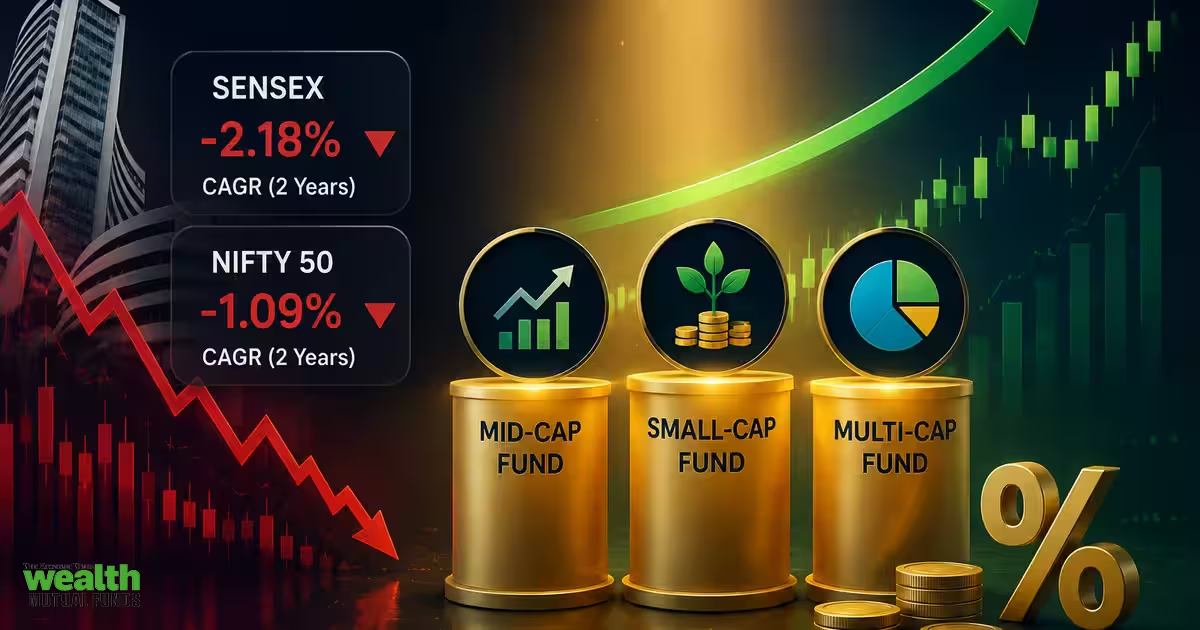
Many mutual fund investors grow concerned when their portfolios fail to deliver meaningful returns despite investing regularly through systematic investment plans (SIPs). Market volatility, frequent portfolio reshuffling, and unrealistic return expectations often prompt them to question their investment strategy. However, financial experts emphasise that equity investing is a long-term journey and periods of muted or even negative returns are a natural part of wealth creation.One such query came from Renuka, a viewer of The Money Show on ET Now, who sought advice after earning barely 1% returns despite investing for four years. She also wanted to know whether her portfolio needed any changes and if her increasing exposure to mid and small-cap funds was weighing on overall performance.Also Read | Planning mutual fund investments for H2 2026? Experts favour largecap, flexicap and multi-asset funds Renuka has been investing in schemes such as the HDFC Silver ETF, Kotak Multicap Fund, Mirae Asset Nifty 50 Index Fund, Parag Parikh Conservative Hybrid Fund, and SBI Gold Fund.She also recently started investing Rs 100 each in several schemes, including HDFC Mid Cap Fund, Invesco India Mid Cap Fund, Edelweiss Mid Cap Fund, Invesco India Smallcap Fund, Nippon India Small Cap Fund, and Bandhan Small Cap Fund.While she expects annualised returns of 12-15% by 2031-32, she is disappointed that her portfolio has generated barely 1% returns despite four years of investing.Harshvardhan Roongta, CEO and CFP at Roongta Securities, said the investor's concerns are understandable, especially after a prolonged period of subdued market performance. He noted that equity markets have delivered limited returns since September 2024, leaving many SIP investors frustrated.According to Roongta, investors must accept that equity markets can remain irrational for extended periods and often test their patience."Many investors become restless after seeing little or no returns for two or three years and decide to exit. Ironically, markets often witness a sharp rally soon after, helping recover years of underperformance," he said.He also stressed one of the most important principles of equity investing: time in the market matters more than timing the market. Roongta said investors should have a minimum investment horizon of five to eight years, as equities can go through prolonged phases of weak performance before delivering strong gains."Over a 10-year period, you may find that only one or two years generate exceptional returns. Those few years often compensate for several years of muted performance," he explained.Roongta also commented on the investor's strategy of investing Rs 100 across multiple funds merely to track their performance before committing larger amounts. He said such an approach serves little meaningful purpose and can unnecessarily complicate the portfolio.Also Read | Hexaware Technologies shares jump 8% after securing Anthropic authorised reseller status for Amazon Bedrock"If you want to evaluate a mutual fund, you need to assess its performance across different market cycles over at least two to three years. Investing Rs 100 merely to track a scheme is unnecessary because ample historical performance data is already available," he said.Instead, he suggested discontinuing these token investments and relying on long-term performance and consistency when selecting funds.Reviewing the investor's core portfolio, Roongta said the existing schemes, including the silver ETF, multicap fund, Nifty 50 index fund, conservative hybrid fund, and gold fund, appear well-suited. He advised the investor to continue SIPs in a disciplined manner and not get discouraged by recent underperformance."The portfolio consists of good-quality schemes. Continue your SIPs with discipline and avoid panicking over short-term returns. Over the next few years, the portfolio is likely to deliver better outcomes," he said.On whether investors with significant exposure to mid-cap and small-cap funds should stay invested despite recent underperformance, Roongta said each market-cap segment comes with a distinct risk-return profile.According to him, large-cap funds are the least volatile, followed by mid-cap funds, while small-cap funds experience the sharpest swings."When markets decline, small-cap funds generally fall much more than large-cap funds. Similarly, during strong bull markets, they can rise much faster. Investors should understand and be comfortable with these fluctuations before investing," he said.The expert added that mid-cap funds continue to offer an attractive balance between risk and return. However, for first-time or conservative investors, he recommends avoiding excessive exposure to small-cap funds."Large-cap and mid-cap funds are sufficient to generate healthy double-digit returns while managing risk more effectively. Conservative and new investors should ideally limit themselves to these two categories rather than chase small-cap funds," he said.Roongta emphasised that investors should not allow a few years of weak returns to derail their long-term financial plans. Equity investing rewards patience, discipline, and consistency far more than frequent portfolio changes or attempts to time the market. For most investors, staying invested through SIPs and maintaining a balanced allocation between large and mid-cap funds may prove more rewarding than chasing short-term performance.(Disclaimer: Recommendations, suggestions, views, and opinions expressed by the experts are their own and do not represent the views of The Economic Times)If you have any mutual fund queries, message ET Mutual Funds on Facebook or X. We will get them answered by our panel of experts. Do share your questions at ETMFqueries@timesinternet.in, along with your age, risk profile, and X handle.
Mutual fund returns stuck at 1% in four years? Expert says next phase could matter the most
After earning just 1% returns from mutual fund investments over four years, an investor sought expert advice on whether to alter her portfolio. Harshvardhan Roongta of Roongta Securities said weak returns are a normal part of equity investing, urging investors to stay disciplined, avoid frequent changes, and focus on long-term wealth creation through consistent SIPs.
850 words~4 min read