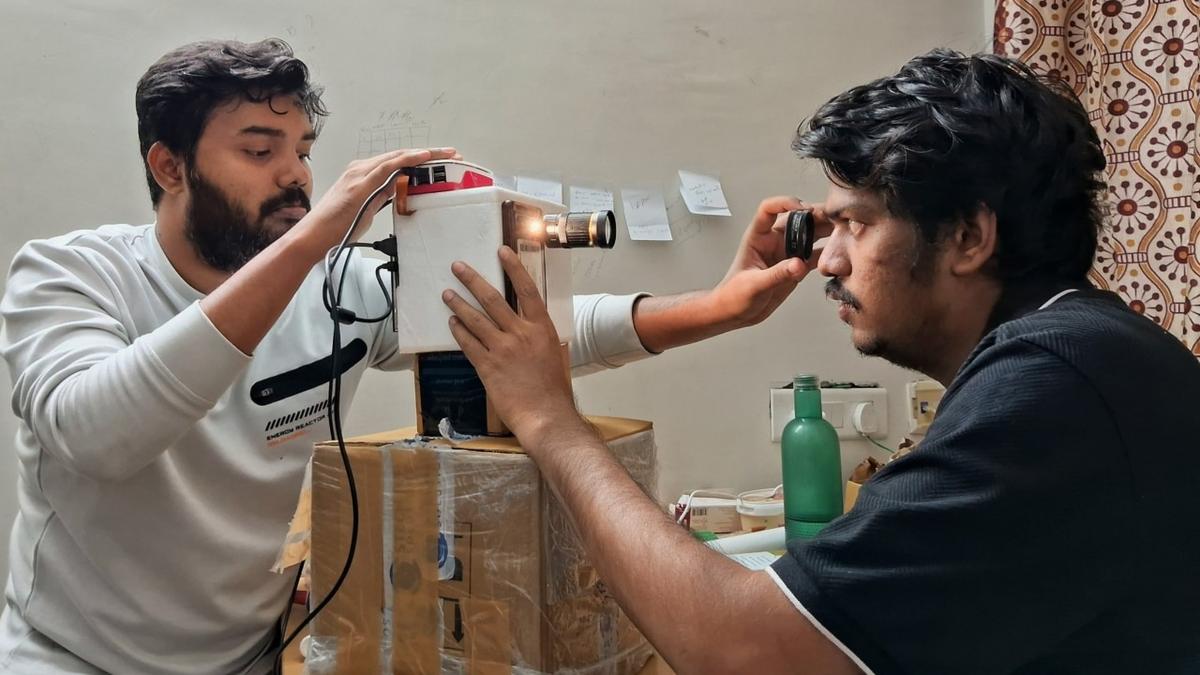
Indian technical institutions are altering postgraduate education. For decades, engineering branches operated within distinct boundaries where mechanical, electrical, and computer science fields functioned separately. Today, a nationwide shift is underway as premier institutes dismantle these traditional departmental walls, encouraging a broader institutional culture of cross-disciplinary technical education. To accelerate this transition, premier institutes have initiated outreach programs with private colleges and faculties across the country to help them implement a cross-disciplinary research culture.(Sign up for THEdge, The Hindu’s weekly education newsletter.)This transformation is visible through new postgraduate combinations. Various IITs, including IIT Delhi, now run a specialised M.Tech in Robotics that integrates computer science AI algorithms, mechanical hardware design, and electrical control systems. Similarly, IIT Madras offers an interdisciplinary M.Tech in Energy Systems, which merges battery chemistry, materials science, and climate economics. These programs sit alongside models like the M.Tech in Technology and Development at IIT Bombay, the M.Tech in Medical Device Innovation at IIT Hyderabad, and the M.Tech in Mobility Engineering at IISc Bangalore, all designed to solve complex industrial and developmental problems.Institutional evolution and setupThe shift away from traditional divisions began as an experiment in institutional policy. The Centre for Technology Alternatives for Rural Areas (CTARA) at IIT Bombay was established in 1985 as a research hub. In 2007, it launched its formal academic program, the M.Tech in Technology and Development. Prof. Anand B. Rao, Head of CTARA, stated that the program was started because faculty realised technology required critical assessment alongside other disciplines.Setting up the program required navigating internal institutional structures. Professor A.W. Date was instrumental in establishing CTARA. He held multiple rounds of negotiations with the Technical Board to approve the curriculum. “It was not easy to happen. During that time, IIT had a siloed approach towards technical education. But a cross-disciplinary approach started to become acceptable during the last decade,” Prof. Rao explained.A similar administrative evolution occurred at IIT Hyderabad. In 2016, the institute started the Center for Healthcare Entrepreneurship to address India’s reliance on importing nearly 80% of its medical devices. In 2020, the center launched the M.Tech in Medical Device Innovation. Prof. Falguni Pati, Head of the Department of Biomedical Engineering, explained that the center runs the program with its own chair and utilises interested faculty from other core departments.Eligibility and integrationTo build hybrid teams, these programs altered admission criteria to accept diverse academic backgrounds. The M.Tech at CTARA accepts engineering graduates from all streams, capping intake between 25 and 30 students annually. The curriculum introduces linkages between development and technology, covering water resources, environment, public policy, and governance.IIT Hyderabad’s Medical Device Innovation course admits 10 to 15 students annually, combining engineering graduates with professional medical graduates. “The students who have completed Ayurveda and Homeopathy are also absorbed as they possess medical knowledge. We are not only building prototypes, we are also building teams,” Prof. Pati said.At IISc Bangalore, the M.Tech in Mobility Engineering is anchored in Mechanical Engineering but integrates classes from Aerospace, Cyber-Physical Systems, and AI. Srujan Srivathsava, a 2026 graduate, explained that the structure allows students to select courses tailored to specific profiles rather than picking subjects randomly.“I was more interested in automotive software, device drivers, and communication protocols. Some students focused on machine learning and image processing for ADAS applications, while others specialised in vehicle cooling or battery technologies,” Mr. Srivathsava said.Fieldwork and clinical immersionA central feature of these courses is direct exposure to field environments at the start of the program. At IIT Hyderabad, students undergo clinical immersion at partner hospitals immediately. Prof. Falguni Pati noted that during hospital visits, students see real gaps on the ground, realizing that even simple instruments are often unavailable or expensive.Srijan Arya, a 2026 graduate of the program and currently a Ph.D. scholar at IIM Ranchi, stated that hospital immersion provided critical design insights. “The biggest Eureka moment came from watching how much time and effort a doctor or nurse lost in a simple routine step. That friction showed us the real design problem was not just performance, but ease of use and speed in a clinical setting,” Mr. Arya said.For CTARA students, the curriculum requires a mandatory two-month village stay. Priyanka Gorade, an alumnus, spent two months in Kolsirsi, a village in Karnataka. Being from Maharashtra, she faced an immediate language barrier.“On the first day I saw everyone speaking in Kannada. Even all the boards were in Kannada. So it was most difficult for me. I came with technical ideas but reality was I needed to be one of them,” Ms. Gorade said.Ms. Gorade conducted household surveys with local student translators and observed that many villagers lacked awareness of government services. “It just remains a policy paper unless and until it reaches ground level. I used to think technology can solve problems very easily, but without consideration of local situations and their belief it is difficult to bring technical solutions in rural areas,” Ms. Gorade stated.Resolving communication gapsBringing together different disciplines creates functional friction. Mr. Arya noted that the classroom at IIT Hyderabad placed engineers next to MBBS doctors.“There were definitely moments when engineers and MBBS teammates misunderstood each other, because one side spoke in technical specs while the other spoke in patient outcomes and workflow. We bridged that gap by turning arguments into demonstrations, using bedside use-cases, sketches, and trial runs,” Mr. Arya said.At IISc Bangalore, Srujan Srivathsava experienced coordination issues during a Mechatronics project weighing 30% of the grade. Mr. Srivathsava, who has an Electronics and Communication background, partnered with a Mechanical Engineering student to build a ball-balancing platform. They worked independently and integrated components at the end, leading to immediate system errors.“The actuators were tilting the platform much more than expected because the supporting beam lengths in the mechanical design were longer than what I had assumed... leading to unstable behavior,” Mr. Srivathsava said.The team resolved the issue by sitting together to analyse how the physical dimensions affected system dynamics, allowing Mr. Srivathsava to update the control software.Evaluation metrics and project outputsEvaluation methods in these programs depart from traditional research models. Prof. Falguni Pati explained that traditional biomedical programs require a research thesis, whereas the Medical Device Innovation degree focuses on product development using existing knowledge. Students spend three semesters building a prototype, producing around five prototypes a year across medical software and hardware fields.“A team consisting of doctors and engineers evaluate the prototype combinedly. We have tie up with hospitals who validate these devices - deployment is not required because it involves a lot of regulations,” Prof. Pati said.This hands-on framework formed the basis for IIT Hyderabad to introduce product-based Ph.D.s starting in 2026.At IIT Bombay, Priyanka Gorade’s final thesis focused on electricity tariffs and subsidy structures, requiring research at the Central Electricity Regulatory Commission in Delhi. “A poor family might tend to increase their consumption up to subsidized slabs and rich people also get a subsidy even if not in need. Subsidy is used for the political agenda as well... On my field visit I found that appliance use is less in rural areas as compared to urban. Electricity theft is also a point to think of,” Ms. Gorade reported.Regulations and employment realitiesMoving prototypes to the market presents significant regulatory hurdles. Mr. Arya noted that compliance under the Medical Devices Rules, 2017, was emotionally draining. “It forced us to revisit design decisions, documentation, and testing again and again before we could feel confident about moving toward market readiness,” Mr. Arya said.Despite these hurdles, some projects transition into commercial products. CTARA and the Rural Technology Action Group (RuTAG) incubated RuKart Technologies, founded by alumni Vikash Jha, Sharayu Kulkarni, and Gunvant Nehete. The startup developed the Subjee Cooler, a zero-energy storage device that operates without electricity, helping small-scale farmers preserve perishable goods and improve their bargaining power.Career paths for graduates vary. Mr. Srivathsava noted that because his batch was only the second to graduate from IISc’s Mobility program, market awareness was low.“During campus placements, many recruiters were not even aware that IISc offered a program like Mobility Engineering. Many companies still follow a relatively traditional hiring approach, where candidates are evaluated within specific domains,” Mr. Srivathsava said.Mr. Srivathsava accepted a position at Analog Devices, noting that hiring mindsets will change as vehicles shift toward digital architectures.According to Prof. Anand B. Rao, CTARA graduates who choose conventional placements secure roles in finance and multinational corporations. Others move to NGOs, startups, or secure government fellowships through the Ministry of Rural Development and the Ministry of Child and Development. Multilateral agencies like UNICEF also hire these graduates.Ms. Gorade followed this path and currently works as a health analytics fellow at the Khushi Baby organisation in Nandurbar, analysing public health data to generate actionable insights for the government.Prof. Falguni Pati reported that roughly 40% of IIT Hyderabad’s graduates start their own ventures, utilising entrepreneurship training embedded in the course.
How IITs are breaking engineering silos through interdisciplinary M.Tech programmes
IITs are revolutionizing engineering education with interdisciplinary M.Tech programs, fostering collaboration across diverse technical fields.
1,467 words~7 min read