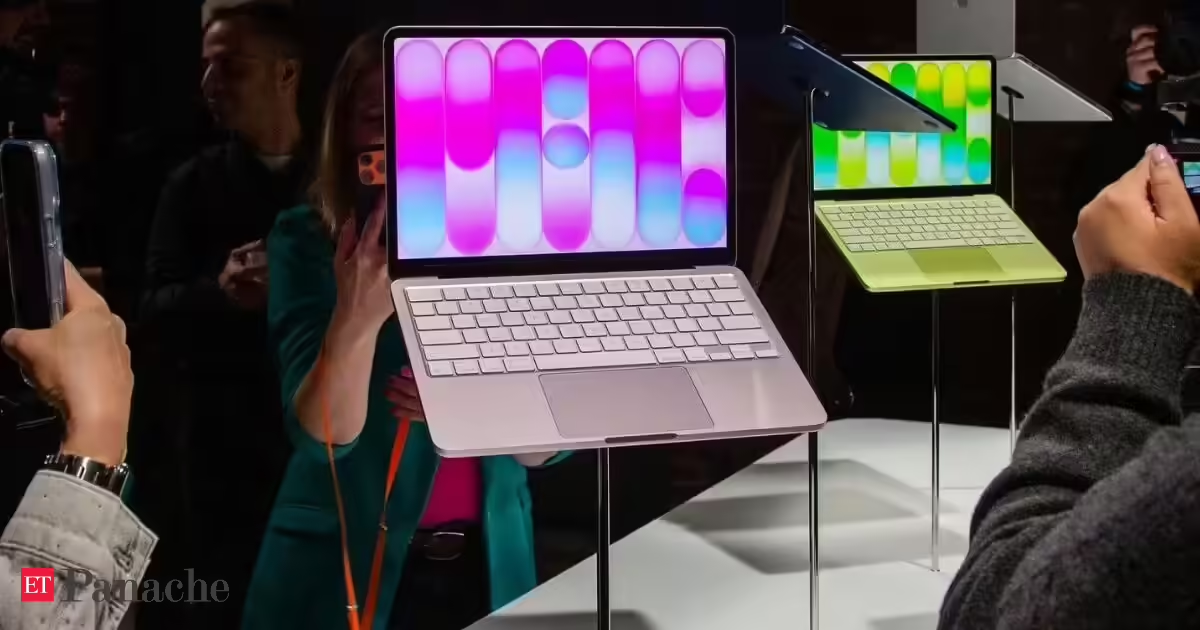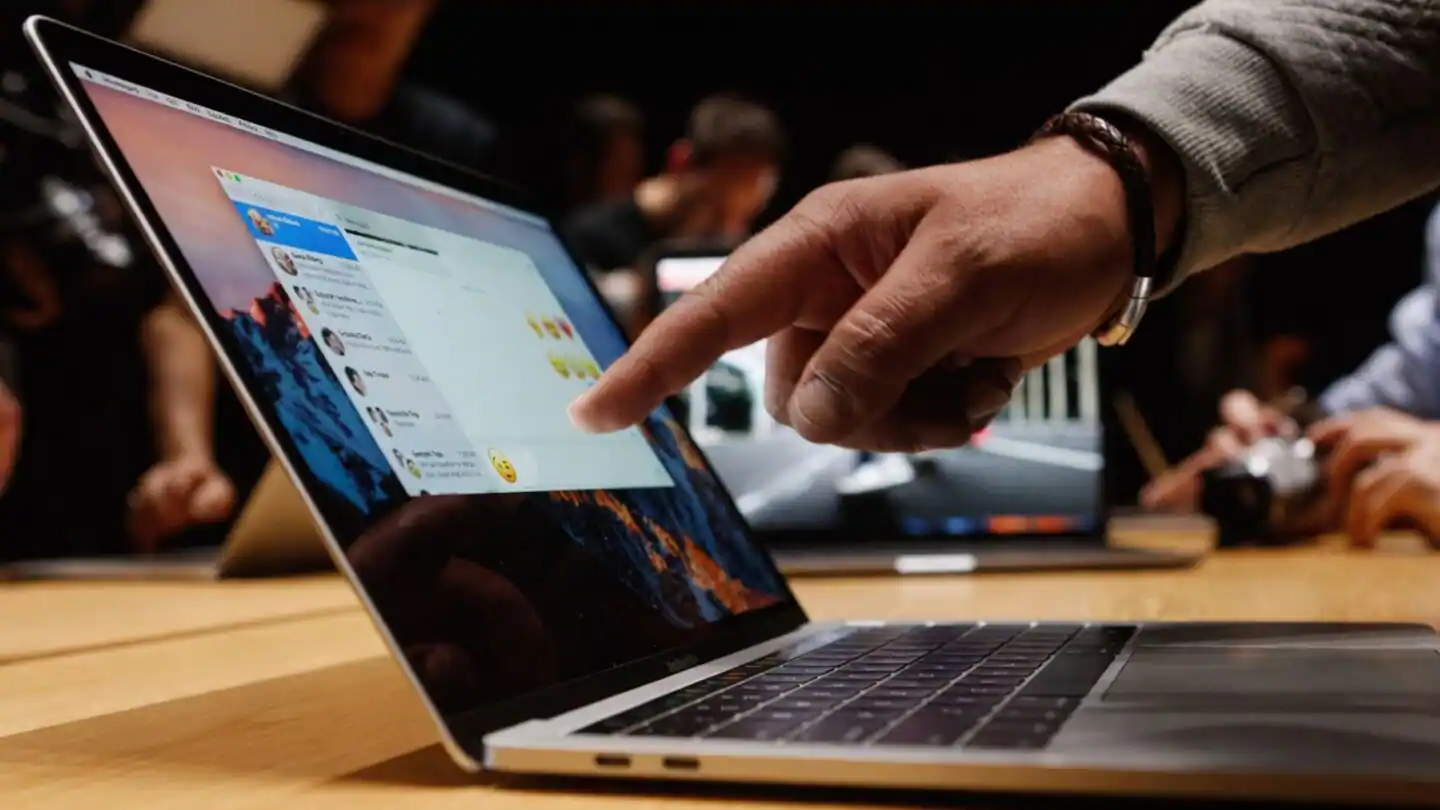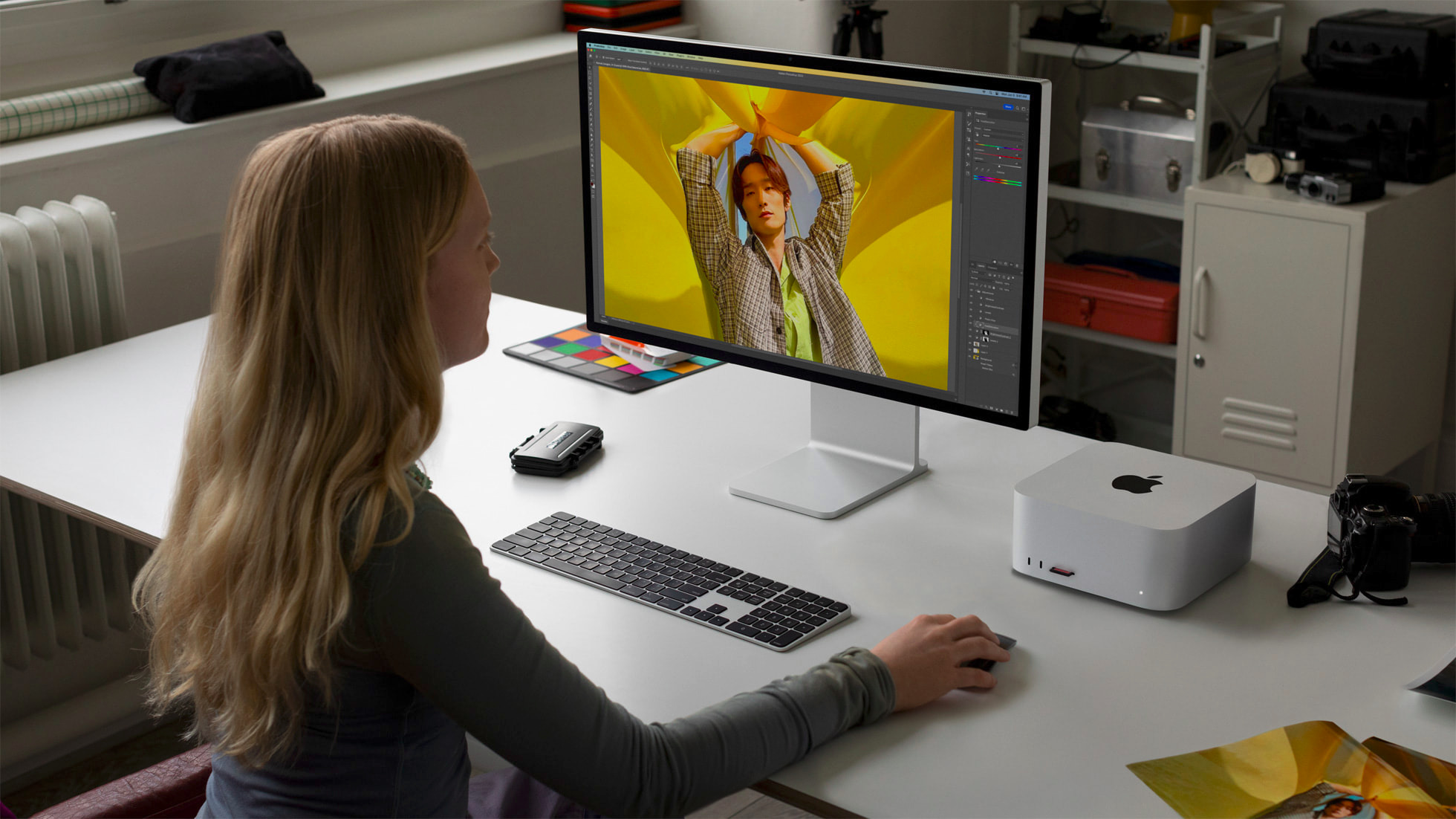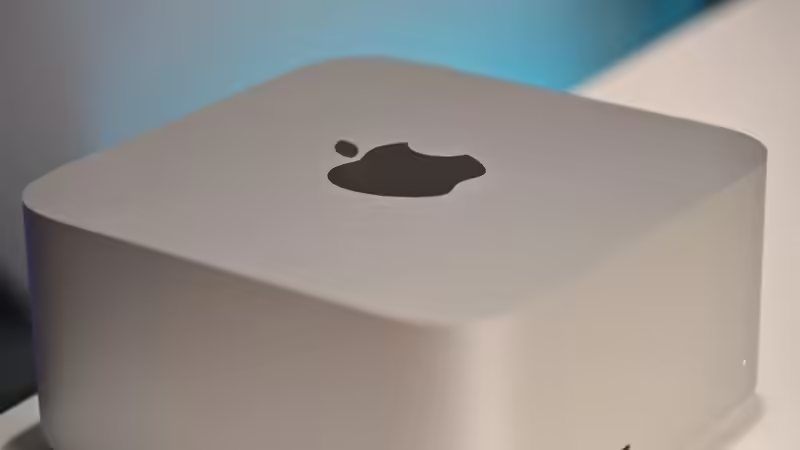
Photo credit: appleinsider.comThe personal computer silicon wars shifted from a predictable sprint to a brutal, multi-front siege. Apple just broke its own cadence. By sidelining the M6 Pro and Max silicon to accelerate development of the M7 generation, the Cupertino giant executed a forced tactical retreat. Following the conclusion of WWDC 2026, the strategic gaps in Apple’s roadmap are glaringly obvious. Microsoft’s aggressive push for Copilot+ PCs exposed a critical vulnerability two years ago. The M4 chip delivers 38 TOPS. Apple spent twenty-four months trailing Qualcomm in raw neural processing throughput.While Apple spent the M5 generation entirely distracted by engineering the first touchscreen MacBook Pros, competitors launched a coordinated assault. Qualcomm deployed the Snapdragon X2 Elite. Intel executed its foundry recovery strategy with Panther Lake on the 18A node. NVIDIA disrupted the ecosystem entirely with RTX Spark, bringing desktop-class AI graphics to the Arm-based Windows ecosystem. Releasing an M6 Pro on a starved 3nm node, with a marginally upgraded Neural Engine, would have handed the "AI PC" marketing war entirely to the Windows ecosystem. The M7 represents a hard pivot, reallocating silicon real estate away from traditional CPU core scaling and toward a ground-up redesigned Neural Engine. Key Takeaways ‘Apple M7 Pro and Max’ chips bypassed the M6 generation entirely, redirecting engineering resources toward a massive NPU architecture overhaul to close the gap with Snapdragon X2 Elite and Nvidia RTX Spark. The ‘M5 Pro and Max’ generation focused exclusively on powering the first touchscreen MacBook Pros, consuming engineering bandwidth and delaying Apple’s neural processing advancements. The ‘M7 generation’ debuts on TSMC’s ‘2nm (N2) process’, a necessary leap to escape the 3nm wafer allocation crunch caused by AI server farm demand. Neural Engine performance jumps to ‘70+ TOPS’, tripling the M4’s capability and enabling local execution of 7B parameter language models while surviving the global memory shortage.The M5 distraction and the touchscreen pivotApple tasked the M5 Pro and Max with a singular, demanding mission: powering the first touchscreen MacBook Pros. This generation prioritised physical hardware integration over neural engine leaps. Adding a touch digitiser to a MacBook display fundamentally alters the thermal dynamics of the clamshell chassis. The display panel generates heat. The backlight array requires thicker power routing. Apple’s silicon team spent the M5 cycle redesigning the SoC’s thermal sensors and power delivery networks to accommodate this new physical reality.The M5 Neural Engine received only a marginal clock speed bump. Apple prioritised efficiency and display pipeline bandwidth to support 120Hz ProMotion touch input. This physical hardware distraction occurred at the exact moment the AI software stack exploded. Apple Intelligence launched, demanding massive on-device inference capabilities. The M5 handled basic text prediction, but running concurrent, multi-model AI workflows entirely offline choked the architecture. Apple knew the M5 was a bridge generation, buying time to finalise the touchscreen form factor while the silicon engineering team prepared a ground-up NPU redesign for the M7. The competitor siege: X2 Elite, Panther Lake, and RTX SparkWhile Apple refined the touchscreen chassis, the Windows ecosystem launched a three-front assault. Qualcomm struck first with the Snapdragon X2 Elite. Building on the foundation of the original X Elite, the X2 generation pushes the Hexagon NPU past the 60 TOPS threshold. Qualcomm optimised the memory controllers for sustained LLM weight streaming, addressing the exact bottleneck that plagued Apple’s M4 and M5 chips.Intel executed a dramatic foundry recovery. After years of manufacturing struggles, Intel’s Panther Lake silicon debuted on the 18A node. This internal foundry success re-established Intel as a serious player in advanced semiconductor manufacturing, breaking TSMC’s monopoly on sub-2nm class processes. Panther Lake integrates a new Xe3 GPU architecture alongside an NPU pushing 50+ TOPS. The foundry recovery allowed Intel to aggressively price Panther Lake silicon, threatening Apple’s margin advantage in the premium laptop tier.NVIDIA introduced the ultimate disruptor: RTX Spark. NVIDIA entered the Windows-on-Arm SoC market, leveraging its absolute dominance in AI graphics. RTX Spark bypasses the traditional NPU model entirely, routing AI inference through a scaled-down Tensor core array. This architecture delivers AI performance measured in hundreds of TOPS, completely redefining the baseline for an "AI PC." Running localised Stable Diffusion models or complex 3D rendering tasks on a laptop suddenly became viable on the Windows side. Apple’s M5 looked architecturally archaic overnight. Why did Apple cancel the M6 Pro and Max?The M6 died on the drafting table because of a convergence of computational deficits and supply chain choke points. Running a localised, 7-billion-parameter Large Language Model (LLM) at 4-bit quantisation requires roughly 4GB of memory. Streaming the weights for that model to the processor at a conversational speed of 20 tokens per second demands a sustained 40GB/s of memory bandwidth. The standard M4 and M5 cap out at 120GB/s. When the operating system background tasks, display rendering, and application memory requests are added to the mix, the memory bus chokes. The system swaps to the SSD, destroying latency and burning battery life.Compounding this computational bottleneck was the global memory and wafer shortage. The AI boom sent Nvidia’s demand for HBM (High Bandwidth Memory) and TSMC’s advanced CoWoS packaging through the roof. This hoarding cascaded into the LPDDR5X market, driving up component costs for traditional PC manufacturers. Apple secures massive wafer allocation contracts years in advance, but the sheer volume of AI server silicon cannibalised the 3nm lines. Apple faced a reality where building an M6 Pro on the N3E node would cost significantly more per die than the M5 did, while delivering insufficient NPU performance to counter X2 Elite and RTX Spark.Cancelling the M6 Pro and Max allowed Apple to bypass the 3nm supply chain congestion entirely. The company reallocated hundreds of engineers to the M7 project, securing early 2nm wafer allocation at TSMC and redesigning the interconnect fabric to utilise LPDDR6, escaping the LPDDR5X price gouging. How does the M7 redesign the silicon architecture?Apple treats its system-on-a-chip (SoC) like a modern Formula 1 power unit. In F1, the internal combustion engine (ICE) acts as the primary power source, but the hybrid energy recovery systems - the MGU-K and MGU-H - dictate the actual performance ceiling of the car. The FIA imposes strict fuel flow limits; the global AI boom imposes strict wafer allocation limits, and Apple imposes strict thermal limits within the new touchscreen MacBook Pro chassis.In the M-series architecture, the CPU acts as the ICE. The GPU serves as the turbocharger. The Neural Engine (NPU) operates as the MGU-K, harvesting and processing massive streams of data continuously. The M4 and M5 heavily restricted the MGU-K. They provided roughly 38 TOPS, entirely inadequate for continuous, multi-model inference.The M7 re-engineers the entire energy flow. Instead of treating the NPU as a secondary coprocessor, the M7 elevates it to a primary compute tier, mimicking Nvidia’s RTX Spark strategy but tailored for macOS. Apple drastically expanded the L2 cache allocated specifically to the Neural Engine, allowing it to hold larger chunks of LLM weights locally without pinging the main unified memory pool. By moving to TSMC’s 2nm (N2) process, Apple gained a 15-25% improvement in power efficiency at the same clock speeds. This efficiency dividend funds the power draw of the expanded Neural Engine, allowing Apple to shrink the physical die size compared to a theoretical M6 Max, yielding more functioning dies per 2nm wafer.Architecture TierM4/M5 (2024-2025)M7 (Late 2026)Strategic ShiftProcess NodeTSMC N3E (3nm)TSMC N2 (2nm)Escapes 3nm AI server allocation crunchNPU TOPS38 TOPS70+ TOPSCounters X2 Elite, exceeds Copilot+ mandateMemory StandardLPDDR5XLPDDR6Bypasses LPDDR5X shortage, wider data busesMemory Bandwidth (Pro)273 GB/s350+ GB/sEliminates weight-streaming bottlenecksDie Yield StrategyLarger die, lower yieldNPU-dedicated cache, optimised footprintMaximises dies per 2nm wafer What to expect from the M7 Neural EngineThe M7 Neural Engine moves past simple matrix multiplication. Current Apple NPUs process data in dense, 16-bit or 8-bit precision. Generative AI models operate most efficiently at 4-bit precision (INT4). Running a 4-bit model on an architecture optimised for 16-bit processing creates translation overhead, slowing down inference and burning power. The M7 introduces native 4-bit execution paths directly into the silicon.This hardware-level support for 4-bit quantisation means the M7 executes AI tasks nearly twice as fast as the M5 while consuming a fraction of the battery. Native support also dictates the software stack. Developers building applications for macOS compile their CoreML models specifically for INT4 execution. The M7 handles the de-quantisation process on the fly, feeding data directly into the Neural Engine’s registers without caching it in main memory. This allows the M7 to compete directly with the raw AI throughput of Nvidia’s RTX Spark Tensor cores, utilising a fraction of the physical silicon area. How does the M7 handle AI signal routing and latency?Running Apple Intelligence requires juggling multiple models simultaneously. A text generation model handles email replies. An image generation model creates custom emojis. A semantic router model decides which of these tools to invoke based on the user's prompt. Routing these concurrent tasks requires massive data pipeline management.The M7 approaches this data routing like a DJ managing audio stems through a complex digital mixer. In electronic music production, a DJ layering four audio tracks risks a buffer overflow if the mixer processes all signals on a single bus. Latency spikes, the audio stutters, and the mix collapses. To prevent this, the DJ routes low-frequency kicks to a dedicated channel with zero-latency monitoring, while routing melodic stems through a secondary DSP channel.The M7 implements dedicated memory channels for the Neural Engine. Background AI tasks, like scanning photos for faces or indexing local files, route through a low-power, high-latency bus. Foreground AI tasks - like generating an email response in real-time as the user types - route through a high-speed, zero-latency bus directly connected to the NPU’s cache. This physical separation of data pathways ensures that a heavy background indexing job introduces zero typing delay in the user interface. The M4 and M5 architectures forced all these signals through a single bus, resulting in the digital equivalent of a buffer underrun - a stuttering, lagging user experience that destroyed the illusion of on-device intelligence.The WWDC 2025 and 2026 software realityApple spent the last two years masking the M4 and M5 silicon deficits through software throttling. macOS 16, released in 2025, introduced heavy restrictions on background AI processes. The system aggressively paused local photo indexing the moment a user opened a heavy application like Final Cut Pro. Image generation took longer, leaning partially on Private Cloud Compute to mask the local NPU bottleneck.WWDC 2026 confirmed the pivot. Apple’s developer sessions heavily emphasised the new CoreML APIs designed specifically for the M7’s native 4-bit execution paths. The operating system finally separates the AI task scheduler from the standard CPU thread scheduler. macOS 18, shipping alongside the M7, assigns AI tasks directly to the Neural Engine’s dedicated cache lanes. The two-year software band-aid is coming off. The M7 provides the raw hardware bandwidth required to run macOS 18’s agentic AI workflows entirely offline, processing continuous background inference while sustaining 120fps UI rendering on the touchscreen displays. What does the M6 cancellation mean for MacBook Pro pricing?Delaying the Pro and Max silicon created a two-year gap between meaningful AI architecture updates. Apple sustained sales of the M4 and M5 MacBooks through a prolonged transitional period by leaning heavily on software updates, the touchscreen novelty, and marketing the Apple Intelligence brand.The pricing strategy, however, shifted dramatically. Apple already tested consumer price elasticity with the M4 iPad Pro lineup, pushing the 1TB cellular model past the Rs 2,00,000 mark in India. The M5 touchscreen MacBook Pros introduced hidden premiums - charging significantly more for Nano-texture glass and higher unified memory tiers.The M7 accelerates this trend. TSMC’s 2nm wafers cost roughly 30-40 per cent more than 3nm wafers. The LPDDR6 memory modules, constrained by the ongoing AI boom’s impact on fabrication plants, carry a steep premium. The M7 MacBook Pro lineup absorbs these costs directly. Base configurations ship with constrained memory bandwidth, artificially segmenting the product line. To actually utilise the 70+ TOPS Neural Engine and compete with RTX Spark configurations, users must upgrade to the Max tiers, which now carry a luxury tax reflecting the global semiconductor scarcity. The developer math behind the M7 transitionDevelopers faced a stark transition over the last two WWDC cycles. For the past decade, Mac applications have relied on the CPU and GPU. The M7 forces a paradigm shift. To fully utilise the M7, developers route machine learning tasks through the Neural Engine using CoreML.A developer building a video editing application previously used the GPU to apply a colour grading filter. On the M7, that same developer writes code to offload the colour grading to the NPU, freeing up the GPU for rendering timelines. This requires rewriting application logic. Developers who optimise for the M7’s NPU achieve drastically better battery life and performance. Applications that ignore the Neural Engine run, but they drain the battery significantly faster by leaning on the GPU, creating a two-tiered software ecosystem.WWDC 2025 introduced the foundational CoreML APIs for task routing. WWDC 2026 finalised the INT4 quantisation framework. The new APIs abstract away the complexity of 4-bit quantisation, allowing developers to pass standard 16-bit models to the system, which the M7 hardware compresses and executes natively. Developers who ignored the WWDC 2026 keynote find their applications running at half the speed of optimised competitors on the new hardware. FAQ: Apple M7 Silicon Strategy1. Will Apple release an M6 chip at all? Apple utilised the M6 brand for lower-tier devices like the MacBook Air and Mac Mini. This allowed Apple to deplete the remaining 3nm wafer inventory and utilise cheaper LPDDR5X memory, reserving the expensive 2nm capacity and LPDDR6 modules for the M7 Pro and Max silicon destined for the touchscreen MacBook Pro and Mac Studio lines.2. How does the global memory shortage affect the M7? The AI boom caused severe constraints in advanced memory packaging. By moving to LPDDR6, Apple escapes the LPDDR5X supply chain bottlenecks, but pays a premium for the newer standard. This drives up the bill of materials, directly resulting in the higher retail prices seen across the Mac and iPad lineups.3. How did the M5 MacBook Pro handle AI over the last year? The M5 MacBook Pro prioritised powering the new touchscreen displays. It handled basic Apple Intelligence features like text summarisation and image generation. Complex workflows involving continuous background indexing or large document analysis experienced delays, relying heavily on cloud processing to compensate for the retained 38 TOPS NPU limitation.4. Why did Apple wait until LPDDR6 for the M7? LPDDR5X caps out at practical bandwidths around 120GB/s for the standard tier and 273GB/s for the Pro tier. LPDDR6 introduces wider data buses and faster clock speeds, allowing Apple to hit the 350+ GB/s baseline required to stream 7B parameter models to the Neural Engine, starving the CPU.5. Will the M7 MacBook Pro be more expensive than the M5? Yes. The combination of TSMC’s 2nm wafer pricing, LPDDR6 memory premiums, and the specialised cooling required for a 70+ TOPS NPU forces Apple to raise the ceiling on MacBook Pro pricing. The base models will likely hold steady, but upgraded memory and storage configurations will carry significantly higher premiums to counter Nvidia and Intel's aggressive pricing.end of article
Apple M7 Chips: Why Apple Skipped the M6 Pro and Max for the AI War
The personal computer silicon wars shifted from a predictable sprint to a brutal, multi-front siege. Apple just broke its own cadence. By sidelining the M6 Pro and Max silicon to accelerate development of the M7 generation, the Cupertino giant executed a forced tactical retreat. Following the conclusion of WWDC 2026, the strategic gaps in Apple’s roadmap are glaringly obvious. Microsoft’s aggressive push for Copilot+ PCs exposed a critical vulnerability two years ago. The M4 chip delivers 38 TOPS.
Apple skipped M6 Pro/Max entirely, accelerating M7 with 70+ TOPS Neural Engine on 2nm to match Snapdragon X2 Elite and RTX Spark. Local 7B LLM inference is now critical for enterprise adoption, directly impacting CTO stack and on-device AI infrastructure budgets.