QOSMIC RAY. An artist’s illustration of laser-based satellite communication
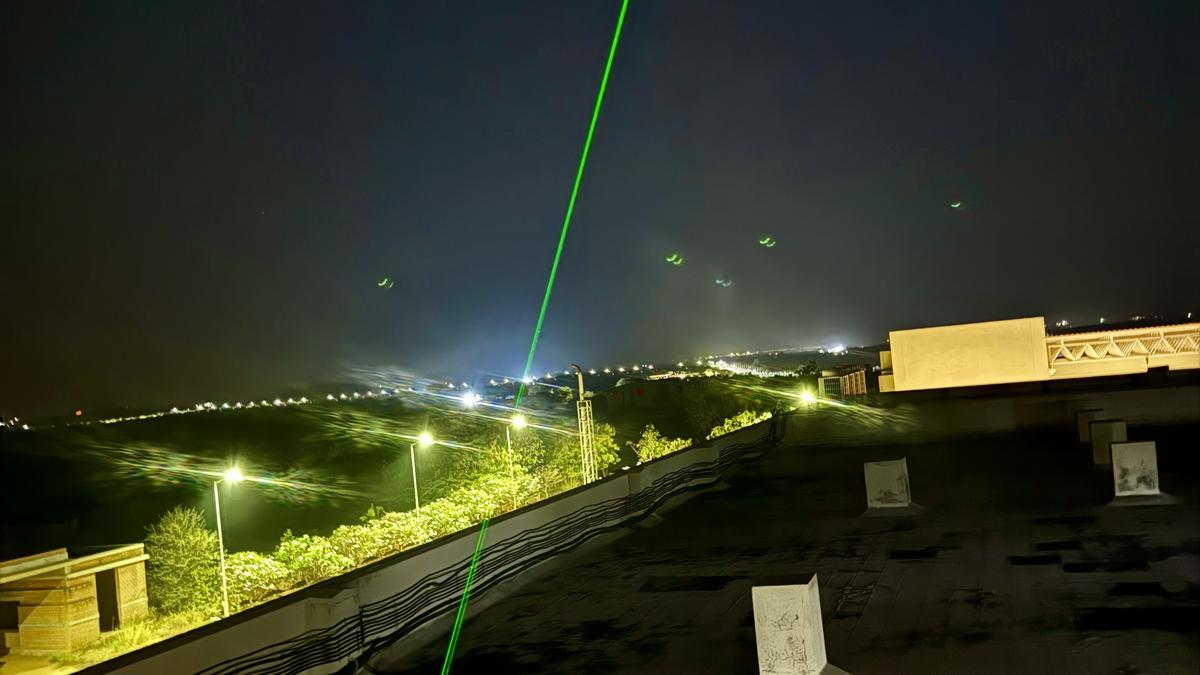
Recently a Bengaluru-based start-up, Qosmic, announced a $3.33 million fundraise from a group of investors that included Accel and Prosus. Qosmic is into an interesting technology that promises to make a big difference in a crucial aspect of space-tech — data transfer.Today, we are seeing an explosion of data from satellites. Modern satellites are remarkably capable machines. Earth observation spacecraft can capture detailed images of vast regions in a single pass. Weather satellites continuously monitor atmospheric conditions. Scientific missions generate tons of measurements from sophisticated instruments. The challenge is in moving the data to where it is needed.For decades, satellites have largely relied on radio frequency (RF) communications. These systems are reliable and well-understood, but constrained by limited spectrum and finite bandwidth. As satellite sensors become more capable, the communications pipeline increasingly risks becoming clogged.The solution pursued by companies such as Qosmic is laser-based optical communication. Instead of transmitting information using radio waves, the system uses tightly focused laser beams. The underlying principle is similar to the fibre-optic cables that transformed terrestrial telecommunications, except here light travels through free space rather than glass fibres.Unlike radio transmissions, laser beams are extremely narrow. A satellite hundreds of kilometres above Earth must point its beam with extraordinary precision at a ground station or another spacecraft. Engineers refer to the process as pointing, acquisition and tracking — the ability to find, lock on to and continuously track a moving target. Qosmic says it has field- tested its optical communications system over a 10-km terrestrial link, demonstrating these capabilities outside laboratory conditions.Looking beyond RFRF transmission is time-tested, but is hitting a limit. A high-resolution satellite generates one to two terabytes a day, but only gets a few short windows over a ground station; over radio, it can push down only a fraction of that. “By industry estimates, roughly two-thirds of the imagery a satellite captures is overwritten before it is ever downlinked. They have paid to collect data they cannot deliver. That is the problem we solve,” says Shreyaans Jain, Co-founder and CEO, Qosmic.Earth observation is just the first wave — the volume problem is about to become orders of magnitude larger. Jain observes that the entire industry is moving to put not just cameras but also computing in orbit. In the last few months, SpaceX and Nvidia have announced AI computing platforms for what they call ‘orbital data centres’, with partners including Starcloud, Axiom Space and Planet Labs. “These are not imaging a few terabytes a day — they are building toward gigawatt-scale clusters,” Jain says.At these volumes, radio cannot carry the traffic. The ground link becomes the bottleneck for the orbital economy. “So our market is not narrowly ‘Earth observation’ — it is the connection between space and the ground itself,” says Jain. “India today has almost none of this infrastructure built indigenously, and the demand only grows from here.”Use caseThe clearest operational example today is the European Space Agency’s (ESA) Sentinel satellites, which are behind the Copernicus programme. Without a laser link, a low-orbiting satellite may be forced to wait for nearly 90 minutes of every 100-minute orbit before it comes in view of a ground station to offload its data. The ESA has built a dedicated laser relay, which today moves nearly 40 terabytes a day and has carried more than a petabyte of data.The agency says even this will prove inadequate when its next generation high data-rate missions come online. “On raw performance, NASA’s TBIRD experiment sent data from a small satellite to the ground at 200 gigabits per second, moving more than a terabyte in a single pass under five minutes, which NASA calls more than a thousand times faster than a comparable radio link,” Jain points out.Orbital data centresToday, many companies want to put up data centres in space — perhaps encouraged by the continuous supply of free solar energy. Another Bengaluru-based start-up, TakeMe2Space, is into this venture and Qosmic is building optical terminals for TakeMe2Space’s MOI satellite constellation.When you put gigawatts of AI compute in orbit, the data moving between those clusters and Earth is at a scale radio cannot touch. Google’s Project Suncatcher demonstrated a single optical transceiver pair running at 1.6 terabits per second in the lab, while a radio downlink tops out at around 100 megabits to a few gigabits, Jain says. Starcloud has filed for a constellation of up to 88,000 compute satellites and envisions clusters in the multi-gigawatt range.“For that traffic, optical is not a ten times improvement over radio — it is the only way to land the data at all,” Jain says.He makes another telling point: Radio spectrum is crowded, and licensing can take months. Optical communication needs no spectrum licence at all.Alternative viewThe user industry has a slightly varied view. Suyash Singh, CEO and Co-founder, GalaxEye, says achieving “pointing accuracy” takes a lot of effort and energy; he would rather use the energy to take more images. He also observes that cloud cover can interfere with optical communication links, making them less reliable than radio-frequency systems under some conditions.“Optical communications is a great technology for the future,” Singh says, but for now GalaxEye is content with the old reliable radio frequency.Published on June 29, 2026