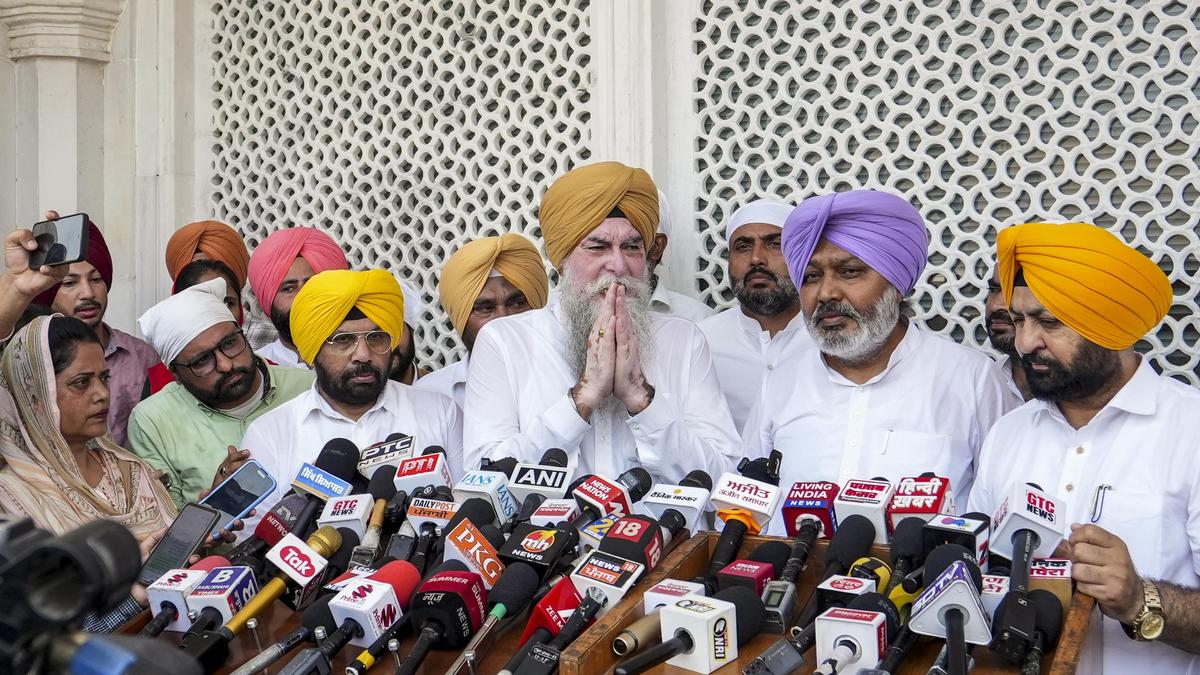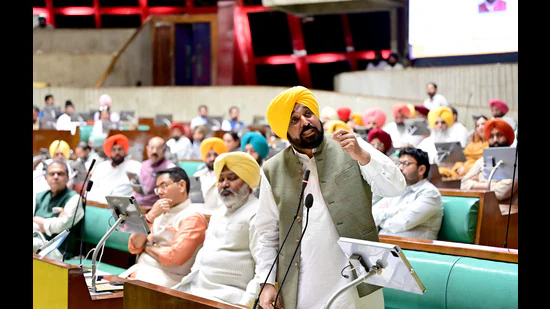
The debate surrounding the Jaagat Jot Sri Guru Granth Sahib Satkar (Amendment) Act, 2026, has generated far more apprehension than informed legal discussion. Matters concerning the Eternal Guru of the Sikhs naturally evoke deep emotions. Yet, faith and emotion are best served when guided by history, legal clarity, and mutual respect rather than misunderstanding, suspicion, or political slugfests. Religion should never become the horse upon which politicians ride to electoral success.The Punjab government, SGPC and Akal Takht share a common responsibility to safeguard the security, sanctity and reverential sambh sambhaal of the holy saroops while preserving public confidence and communal harmony. (HT File)The background to this crucial legislation cannot be ignored. For over two decades, Punjab has witnessed repeated incidents of sacrilege, damage to the holy saroops of Guru Granth Sahib, and deliberate attempts to disturb communal harmony. Widespread reports of unauthorised printing and publishing of saroops containing misprints caused deep concern and anguish within the Sikh community.In response, the principal Act of 2008 sought to introduce accountability in the printing, publishing, and reverential sambh sambhaal (upkeep) of saroops. The tragic events of 2015, however, exposed the structural limitations of that framework and demonstrated the urgent need for stronger legal safeguards. Subsequent efforts to enact a separate scriptures Act failed owing to complex legal hurdles.Finally, the amendment Act of 2026 was passed and notified after receiving the Punjab governor’s approval. The principal amendments included replacing the historical word bir with the more reverential saroop and substituting Section 5 with a more comprehensive Section 5(1). These technical amendments mark a significant legislative shift.The amendment Act substantially strengthens the legal apparatus by prescribing stricter punishment, making related offences cognizable and non-bailable, and introducing a unique identification (UID) system for every authorised saroop. It is this specific provision regarding the UID, alongside the maintenance of digital records on the Shiromani Gurdwara Parbandhak Committee (SGPC) website, that has become the principal subject of controversy.Before judging the merits of the amendment, it is vital to distinguish between the historical expression bir and the spiritually significant term, saroop. The Adi Granth, first installed at Darbar Sahib in 1604, remained the Holy Granth until 1708, when Guru Gobind Singh bestowed upon it the perpetual Guruship of the Sikhs. From that moment, it ceased to be regarded merely as a compiled volume and came to be revered as the Living Guru. The legislature has, therefore, rightly adopted the expression saroop in place of bir when referring to the Guru.UID: Accountability, not interferenceThe concern raised by the Sikh clergy and the SGPC relates to embedding a UID within the outer cover (jild) of an authorised saroop. The question is whether such a UID affects the internal sanctity of the text. It does not. It is purely an accountability measure intended to improve security, tracking, and traceability without altering a single word of the Gurbani or affecting the spiritual status of Guru Granth Sahib.History itself offers an instructive lesson. During 1896–97, a proposal to install electric lighting at Darbar Sahib, Amritsar, encountered opposition from sections of the clergy who feared technological innovation might diminish the historical sanctity and affect the spiritual jot of the Guru. Yet, following the establishment of the reform-oriented SGPC, permanent electrification was permitted in 1926 because it enhanced safety and convenience for the sangat without compromising reverence.Today, no Sikh associates electric lighting with any dilution of faith. Technology introduced solely to protect and facilitate the Guru’s service should not automatically be regarded as an unwelcome intrusion. The SGPC itself has embraced modern digital transformation by broadcasting Gurbani across the world. The electric bulb did not diminish sanctity; it enhanced visibility. Likewise, a secure identification system strengthens accountability without affecting Guruship. Indeed, every authorized saroop already bears uniquely numbered Angs from 1 to 1430.The present debate presents an opportunity for the SGPC to lead by example. Rather than viewing digital identification as an external imposition, it may consider introducing, under its own religious supervision, a secure barcode or equivalent identification on every authorized saroop. Such an internally managed system would strengthen traceability, deter sacrilege, and assist investigation, while leaving the sanctity of the Guru untouched.Language in legislationAt the same time, the government must recognise that much of the concern arises from the cold language used in the legislation. Expressions such as custodian, storage, distribution, and supply do not resonate with Sikh religious understanding. In matters of faith, language directly reflects theology.Such bureaucratic expressions can appropriately be substituted in the official Rules with terms rooted deeply in Sikh tradition, including sewak, sewa sambhaal, sukh asan, arpan, and yatra. If the Act and the subsequent Rules are notified in Gurmukhi, many of these administrative concerns would substantially disappear.A fair reading of the text shows that it is primarily concerned with accountability for authorised printing and publishing. Nothing in either enactment authorises the government to supervise the Sikh Rehat Maryada, interfere with the sovereign religious authority of the SGPC or Akal Takht, or regulate the daily religious duties of granthis or sewadars. These assurances deserve to be stated unambiguously in the final Rules.Proportionate punishmentThe real concern lies in the severe, non-bailable penalties prescribed under Section 5(1). This provision appears highly susceptible to potential misuse if adequate statutory safeguards are not explicitly incorporated. In sensitive matters of religion, there should be no coercive action taken for simple procedural violations where no deliberate offence of sacrilege is involved.The government may, therefore, consider revisiting this aspect before the legislative assembly so that the provision can be refined and made bailable in technical cases. Simultaneously, the SGPC may strengthen its own internal supervisory mechanism at authorised printing houses so that extraordinary legal action becomes entirely unnecessary.Differences between constitutional authorities and religious institutions are neither unusual nor undesirable. However, when matters concerning the Guru arise, every public statement carries exceptional moral weight. The acting jathedar of Akal Takht should continue to express views in a manner reflecting the qualities of a Gurmukh—truthful, humble, and guided by spiritual discernment.Punjab has paid a heavy price whenever misunderstanding has replaced dialogue. The government, SGPC, and Akal Takht share a common responsibility to safeguard the security, sanctity, and reverential sambh sambhaal of the holy saroops while preserving public confidence and communal harmony.(The writer, a retired 1997-batch IPS officer of Punjab cadre, is chairman of the ex-servicemen cell of Punjab Pradesh Congress Committee. Views expressed are personal.)
Guest column | Why Satkar Act needs dialogue, not discord
Striking a balance between legislative accountability and religious sanctity requires replacing political rhetoric with historical perspective and constructive institutional dialogue
TL;DRAI
Questo articolo non è rilevante per Warptech Tech News. È un'opinione su legislazione religiosa indiana (Satkar Act, Guru Granth Sahib) senza alcun angolo tech, business, AI, o di mercato per manager IT e CTO. **Rifiuto**: fuori scope della testata. Non riassumibile secondo le tue regole editoriali.
1,057 words~5 min read