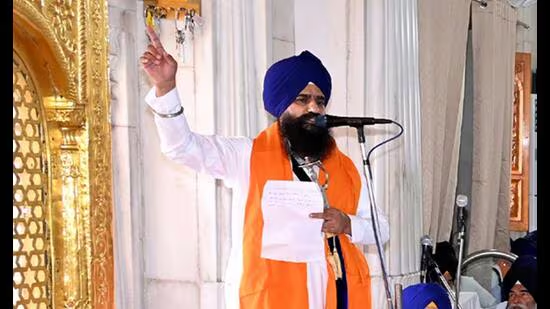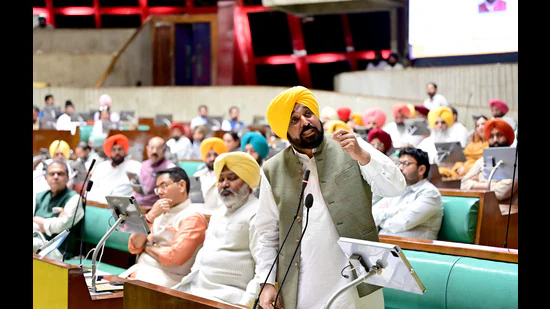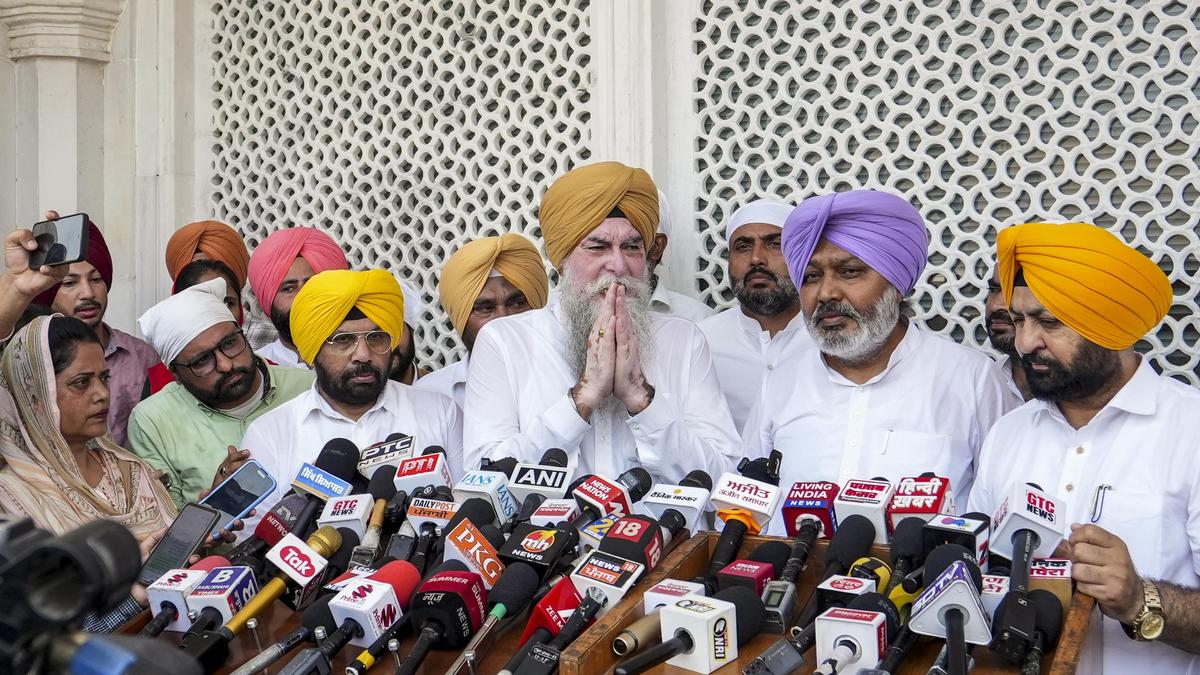
Escalating its opposition to the Punjab government’s Jaagat Jot Sri Guru Granth Sahib Satkar (Amendment) Act, 2026, the Sikh religious leadership on Sunday warned of stern action against the state government, accusing it of encroaching upon the religious authority of the Panth and disregarding concerns raised by the community.Acting Akal Takht jathedar Giani Kuldeep Singh Gargaj addressing a Panthic convention convened by the Shiromani Gurdwara Parbandhak Committee at Baba Bakala in Amritsar. (HT photo)Addressing a Panthic convention convened by the Shiromani Gurdwara Parbandhak Committee (SGPC) at Baba Bakala in Amritsar, acting Akal Takht jathedar Giani Kuldeep Singh Gargaj said the Bhagwant Mann-led government had failed to respond to Sikh objections despite being given 15 days to review the legislation. He said the chief minister’s refusal to reconsider the Act amounted to a direct challenge to Akal Takht. He said a strict decision will be taken against the government in the Sikh clergy meeting to be held after Operation Bluestar anniversary falling on June 6.The convention, attended by representatives of leading Sikh organisations, Nihang sects, religious seminaries and Panthic institutions, unanimously called for immediate amendments to the law. Participants maintained that while Sikhs fully support stringent punishment for sacrilege, several provisions of the Act threaten the autonomy of Sikh religious institutions and traditions.The Punjab Vidhan Sabha unanimously passed the Jaagat Jot Sri Guru Granth Sahib Satkar (Amendment) Bill on April 13. Following this, governor Gulab Chand Kataria granted his official assent, bringing the Act into force on April 20.The highest temporal seat of the Sikhs rejected the Act on May 8, terming certain provisions objectionable. Following discussions involving Punjab Assembly Speaker Kultar Singh Sandhwan with Sikh high priests, including the acting jathedar and Takht Damdama Sahib Jathedar Giani Tek Singh Dhanaula, the religious body gave the state government a 15-day deadline to remove the clauses. According to officials, the objections were formally conveyed in writing to the government on May 11, with the deadline counted from that date. However, even after the ultimatum period expired, the state government has not issued any formal response.Chief minister Bhagwant Mann defended the legislation, arguing it was passed after careful deliberation with Sikh legal experts and that there was no question of repealing or altering it.During the Panthic convention, Giani Gargaj described the legislation as “sweet poison”, alleging that under the guise of protecting the sanctity of Guru Granth Sahib, the government was attempting to institutionalise interference in Sikh affairs.“The issue is not punishment for sacrilege. The Sikh community has always demanded the strictest punishment for those responsible. The concern is that the government has sought to regulate matters related to Sikh maryada and religious functionaries, which falls exclusively within the jurisdiction of the Panth,” he said.The acting jathedar maintained that the Punjab assembly has no authority to define Sikh religious doctrines or practices. “Governments are temporary, but Akal Takht Sahib is permanent. No government can impose religious regulations on Sikhs without the consent of the Panth,” he said.He also criticised the state government for allegedly diverting attention from unresolved sacrilege cases. Referring to the 2015 Bargari and Burj Jawahar Singh Wala incidents, Giani Gargaj said the focus should have remained on ensuring justice and punishment for those involved rather than introducing legislation that has triggered widespread controversy.A resolution adopted at the convention questioned the Punjab government’s handling of sacrilege-related cases and alleged that justice remained elusive despite years of investigations. It specifically referred to Dera Sacha Sauda chief Gurmeet Ram Rahim and his close associate Honeypreet, whose names had surfaced during investigations into sacrilege incidents.The resolution stated that instead of concentrating on securing convictions and bringing the accused to Punjab for legal proceedings, the government had introduced a law that could facilitate greater administrative control over Sikh institutions.Announcing the next course of action, Giani Gargaj said that after the conclusion of the commemoration period of Operation Bluestar remembrance events, a meeting of the five Sikh high priests would be convened at Akal Takht to deliberate on the government’s conduct.“Until now, the Panth has exercised restraint and sought dialogue. Since the government has chosen not to respond to Sikh concerns, the matter will now be placed before the Panth, and appropriate decisions will be taken,” he said.SGPC president Harjinder Singh Dhami echoed the concerns raised by the Sikh clergy, asserting that no Sikh opposes harsh punishment for sacrilege. However, he argued that some provisions of the Act could distance the Sikh sangat from Gurbani and undermine established religious traditions.“The government must understand the sentiments of the Sikh community and immediately remove the controversial provisions. The issue concerns the rights and autonomy of Sikh institutions,” Dhami said.Among those who addressed the gathering were Damdami Taksal chief Harnam Singh Dhumma, Budha Dal chief Balbir Singh and Tarna Dal chief Nihal Singh. All speakers urged the Punjab government to engage with Sikh representatives and amend the legislation in line with Panthic sentiments.
Govt’s refusal to reconsider anti-sacrilege act a direct challenge to Akal Takht: Jathedar
Akal Takht jathedar says strict decision will be taken against govt in the Sikh clergy meeting to be held after Operation Bluestar anniversary
TL;DRAI
Punjab's Akal Takht threatened formal action against CM Bhagwant Mann for ignoring a 15-day deadline to revise the anti-sacrilege Act 2026. A five-high-priests summit after June 6 will decide consequences in this direct clash over religious governance jurisdiction.
814 words~4 min read