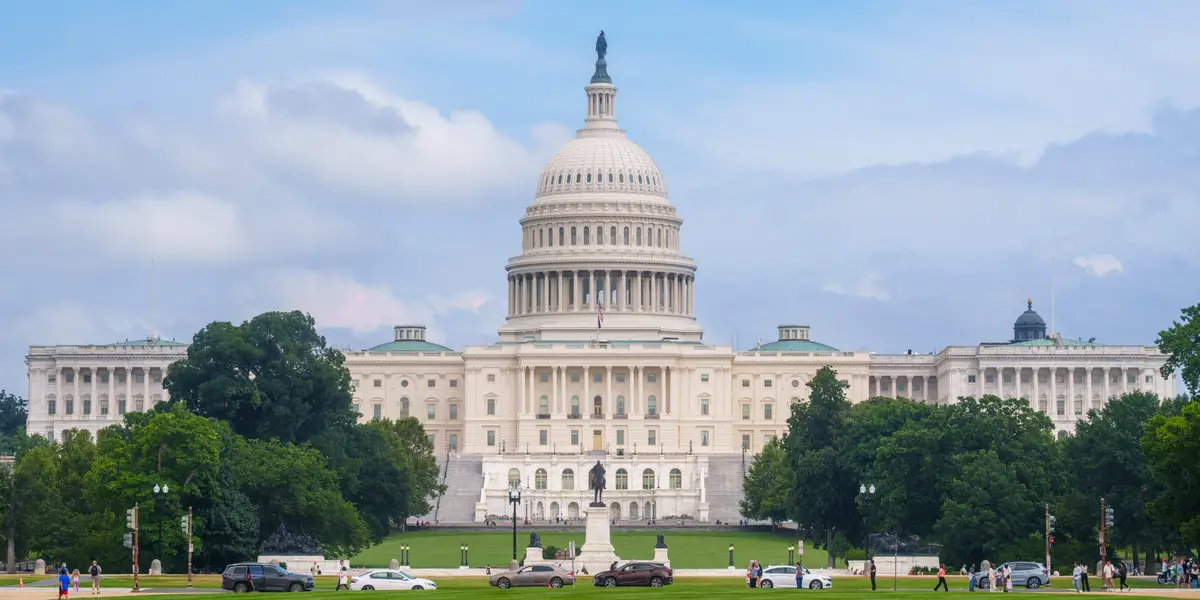
A state's capitol can tell you a lot about its history.State capitols house each state's legislative branch of government, executive offices, and other administrative and ceremonial spaces. While their function may be the same across all 50 states, their architectural designs vary.Many state capitols feature references to their locations, like the Kansas State Capitol, which is topped by Ad Astra, a statue representing a Kansa (Kaw) warrior, while the New Hampshire State House, built largely from locally quarried granite, nods to the state's "Granite State" identity.Some buildings date back to the founding of the United States. Maryland's State House in Annapolis, completed in 1779, is the oldest one in continuous use as a legislative center. That makes it just three years younger than the country as a whole.Every capitol has a unique look and distinct origin. Here's what the capitol looks like in every state and Washington, DC.
Montgomery, Alabama
Alabama's capitol in Montgomery.
Carol M. Highsmith/Buyenlarge/Getty Images
Alabama's capitol served as the first capital of the Confederacy, and there's a brass star on one of the porticos marking the spot where Jefferson Davis was sworn in as its president, according to the Alabama Historical Commission.The building that stands today was constructed in 1851, after a fire burned down the original building in 1849, according to the Alabama Historical Commission.One of the more famous parts of the capitol grounds is the Avenue of Flags. It has the flag of every state, plus a native rock from each state at the base of its flag. It was dedicated in 1968, according to Exploring Montgomery.