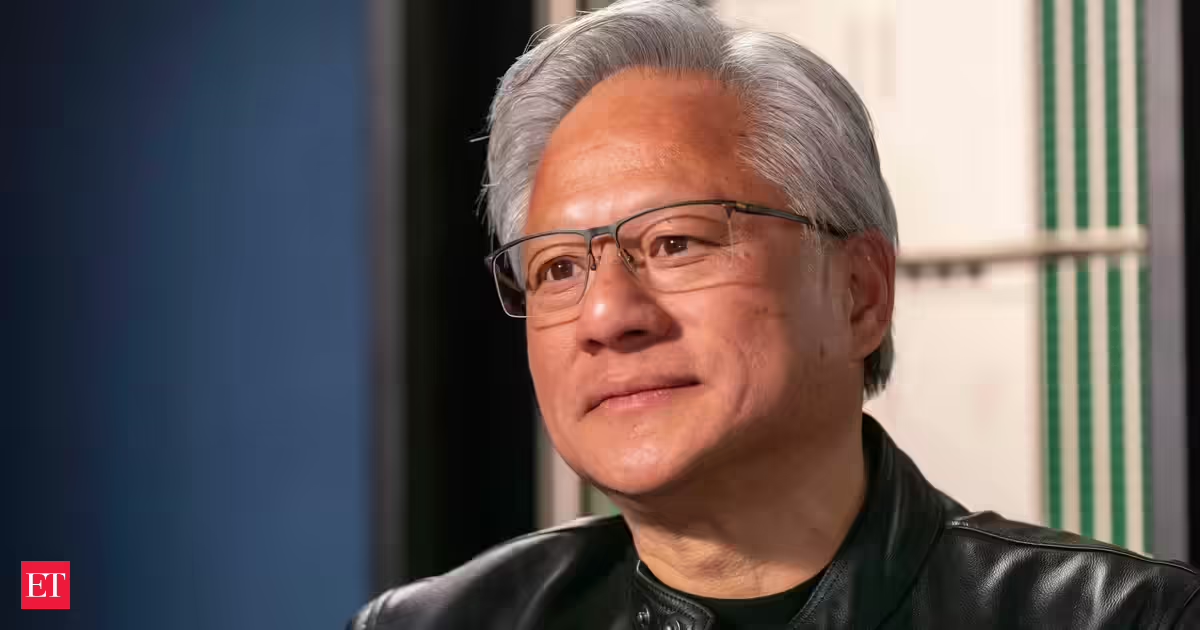
In an industry where speed often matters more than certainty, few leaders have been as vocal about intellectual honesty as NVIDIA’s co-founder and CEO. For him, progress isn’t about always being right, it’s about being willing to be wrong fast, learn faster, and keep moving.This mindset sits at the center of how Jensen Huang has built one of the most influential technology companies in the world.Quote of the day: “Without intellectual honesty, you can't have a culture that's willing to tolerate failure because people cling too much to an idea that likely will be bad or isn't working and they feel like their reputation is tied up in it. They can't admit failure.”Jensen Huang is the co-founder, president, and CEO of NVIDIA, a company that began in 1993 with a focus on graphics processing units (GPUs) and later transformed into a powerhouse driving artificial intelligence, gaming, data centers, and scientific computing.Born in Taiwan and raised partly in Thailand and the United States, Huang’s journey reflects both immigrant resilience and technical ambition. He studied electrical engineering at Oregon State University and later earned a master’s degree from Stanford.Under his leadership, NVIDIA, the world's most valuable company, evolved from a niche graphics card company into a central player in the AI revolution, powering everything from gaming rigs to large-scale machine learning systems.What the quote meansAt the core of Huang’s statement is a simple but uncomfortable truth: organizations don’t fail because they make mistakes, they fail because they refuse to acknowledge them early.“Intellectual honesty” here means the ability to detach ego from ideas. In fast-moving industries like AI and computing, ideas are constantly tested against reality. If teams become emotionally attached to their work, failure stops being data, it becomes personal.Huang’s point is that when reputation is tied too closely to being “right,” people stop iterating. They defend weak ideas longer than they should. As a result, companies slow down, even when they believe they are being ambitious.In contrast, a culture that normalizes honest failure treats mistakes as information, not identity. That allows faster pivots, better innovation cycles, and ultimately stronger outcomes.Why it matters In modern technology companies, especially those working in AI, the pace of change is unforgiving. What works today may be obsolete in months.Huang’s philosophy explains part of NVIDIA’s success: internal teams are encouraged to test aggressively, discard weak approaches quickly, and avoid overcommitting to early assumptions.This approach doesn’t eliminate failure, it makes failure useful. Instead of being hidden or politicized, it becomes part of the development process.More quotes from Jensen Huang“Speed is the ultimate advantage in technology.”“Great companies are built on the willingness to be wrong quickly.”
Quote of the day by Nvidia founder Jensen Huang: ‘Without intellectual honesty, you can't have a culture that's…’ – Hard truth about failure most leaders avoid
NVIDIA CEO Jensen Huang champions intellectual honesty, emphasizing that progress hinges on embracing failure swiftly and learning from it. This philosophy, he argues, is crucial for fostering a culture where teams can admit mistakes without damaging reputations. By detaching ego from ideas and treating failures as valuable data, companies can accelerate innovation and maintain a competitive edge in rapidly evolving tech landscapes like AI.
438 words~2 min read