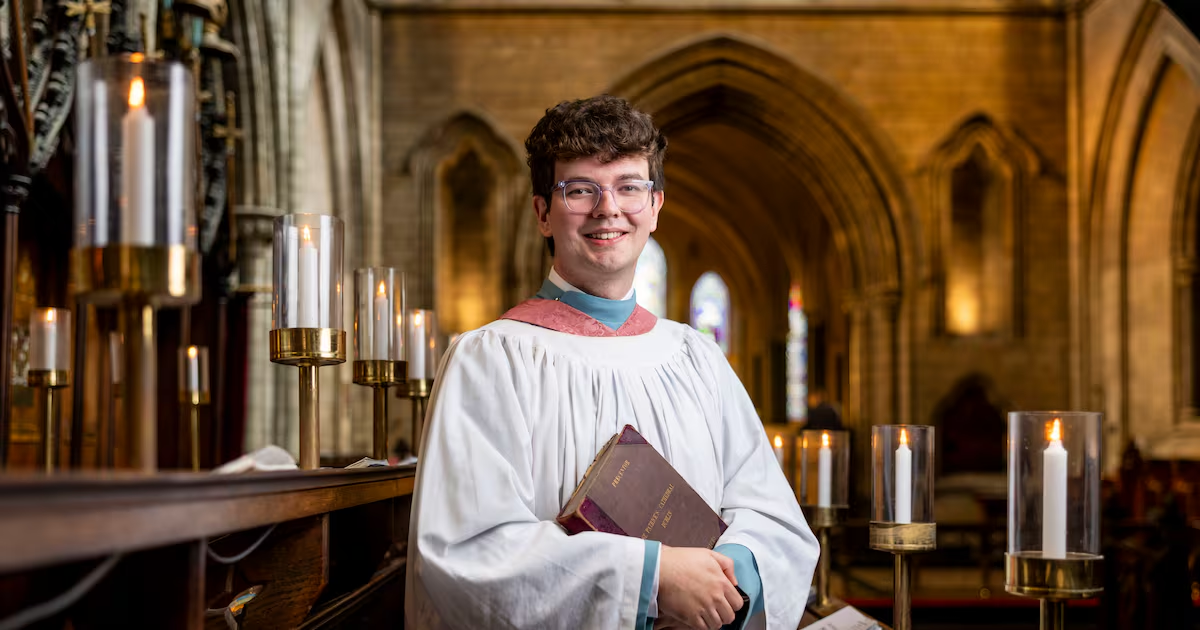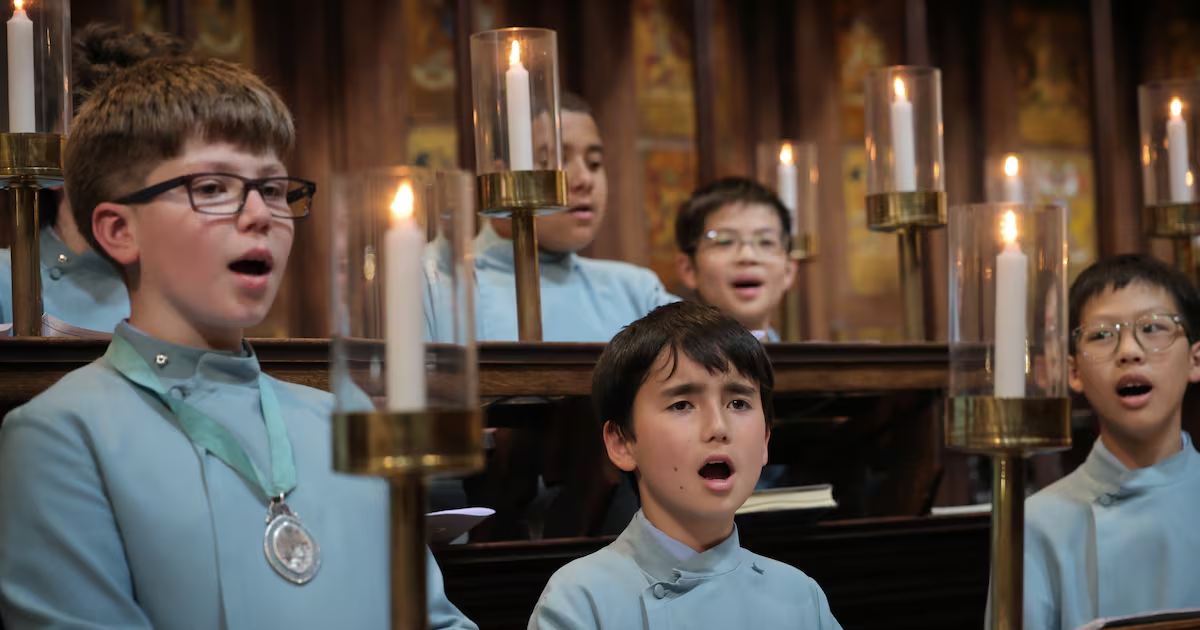
A decline in the number of boy choristers at St Patrick’s Cathedral Choir School in Dublin has led to a recruitment driveSt Patrick's Cathedral Choir School pupils Peter Cowell, Daniel Fernandes, Nicolas Blanzquez, Alexander Shi and Maximus Shi rehearse in St Patrick’s Cathedral, Dublin. Photograph: Bryan O’Brien Sun Jun 28 2026 - 06:00 • 5 MIN READAcross the road from the entrance to St Patrick’s Cathedral in Dublin, a bustling tourist attraction as well as a place of worship, is a blue wooden door with a discreet plaque featuring the words: St Patrick’s Cathedral Choir School. Founded 1432 AD.The primary school, which is Ireland’s oldest school and the only remaining school in Ireland with a dedicated choir school, is now struggling to attract enough boys to continue the tradition of male choristers singing at weekday matins [morning prayer] and evensong, as well as at Sunday services in the cathedral.“We used to go into all the Church of Ireland schools in Dublin and audition second-class boys, but they don’t let us in any more because they are all fighting to keep their numbers up,” says Stuart Nicholson, master of the music at St Patrick’s Cathedral Choir School.The choir school first noticed that numbers enrolling in the school began to drop after the Covid pandemic, but the decrease in numbers has been more significant in boys. Girls were first admitted to the school in 2016 and a separate junior choir for eight- to 12- year-old girls formed in 2017.There were 27 boys in the school before the pandemic, but there are only 10 across third to sixth class in the 2025/2026 academic year. The school doesn’t have an intake for children below third class. The ethereal voices of prepubescent boys have long been cherished by churches throughout the world. Choir schools were founded in medieval times to allow these young male voices to be trained to sing sacred music in church before their voices broke.“Boys are at their vocal peak in their very early teens before their voices break, but girls’ voices don’t reach maturity until much later,” says Nicholson. Young male voices can also be stronger than young female voices, as girls’ full soprano voices usually don’t fully develop until their senior years in secondary school. The blue entrance dooorway to St Patrick's Cathedral Choir School. Photograph: Bryan O’Brien St Patrick's Cathedral Choir School choir master Stuart Nicholson walks with pupils to St Patrick’s Cathedral for a rehearsal. Photograph: Bryan O’Brien Nicholson says that, ideally, there should be six boys in each primary school class to have a choir of 24 to sing at services and perform at concerts both at home and abroad throughout the year. “If we get four in each year we can maintain the status quo, but this year there was only one boy in third class and no boys in fourth class,” he says.Recently, in a drive to recruit more young choristers, St Patrick’s has been putting up posters across the communities of Black Pitts, South Circular Road and the Coombe. “We have come across some musical families, none of whom knew we were here,” says Nicholson.[ The Irish herbalists finding new purpose in ancient remediesOpens in new window ]One would expect that the small classes – eight in the 2025/2026 third/fourth classroom and 16 in the 2025/2026 fifth and sixth classroom – would be a draw. “People are a bit more wary of moving their children from one school to another now because it would mean taking them away from their friends,” says Keith Matthews, a choral scholar working in the choir school and a former chorister himself.The current group of choristers is certainly a good advertisement for the school. Happy and confident to chat to The Irish Times, they don’t seem a bit fazed about coming in for 8.30am for rehearsals and 9am matins before class, staying until 6pm on two weekdays for more rehearsals and 5.30pm evensong, and coming in again to sing in Sunday services at the cathedral. The boys also appear very comfortable walking past the throngs of tourists in the cathedral to take up their positions in the front row stalls of the chancel to give The Irish Times a short unaccompanied performance. Peter, now in 6th class, moved from a Gaelscoil in Lucan to the choir school in third class. “There have been lots of opportunities both academic and with the choir. I enjoy singing immensely and I play the piano,” he says. Pupils at St Patrick’s Cathedral Choir School get free instrument tuition and music theory lessons while at the school, as well as time with a professional vocal coach. They must pass a vocal trial before being admitted. St Patrick's Cathedral Choir School boys enter the cathedral for choir practice. Photograph: Bryan O’Brien St Patrick's Cathedral Choir School choristers put on their robes in preparation for rehearsal. Photograph: Bryan O’Brien Nicolas came to Ireland from Spain with his parents two years ago. “I came to learn English and had to choose a school. I also like singing,” he says. Now fluent in English, Nicolas will return to Spain with his parents at the end of sixth class in 2027.Daniel had been attending another school in Dublin when his Brazilian mother discovered St Patrick’s through the choir she sang in. Daniel says: “My mother wanted me to build my confidence in case I wanted to go on stage. In Brazil I went to a school with 400 students and 58 in each class, but this is such a small school that everyone is friends with each other.” Clearly passionate about singing, he adds: “The way we move from note to note is fun. It sounds heavenly to sing and to hear the singing.” Collecting him from school, his father, Riccardo Farron, says that once Daniel is happy, he is happy. “He is so happy sometimes that he continues to sing at home. I go to hear him sing in the cathedral when I’m not working,” Farron adds.Sylvia O’Brien, herself an opera singer and mother of a sixth-class boy, Tristan, says the choir school has given her son a “natural introduction to music”. “It’s the practical aspect of performing music in a live environment and St Patrick’s Cathedral has one of the best acoustics in the country,” she says. Microphones are not used as the vaulted ceilings in the cathedral carry the choristers’ voices throughout the building.Pearce Maloney is the principal of St Patrick’s Cathedral Choir School. While it is under the patronage of the Church of Ireland, children of all religions and none are welcome, he says. Maloney sees his role as balancing out the academics with the children’s choral commitments.St Patrick's Cathedral Choir School choristers wait to enter the chancel to begin their rehearsal. Photograph: Bryan O’Brien Choir master Stuart Nicholson leads the boys of St Patrick's Cathedral Choir School in a rehearsal. Photograph: Bryan O’Brien “They are all very creative and articulate. As they are pursuing a mastery in music, this is a discipline they can apply to other areas of their lives,” says Maloney. He estimates that the choristers are involved in about 10,000 hours of music over the four years they are at the school.The classrooms are in a 1970s block that adjoins a larger room with a baby grand piano used for rehearsal by students at St Patrick’s Grammar School next door, as well as the choristers in the junior school. Some of the boys who move on to the adjoining secondary school continue to sing with the choristers until their voices break. The relationship between the choristers, the director of music and teachers seems relaxed and friendly. The boys and girls at the choir school rehearse separately but sometimes sing together for matins and evensong in the cathedral. “The girls are flourishing and finding their voices and their feet,” says Nicholson. Despite the concern about the declining number of boy choristers, the choir school has no intention of closing any time soon. “There will always be an ebb and flow in numbers and we will keep it going even with small numbers,” Nicholson insists.IN THIS SECTION
Facing the music: St Patrick’s Cathedral Choir School struggles to attract boy singers
A decline in the number of boy choristers at St Patrick’s Cathedral Choir School in Dublin has led to a recruitment drive
1,354 words~6 min read