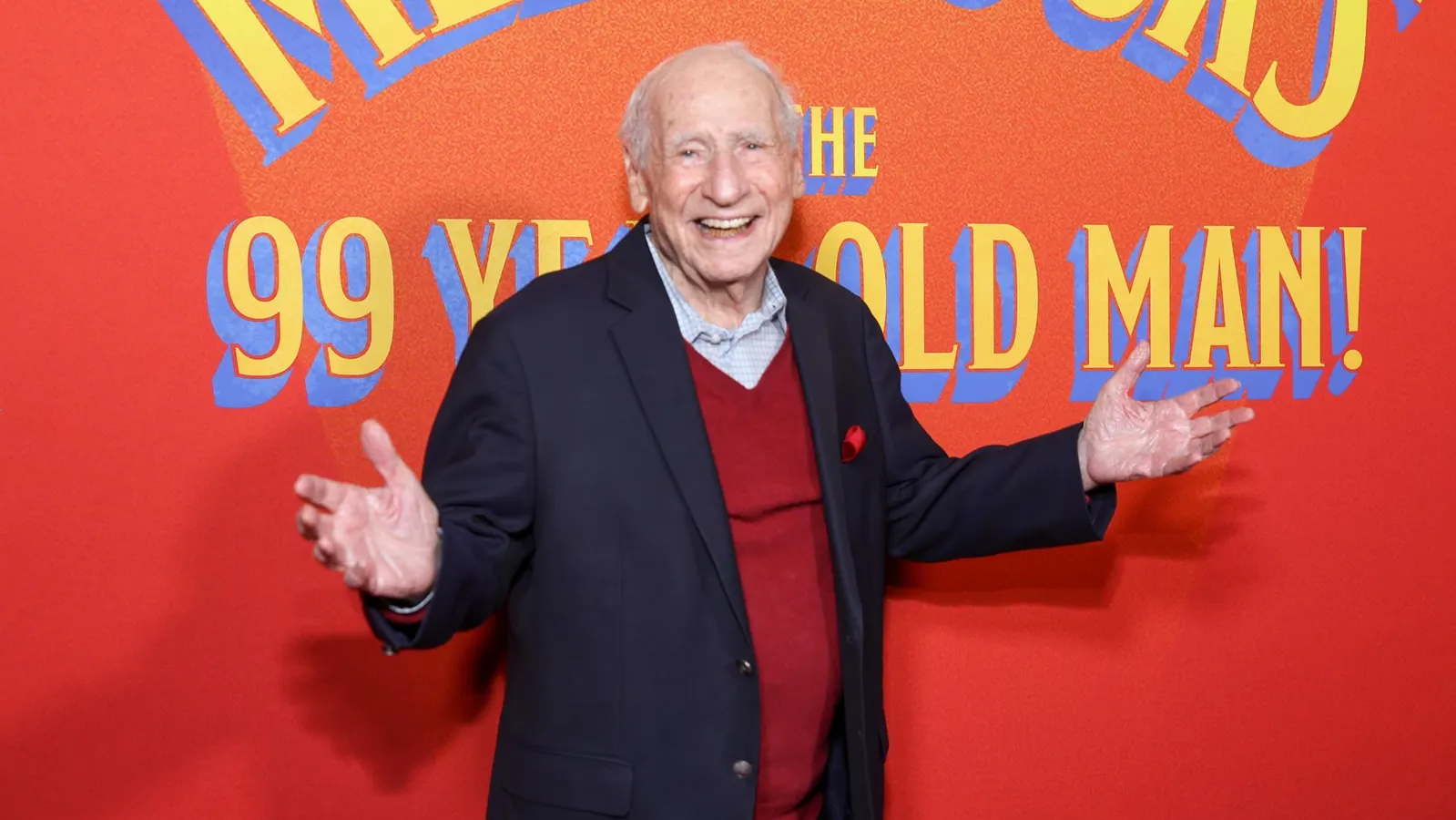
No. 1He started a novel titled “Springtime for Hitler.”No. 2He turned that into a play.No. 3He turned that play into a flop film titled “The Producers.” No. 4He won a screenplay Oscar for that flop …No. 5… turned that flop into a Broadway hit … No. 6… then tried to destroy “The Producers” on “Curb Your Enthusiasm.” No. 7He never did a serious movie because to him comedy was serious.No. 8At 9 he saw his first Broadway show, “Anything Goes,” with the Broadway belter Ethel Merman, which explains everything. No. 9As a boy he saw the 1931 “Frankenstein,” which also explains so much. No. 10He’s the king of American absurdist comedy. The History of the World, Part I No. 11All definitions of comedy are terrible, but his is the least bad: “Tragedy is when I cut my finger. Comedy is when you fall into a sewer and die.” No. 12He didn’t luxuriate in anxiety and despair. They were motivators.No. 13“If your enemy is laughing, how can he bludgeon you to death?” — Mel BrooksNo. 14His handprints outside the Chinese Theater in Hollywood have 11 fingers, thanks to a joke prosthetic. No. 15In the most storied writers room of all time — Sid Caesar’s “Your Show of Shows” in the 1950s — he inspired the most jealousy. No. 16When “Caesar’s Hour” didn’t win an Emmy, Brooks jumped on a table and yelled “Nietzsche was right! There is no God!”No. 17He was lovable enough for the actress Anne Bancroft to tell her therapist, “Let’s speed this process up. I’ve met the right man.” No. 18She became his second wife.No. 19His company, Brooksfilms, produced Bancroft’s directing debut, “Fatso” (1980), when few American women were making Hollywood features. No. 20He shouted at Elia Kazan at a Directors Guild meeting for not supporting female filmmakers …No. 21… and for naming names during the Red Scare.No. 22He hired David Lynch to direct “The Elephant Man” (1980), starting Lynch’s Hollywood career. No. 23Brooks called Lynch’s 1977 “Eraserhead” the “best film I’ve ever seen about what it’s like to have kids.”No. 24Brooksfilms also produced David Cronenberg’s hit “The Fly” (1986).No. 25He told Cronenberg, “When it comes to gore, extreme whatever, don’t hold back.” The Fly No. 26No one mocked Hitler as often or with as much force. No. 27You could call him Corporal Brooks. He fought in World War II, enlisting when he was 17. No. 28On the battlefront, he blared a rendition of “Toot, Toot, Tootsie (Goodbye)” across enemy lines.No. 29After Germany’s defeat, he toured that country entertaining American soldiers in a Mercedes driven by a blond German fiddler named Helga.No. 30When he won best screenplay for “The Producers” (1967), he said: “I’ll just say what’s in my heart: ba-bump, ba-bump, ba-bump, ba-bump.” No. 31He also thanked the “Academy of Motion Picture Arts, Science and Money.”No. 32At the height of his Hollywood success, he made a black-and-white movie … Young Frankenstein No. 33… then he made a (nearly) silent one. No. 34The sole audible word in “Silent Movie” (1976) is delivered by a mime. No. 35He is a casting savant, responsible for breaks (Teri Garr, Dave Chappelle) and starring roles (Gene Wilder, Bill Pullman). Young Frankenstein Robin Hood: Men in Tights Blazing Saddles Spaceballs No. 36“Blazing Saddles” is the greatest revisionist western of all time. (Sorry, Clint.) No. 37You couldn’t do “Blazing Saddles” today. Or then. But he did.No. 38It has the noisiest fart joke of all time … Blazing Saddles No. 39… and one of the funniest penis jokes.No. 40When Richard Pryor offered his fellow writers cocaine on their first day on “Blazing Saddles,” Brooks said, “Never before lunch.”No. 41In 1974, “Blazing Saddles” was a Top 10 hit at the box office.No. 42Later that year came “Young Frankenstein,” a Top 10 hit in 1975.No. 43Mel Brooks directed some of the defining American movies of the 1970s yet is rarely discussed as an auteur. The History of the World, Part I Funnyman, vulgarian, auteur — Mel Brooks’s imprint on American cinema is incontestable yet scandalously undervalued. In 1974, two of his most beloved hits, “Blazing Saddles” and “Young Frankenstein,” began their climb to the top of the box office.But Brooks remains sidelined in the literature on that era: He is mentioned just once in Peter Biskind’s influential history of that period, “Easy Riders, Raging Bulls.” Yet when Orson Welles said that “I believe a work is good to the degree that it expresses the man who created it,” he could have been talking about Brooks.Like many filmmakers, Brooks has had a lifelong love of movies but he didn’t grow up simply watching them, he gorged. In his 2021 memoir, “All About Me,” he writes about attending Saturday screenings where, fortified with his mother’s sandwiches, he spent hours feasting on cartoons, newsreels and features.He loved all types of movies and performers, including comedies and westerns, but Brooks’s greatest childhood love was the musical. It’s a passion that’s evident throughout his filmography, which often features song-and-dance numbers — both intimate and spectacular — amid an ecstatic cacophony of high and pop culture allusions, rambunctious physical comedy and intellectual wit. If Brooks’s critical reputation has shifted over the decades, it’s partly because ideas about aesthetic values — what constitutes good taste — have changed. In 1969, Pauline Kael wrote that those who like movies such as “The Producers,” his feature directorial debut, didn’t seem “bothered by their technical ineptitude and visual ugliness.” (Guilty!) In time, it became a cult hit and a national treasure: In 1996, it was included in the film registry at the Library of Congress, which is dedicated to American cinematic heritage. And why not? This is, after all, a classic story of American enterprise about two crooks trying to swindle investors, in this case with a show, “Springtime for Hitler.”One of Brooks’s signatures is that he turns nightmares into comedy (as he does in his loveliest, most delicate film, “Young Frankenstein”). That he was mocking both Nazis and Jewish stereotypes with annihilating force in “The Producers” seemed lost on many at the time. Decades later, the critic J. Hoberman offered a trenchant revisionist take, calling the film “a rebellion against invisibility, the equivalent of dancing on Hitler’s grave.”That dancing reaches an apotheosis in the “Spanish Inquisition” number in “History of the World, Part 1” (1981), in which Brooks plays Torquemada, a real historical figure who here breezily tortures Jewish prisoners while twinkle-toeing through a dungeon.In the frenzied finale, a bevy of nuns in swimsuits performs in a giant pool à la the old MGM aquatic star Esther Williams before posing atop an enormous menorah. It’s a jaw-droppingly absurdist and technically impressive pastiche of Old Hollywood; it slays, comically. It’s also a perfect expression of how Brooks, in drawing from the pleasures of the 20th century and its real-life horrors, became at once a filmmaker of his time and timeless.— Manohla DargisNo. 44No one got more laughs from Jewish names like Murray …No. 45… and “May the Schwartz be with you” … Spaceballs No. 46… or Yiddish words. Blazing Saddles (This means “let them go!”)No. 47He denied that his comedy was Jewish and no one believed it.No. 48(He didn’t believe it, either.)No. 49Mel Brooks did more than anyone to take the Jewish sensibility out of the closet of American comedy. It didn’t budge easily. In fact, though he and Carl Reiner regularly killed at parties in the 1950s with an improv double act, they initially didn’t record it because Brooks felt the humor was too insular. This was the 2000 Year Old Man, a heavily accented ancient figure interviewed about his experience with everything from the invention of fire to time with Shakespeare.When Reiner, playing the straight-man interviewer, asked him about Paul Revere, Brooks called the hero of the American Revolution an “antisemite bastard,” saying that he ran through town crying, “The Yiddish are coming! The Yiddish are coming!” Informed of his mistake, Brooks turned sheepish, saying he felt bad about missing Revere’s funeral.Brooks was writing for the first great television sketch program, “Your Show of Shows,” at the time, and the 2000 Year Old Man marked the birth of Brooks the performer. Not long after the comic George Burns told Brooks and Reiner to put their routine on an album or else he would steal the idea, The 2000 Year Old Man transformed from a private joke among friends into a cult hit, then a phenomenon that has become a key part of the DNA of modern comedy. Comedians including Larry David and Paul Reiser have cited listening to these albums as formative moments in their career awakenings.The jokes also provide a road map to Brooks’s career: over the top, then understated, deeply silly and deceptively smart, with patient setups and explosive punchlines. Like his hit movies. The five 2000 Year Old Man albums represent a significant shift in popular culture: from smuggling a Jewish style into popular culture to something more overt. Reiner’s son Rob once described the classic Hollywood strategy this way: “You take the comedy of the Jew and you push it through the goy.”Once Brooks decided to make this inside joke for everyone, he spent his career inverting this formula, taking the most gentile mass culture, whether it be James Bond or “Star Wars,” and filtering it through a Jewish lens. He mainstreamed Jewish comedy by making everyone sound like a Jew, even cowboys and robots. A few peers did something similar, but none were as relentless, as pointed or as successful as Brooks in making the Jewish comic voice the lingua franca of American comedy.This began with the 2000 Year Man, where the core of the joke imagined what would happen if we saw every major event ever from the perspective of a grousing unimpressed salesman. In the original album, Brooks describes his business as selling Stars of David — “As soon as religion came in, I was one of the first in that” — but when the opportunity arose to make money off crosses, he passed. With a verbal shrug, he said: “I didn’t know it would be such a hit.”— Jason ZinomanNo. 50“There are critics who regard me as just a vulgar primitive. I never quarrel.” — Mel BrooksNo. 51He’s both the quintessential outsider and the ultimate insider.No. 52He was on the first “Tonight Show” hosted by Johnny Carson. No. 53He punched up history to make it funnier.No. 54Did Moses part the Red Sea? “He didn’t part anything. He didn’t even part his hair if you saw pictures of him.”No. 55The 11th commandment? “Thou shalt not squint.” The History of the World, Part I No. 56The reason Marie Antoinette said “Let them eat cake” was she owned a bakery.No. 57He adopted the phrase “funny is money,” but capitalism has always been one of his favorite targets. Silent Movie No. 58He makes the most of scenes of people being shocked and appalled. The Producers No. 59“If it wasn’t for Mel Brooks, I would not have a job. Or a life.” — Judd Apatow, a director of “Mel Brooks: The 99 Year Old Man!” No. 60An exuberant song-and-dance man, Brooks put everyone from nuns to aliens into musical numbers. (Even the monster tap-dances in “Young Frankenstein.”) Young Frankenstein History of the World, Part I Spaceballs Life Stinks No. 61“The thing about satire is that the walls, the costumes, the floors, everything surrounding the comedy has to be real.” — Mel Brooks No. 62His fingerprints are all over comedy and pop culture.No. 63He created the television satire “Get Smart” with Buck Henry. No. 64His deadpan parodies led to the “Airplane!” movies …No. 65… also the “Naked Gun” ones …No. 66… and the “Scary Movie” series.No. 67He and an ex-roommate were inspirations for “The Odd Couple.”No. 68The end of “The Blues Brothers” owes a debt to the finale of “Blazing Saddles.” No. 69Watching Marty Feldman in “Young Frankenstein” inspired the hook of Aerosmith’s classic “Walk This Way.” No. 70Which also became a hit with Run-DMC. No. 71He could go high or low, do slapstick, visual puns, malaprops, double-entendres, slow burns.No. 72He’s a maestro of self-referentiality. Spaceballs No. 73He played Comicus, a stand-up philosopher at the original Caesar’s palace. The History of the World, Part I No. 74Brooks released his Russian movie, “The Twelve Chairs” (1970), five years before Woody Allen made his Russian movie, “Love and Death.” No. 75His son Nicholas is named after his favorite author, Nikolai Gogol.No. 76“My God, I’d love to smash into the casket of Dostoyevsky, grab that bony hand and scream at the remains, ‘Well done, you goddam genius.’” — Mel BrooksNo. 77He said, “Comedy is the opposite of death.”No. 78He faced the void by writing a poem about it. “Life may be rotten today, folks / But I take it all in stride / Cause tomorrow I’m on my way, folks / I’m committing suicide”No. 79Or, as he wrote in the theme song for “The Twelve Chairs”: “Hope for the best / Expect the worst!”No. 80He turned horror into absurd comedy.No. 81He made the shower scene in “Psycho” funny … High Anxiety No. 82… twice. Silent Movie No. 83His song “Springtime for Hitler” from “The Producers” is one of the most awkward earworms in history. Hum it, and it’s in your skull forever. No. 84He drafted Jesus into a “Who’s on first?”-style routine. The History of the World, Part I No. 85“My mind is a raging torrent, flooded with rivulets of thought cascading into a waterfall of creative alternatives.”No. 86His comedy is spectacularly dirty.No. 87(He was once typecast as a toilet.) Look Who’s Talking Too No. 88His comedy is also deceptively clean.No. 89(He only made two R-rated movies.) No. 90“Grateful that I have got to be on this planet at the same time as you.” — Ike Barinholtz, co-star, “History of the World Part II.” No. 91He did every form of live comedy (standup, sketch, improv) and he worked everywhere (Brooklyn street corners, the Catskills, Broadway, Hollywood).No. 92He regularly watched “Jeopardy!” with Carl Reiner.No. 93He knows when to break the fourth wall. Blazing Saddles No. 94He narrated “The Critic” (1963), an abstract short in which an old Jewish man watches an abstract short. It won an Oscar. No. 95In his 70s, Brooks set a record for Tony Awards at the time with “The Producers.” No. 96The show ushered in a new era of winking, elbow-jabbing meta-musicals.No. 97(Not to mention, repaid Brooks’s debt to Ethel Merman by serving as a love letter to the Broadway musical.)No. 98When he accepted best musical, he thanked (who else?) Adolf Hitler for being such a funny guy.No. 99He knows the power of a big finale. Silent Movie No. 100“Spaceballs: the New One” is coming out next year. It’s just like the old one, but it’s new.
100 Reasons to Love Mel Brooks on His 100th Birthday
Here are 100 reasons to love the comedy writer, director and star who’s celebrating a milestone on Sunday and who’s changed our culture in surprising ways.
2,454 words~11 min read