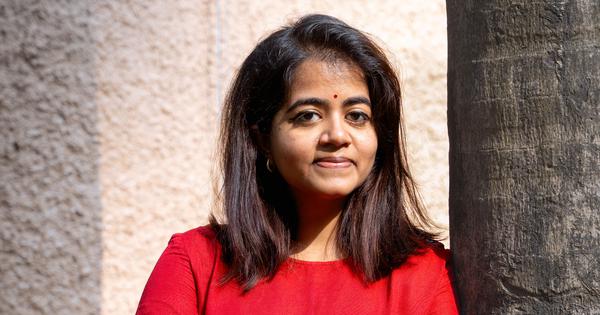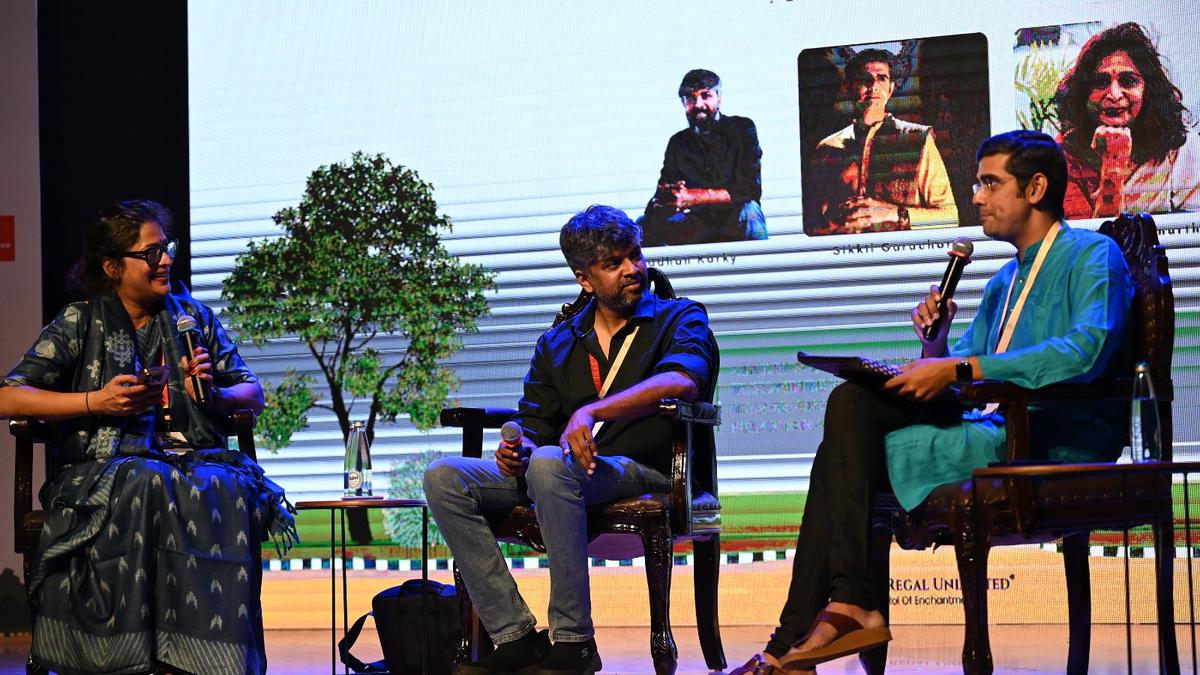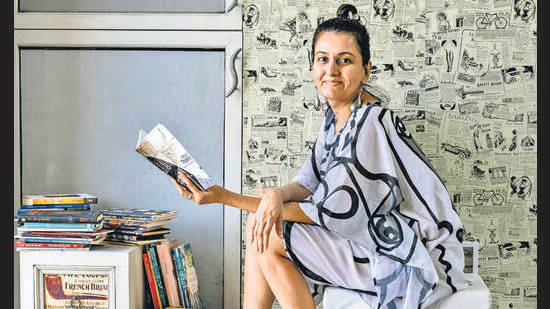
MUMBAI: “It takes real narcissists to find themselves at the centre of a city so swollen with people even at 2 a.m., 4 a.m., 5.47 a.m. …” writes Saranya Subramanian in her chromatic Bombay poem that’s part of her debut collection, ‘Absent People, Absent Places’. One wonders what would happen if all the poets replaced these narcissists. The simple, uncomplicated answer is that there would never be a dearth of verse about the city. A more nuanced response, though, would challenge this premise altogether: poets would rather lurk in the corners as silent flâneurs observing, listening and remembering.Suchita Parikh-Mundul whose debut poetry collection ‘Absurd Theatre’ released this year, says social media has helped her find a community of poets she can discuss her work with. (Anshuman Poyrekar/HT Photo)And yet, most poets of Mumbai have resisted staying hidden, finding instead a rare kinship in community, one that in recent years has witnessed a resurgence. The revival of Poetry Circle 2.0 in August last year, and, much before that collectives and movements such as Poetry in Parks, The Bombay Poetry Crawl, The Manch and Poetrification by The Hoshruba Repertory, among others, continue to draw attention to both verse and the verse-maker across regional and linguistic boundaries.“Poetry never really died or disappeared from the scene,” shares poet, art critic and cultural theorist Ranjit Hoskote, harking back to the salons and reading groups led by Nissim Ezekiel, Dilip Chitre, Adil Jussawalla, Toni Patel and others, alongside the formidable role of the 1934-founded PEN All-India Centre, headquartered in New Marine Lines. “What has changed over time is the ways in which poetry is transmitted and shared, and how people assemble around it.”The pursuit, however, remains the same, which is “a wider cultivation of the literary imagination, both for writers and readers.”Walking with the poetsBack in 2020, Subramanian, then a young graduate from Ashoka University, founded The Bombay Poetry Crawl, an idea that emerged out of her thesis, a spatial mapping project, locating the characters from Arun Kolatkar’s Kala Ghoda poems. “I had a lot of fun walking around and searching for those characters. So I thought, ‘why not take other people with me?’”After her first walk that took place days before the pandemic-induced lockdown, Subramanian continued her work through a series of online talks that drew attention to other 20th century poets from the city. “I realized that you can’t read any poet in isolation.” She resumed the guided poetry walks with great gusto after completing her Master’s degree at the University of San Francisco. Through the archival initiative, Subramanian, 29, has been exploring spaces frequented by poets, and mapping verses to the streets, mills, homes and cafés where they were written. She has already led over a hundred of these walks, covering poets writing across languages, from Namdeo Dhasal, Malika Amar Sheikh, Narayan Surve to Eunice de Souza, Gieve Patel, Kaifi Azmi and Sahir Ludhianvi.It’s through these walks that she also discovered that public memory about poets varies from city to city. In Chennai, she says, people know their poets down pat. “They worship their poets … can recite their poetry by heart.” While Mumbai has a rich poetic tradition, the awareness is still limited, she feels. But of late there has been a genuine curiosity to experience the city through verse, and it’s probably what is attracting a diverse group of people to her walks. “Earlier, the attendees would mostly comprise students or those with an Arts background. Now, I get people from STEM, finance and corporate,” says Subramanian, who is currently digitising archives entrusted to her by Jussawalla.Making new connectionsThe renewed appreciation for poetry, some feel, is perhaps also the result of the months, even years, lost to COVID-19, one of the worst pandemics of the last hundred years. Many sought answers beyond science to the prevailing uncertainty and overwhelming sense of loss of control.Marathi poet, editor and publisher Hemant Divate confesses to having avoided poetry addas and events until the pandemic. “The work happening in these spaces was different from my own practice and the kind of poetry I was reading.” The forced lockdown, he says, compelled him to seek these spaces out and start forging connections again.In 2021, as the city emerged out of the deadlier second COVID wave, Divate also noticed sales of poetry books skyrocket. In a first since the launch of his publishing arm Poetrywala (2003), he’d sold over 5,000 poetry books in the short span of six to eight months, generating a revenue of र9 lakh. “Everyone was reading poetry. It was probably helping them cope. For some, there was also a realisation that they had received a second shot at life. The arts became a means to understand what we were feeling,” he says, adding with conviction, “We are after all most human when we create and consume art.”There is now, says Hoskote, also a keen sense of awareness on the part of the new generation, “that poetry is important, and that it has the capacity to move you beyond all the forces of mind-numbing oppression”.Though readership has since plateaued, Divate believes that the brief uptick in sales did fuel the ambition of many poets, who’ve started writing more consistently and without inhibition. Divate has brought out several English debuts in the last few years—Yamini Dand Shah, Jennifer Robertson, Dion D’Souza and Suchita Parikh-Mundul, to name a few. Poetry in other languages, he says, boast of equally promising talent.Poet Suchita Parikh-Mundul remembers attempting to self-publish her first book of poems in 2005, but quickly burying the idea because it made her feel “exposed”. Her just-released collection, ‘Absurd Theatre’, which is split into three acts, draws attention to “aspects of life one might experience, especially in an urban setting”. Mumbai features prominently in her verse: “The coastal road curves above the diamonds of the Arabian Sea like an armful of edelweiss,” read the opening lines of one of her poems. “I didn’t realise how much of the city I had internalised until I went back to my poems,” she says.Looking back, Mundul says that much of the trepidation she felt as a young poet has been alleviated by the explosion of social media, which has made poetry more accessible, and even democratic. What it has done most for her is help her find a community. “Once every week, I meet three other poets online. We all live in different Indian cities, and one is from Cairo. During these sessions, we come up with a prompt and then write a poem before discussing it. Writing in a safe space makes a lot of difference, you feel less alone.”Writing in a traditionPoets in the city have always worked in a tradition, shares Hoskote. It’s a sentiment shared by poet Menka Shivdasani. “All of us learn from those who come before us,” she says.For a long time, the Poetry Circle, co-founded by Shivdasani, Nitin Mukadam and Akil Contractor in 1986, served as the platform fostering this tradition through mentorship, workshopping, and engagement.“[At Poetry Circle] We placed a strong emphasis on reading very widely, and thinking past borders,” says Hoskote, an alumnus of this collective. “I think it was both, for us, a crucible of ideas and a place where we all trained in some ways for the roles that we eventually came to occupy.”Shivdasani had considered resurrecting the Poetry Circle—which waned by the noughties, eventually drawing to a close in 2005—as a tribute to Mukadam, after his death in 2015.The need for it, she says, felt even more urgent after the pandemic and the rise of social media, where poets often sought instant validation. “I felt that the more we connected online, the more important it was to meet face-to-face for deeper discussions,” she says. Sometimes even the best poets can write poems that could benefit from such conversations, she adds.It was only last year when author-poet-translator Jerry Pinto, a member of the original group, offered the People’s Free Reading Room and Library, where he is chairman of the board of trustees, as a venue that the plan took flight. Shivdasani and Contractor, along with Pinto, continue to be active collaborators in this new iteration, ably supported by poets Dion D’Souza and Urna Bose. “When a poet has a space that allows them to share their poem and get constructive feedback and encouragement, it not only helps them create much better work, but also hones their craft.”The hope, she says, is to ensure that the city’s poetic tradition continues to grow in the same vein as it has over the last many decades. “And I think that will happen because there are certainly some talented poets out there. It’s up to us as a society, and a community, to provide that space for them to flourish.”
Verse city: Mumbai all shaken up by rhyme and rhythm
The revival of Poetry Circle 2.0 in August last year, and, much before that collectives and movements such as Poetry in Parks, The Bombay Poetry Crawl, The Manch and Poetrification by The Hoshruba Repertory, among others, continue to draw attention to both verse and the verse-maker | Mumbai news
1,457 words~7 min read