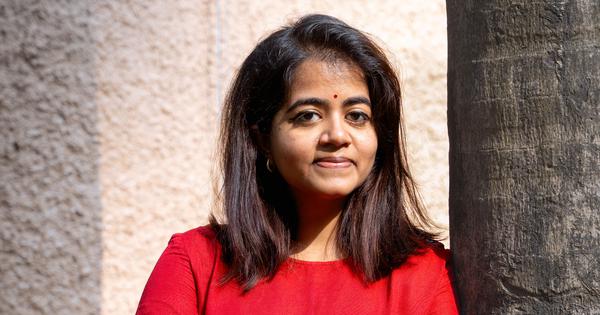
Beneath the deepening indigo of the night sky, shadows huddle under open umbrellas, conversing quietly. A soft drizzle falls. The earth is hushed, as though at the beginning of the universe. A postcard slips into my hand. It reads, “outside the window: a serpentine trail/ of sunlight. soft flames river their way/ towards our home. we are here,/absent people, visible at night. i am here, an absent person, but i am still here, sitting still. still waters/ freeze in fear. outside, the hate speech / gets louder. hate, i learn, is not those mobs that ash people down. it is / the casual shrug of the unaffected; /a single spark of apathy that, once lit,/ can burn an entire forest down.”Cityscapes and peopleSaranya Subramanian’s debut collection of poetry, Absent People, Absent Places, opens with a question that confronts the apathy and anxiety of the times we inhabit. Her poetic language stands out for its ingenuity and ease, at once contemplative and nonchalant. “We are swept away by the frantic need to do, and do/ now. Our love for languages-his, math, mine, poetry-constantly jostles against /our maya-driven, caffeinated legs perpetually/ running to grey offices and grey meetings./ Such is the fate of those of us who cannot wait, who refuse to bloom when the conditions are/ just right, who rebel against sunlight and water,/who sprout oddly, wrongly in somersaulted bodies.”The poems are as much about cityscapes as they are about the people. We glimpse the Bombay of Adil Jussawala, Eunice de Souza and Arun Kolatkar. In this context, it is impossible to overlook The Bombay Poetry Crawl, founded by Subramanian in 2020, which has left a distinct imprint, archiving poetry through walks that invite participants to experience the city. In the poet’s words, “it seeks to archive the un-archivable, the forgotten, the erased, the censored, the politically ostracised, the genderless, formless, faceless figures that make up the city.”There’s “Prabhadevi Before Dawn”, where “to the everydayness of colour theory/ and impressive histories of landscapes in/ frames and framed landscapes” the poet adds another world – “Here, water is everywhere: in high tide rising at the/ beach, dew peppering leaves, and buckets/ filled with grumbling water, carried by/ car cleaners through the streets/ everything is black, so Monet must have been wrong: this is a portrait engorged with blackness. Black cats and bats mewl and/ howl, black roads roll out towards a pitch-black horizon, black/ goddesses and gods allow silence to thrive in a soon-to-be-gone,/deep indigo sky.”Depth of memoriesThere is also a voice that chronicles the unsettling memories the city has lived through and preserves the words of those who lived through them. It traces how identities divided people while also revealing how the city’s undying spirit endured beyond those dark days. “The night we were out all night, / we saw lovers at street corners / the very lane / where 27 years ago Appa-dark- / skinned man with a vague beard / and kada in hand – was stopped / in a kaali peeli by a mob. The men / were brandishing swords; silver glistening in noon’s sleepy sky. / Their screams setting off explosives, / burning gullies, bombing Bombay. / ‘Akka was one, Amma was home / with her. I had to make it back to Andheri / from Fort, but I didn’t know if I would. / Should I tell them that my name is / Subramanian or Mohammed?’ Appa’s / story every time it’s told, leaves me nameless. That night, when we were out all night, the couple shared their / light with us. A young sun. A nebula /being birthed on the street.”The poems balance subtle humour and quiet insight, at times interweaving the poet’s mother tongue, Tamil, carrying deep memories. “A river of caffeine running down / my throat, a current of language / flowing the other way, moving up / to my tongue. I’m on holiday / and Thatha teaches me Tamil. / Coffee, news and afternoon classes / go well with a plate of murukku. Every piece looks like a Tamil letter. / I eat the letters, fried to perfection, / hoping it will help me learn faster / When Murugan lost the race to Pilayar, / Thatha says, he was so jealous of his anna / that he ran away and hid in bhumilok / he sang to the earthy people – a new song in a whole new language. / Bursting from his mouth: a confetti of words and alphabets, decorating / the land and sprinkling poetry on people. /Tamil was born on that day.”Indian poetry in English has evolved through voices that embraced nationalism to rebellion, from formal structures rhymed to the unmetered, earthiness to experimentation. Each poet brought his or her distinct oeuvre, marking the power and beauty of poetry. It is to this long tradition that Subramanian’s young voice belongs as it says, “Watch the enormous cake of words rise / in the oven of night. Sneak into the pool of his voice. / Who cares if it’s past midnight. It’s yours. Everything is yours. Take a swim. Vaseegara plays. You don’t owe anyone anything, you tell yourself, you keep telling / yourself. You’re with your best friend on top / of a water tanker. Dusk is to come. / Who cares how you’ll climb back down.”Through Subramanian’s poetry, the urban landscape becomes more than a backdrop. Her voice reminds us that poetry is not merely a way of seeing the world but a way of remembering, of noticing what is forgotten and of honouring absence.Absent People, Absent Places, Saranya Subramanian, Westland.
‘Absent People, Absent Places’: Saranya Subramanian’s poetic language is ingenious and at ease
The poems chronicle the unsettling memories the city has lived through and preserve the words of those who lived through them.
941 words~4 min read